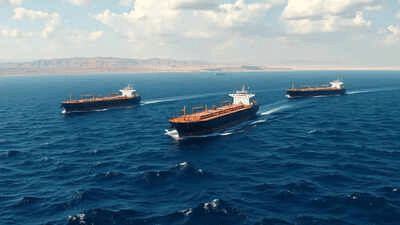
Now a major breakthrough in the Middle East arrived early Wednesday morning. The United States and Iran agreed to a two-week ceasefire to end their 40-day conflict. Therefore, the strategic Strait of Hormuz will finally reopen to global shipping. However, the deal includes a controversial new provision. Iran and Oman may now levy a transit fee on all passing vessels. This marks a massive shift in international maritime history. Meanwhile, global markets are reacting quickly to the news.
Add businessleague.in as a Preferred Source


Also Read |Tamil Nadu Voter List Purge: 97 Lakh Names Deleted in SIR Phase 1
The Two-Week Ceasefire Framework
Now the world is breathing a sigh of relief. First, the 40-day war between the US and Iran reached a pause. Therefore, both nations accepted a temporary ceasefire plan. This window allows diplomats to finalize a long-term peace agreement.
Next, President Donald Trump called the plan a “workable basis” for talks. Thus, he signaled a rare moment of optimism in 2026. He expects the final deal to be “consummated” within the next 14 days.
Meanwhile, the fighting had effectively paralyzed the region since February 28. Therefore, the reopening of the waterway is the top priority. Most experts believe this two-week window is a test of trust.
Strait of Hormuz: The $100 Billion Chokepoint
So why does this tiny strip of water matter so much? The Strait of Hormuz is only 34 km wide. Therefore, it is a massive chokepoint for global energy.
First, roughly one-fifth of the world’s oil passes through here daily. This includes vital supplies of liquefied natural gas (LNG). Thus, even a short closure sends global prices soaring.
Next, the strait connects the Persian Gulf to the Indian Ocean. Therefore, it is the only exit for major oil producers. Without this route, global trade effectively grinds to a halt.
Meanwhile, the conflict caused several attacks on tankers in March. This effectively closed the route for over a month. Therefore, the Strait of Hormuz transit fee 2026 is the price of reopening.
How the New Transit Fee Will Work
Now the details of the “toll” are emerging. Iran’s Deputy Foreign Minister Kazem Gharibabadi discussed the protocol last week. Therefore, we have an idea of how the fees will look.
First, the fee will not be a flat rate. It will vary based on the type of ship. Thus, a massive oil tanker will pay more than a cargo ship.
Next, the cargo itself will determine the cost. Ships carrying hazardous materials or high-value oil may face higher fees. Therefore, the fee structure is quite complex.
Finally, Iran and Oman will share the collection duties. They are currently drafting a joint protocol to manage the funds. Thus, they intend the move to “facilitate” rather than block traffic.
Also Read |Tamil Nadu Voter List Purge: 97 Lakh Names Deleted in SIR Phase 1
The 10-Point Proposal from Tehran
So what did Iran offer to get this deal? Tehran presented a 10-point proposal to Washington recently. Therefore, most major points of contention are now resolved.
First, the proposal includes the conditional reopening of the waterway. This was the biggest demand from the US side. Thus, Iran used its control over the strait as a bargaining chip.
Next, the proposal addresses the removal of certain sanctions. In exchange, the US gets a guarantee of safe passage. Therefore, the two sides are trading security for economic relief.
Meanwhile, the “transit fee” was a surprise addition to the list. Most analysts did not expect the US to agree to a toll. Therefore, this shows how much the US wanted to end the war.
UNCLOS and the Legality of Maritime Tolls
Now legal experts are raising serious questions. The United Nations Convention on the Law of the Sea (UNCLOS) is very clear. Therefore, countries cannot demand money just for passage.
First, straits used for international navigation must remain free. Thus, Iran and Oman are technically breaking global norms.
Next, UNCLOS allows fees only for specific services. This includes piloting, tugging, or port safety. Therefore, calling it a “reconstruction fee” might lead to a legal battle.
Meanwhile, the US agreement might bypass these rules. If the two main powers agree, UNCLOS may be ignored. Therefore, this sets a dangerous precedent for other waterways.
Post-War Reconstruction: Why Iran Needs the Cash
So where will all this money go? Tehran officials say the funds are for rebuilding. The 40-day war caused widespread destruction across the country. Therefore, Iran needs a massive influx of capital.
First, the conflict hit Iran’s defense and administrative centers hard. Thus, the government needs to rebuild its core infrastructure.
Next, civilian areas suffered during the air strikes. Many cities require new power grids and water systems. Therefore, the transit fee acts as a “war reparation” of sorts.
Meanwhile, Oman will also benefit from the funds. They will use their share to upgrade maritime security. Therefore, both nations see this as a way to recover from the crisis.
Also Read |Tamil Nadu Voter List Purge: 97 Lakh Names Deleted in SIR Phase 1
Gulf Nations React: UAE and Qatar Raise Alarms
Now not everyone is happy with this “transit fee” idea. Neighboring Gulf nations have expressed strong opposition. Therefore, the regional alliance is currently split.
First, the UAE and Qatar called for “free and open navigation.” They argue that tolls will hurt their own economies. Thus, they are lobbying the US to rethink the plan.
Next, these nations believe the fee sets a bad example. If Hormuz has a toll, will the Suez Canal be next? Therefore, they want to wait for a permanent peace deal.
Meanwhile, they argue that financial mechanisms should be the last step. They want security guarantees first. Therefore, the Friday meeting in Islamabad will be very tense.
Oil Prices: Will the Market Finally Stabilize?
Now the big question for consumers is about gas prices. The closure of the strait sent prices to record highs. Therefore, the reopening should provide some relief.
First, analysts expect a sharp drop in crude futures today. The “fear premium” is leaving the market. Thus, you might see lower prices at the pump soon.
Next, the transit fee adds a new cost to shipping. This might offset some of the price drops. Therefore, the net effect on consumers is still uncertain.
Finally, the Islamabad negotiations are the key. If the two-week ceasefire fails, prices will skyrocket again. So the world is watching Friday’s summit with bated breath.
Common Questions Answered
Is the Strait of Hormuz open right now? Now yes, the two-week ceasefire allows ships to pass again. Therefore, the 40-day closure has officially ended.
How much is the new transit fee? First, the rate varies by ship type and cargo. Iran and Oman are currently finalizing the specific protocol.
Why is the US allowing this toll? So the US priority is reopening the oil route. Therefore, they accepted the fee to secure a ceasefire.
What is the Islamabad negotiation on Friday? Next, the US, Iran, and Israel will meet in Pakistan. They want to turn the ceasefire into a long-term peace.
Is it legal to charge for passing through the strait? Technically, UNCLOS forbids tolls for passage. But the US-Iran agreement might override this rule.
What countries are against the transit fee? Currently, the UAE and Qatar are leading the opposition. They want the waterway to remain free for all.
Also Read |Tamil Nadu Voter List Purge: 97 Lakh Names Deleted in SIR Phase 1
End….
Add businessleague.in as a Preferred Source
🙏 Support Independent Journalism
We keep news free for you.
Most readers support with ₹500 ❤️
or scan QR below

Voluntary contribution. No tax benefits.
DISCLAIMER
We have taken all measures to ensure that the information provided in this article and on our social media platform is credible, verified and sourced from other Big media Houses. For any feedback or complaint, reach out to us at businessleaguein@gmail.com