
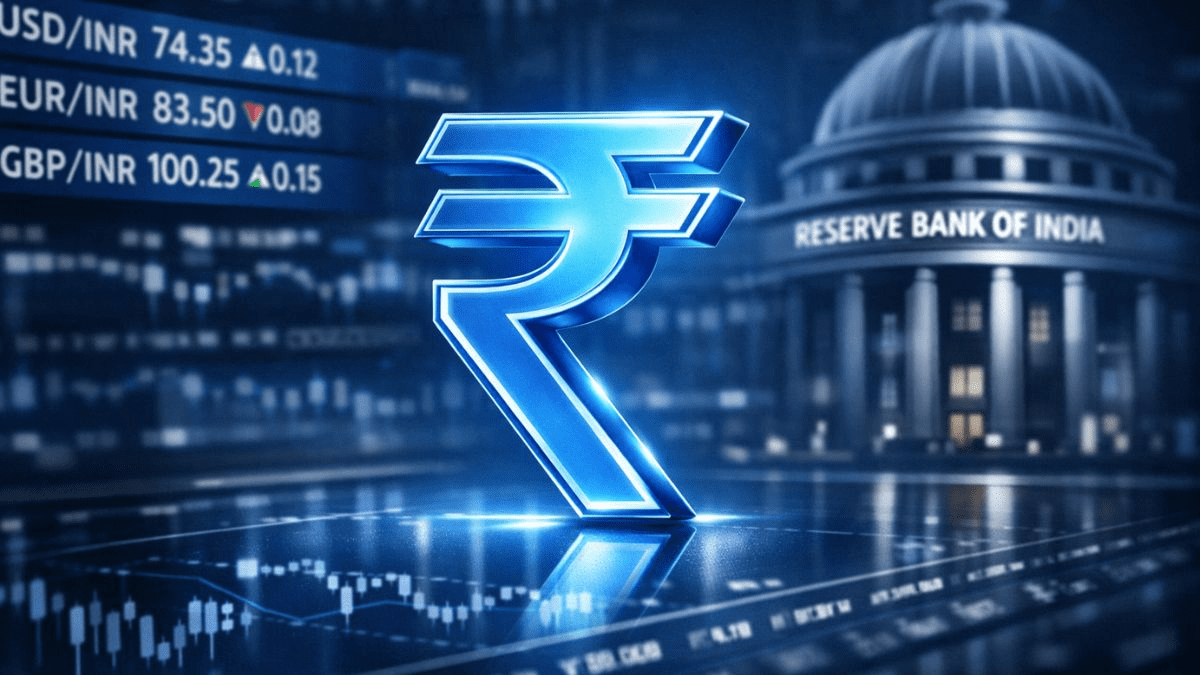
Now the Indian forex market is witnessing a tactical retreat from emergency measures. The Reserve Bank of India (RBI) has officially announced a partial withdrawal of restrictions on RBI rupee NDC trading. Therefore, authorized dealers are once again permitted to offer rupee-denominated non-deliverable contracts (NDCs) to both resident and non-resident users. This policy pivot, effective immediately, signals that the central bank believes the worst of the recent currency stress has passed.
Add businessleague.in as a Preferred Source


Meanwhile, the local unit continues to face pressure from geopolitical tensions in the Middle East.
But for market participants, the return of standard hedging activity is a welcome sign of stability.
Also Read |Tamil Nadu Voter List Purge: 97 Lakh Names Deleted in SIR Phase 1
Why the RBI Restored Rupee NDC Trading Now
Now the RBI is attempting to balance liquidity with stability. The central bank recognized that the prolonged ban on NDCs was hindering legitimate corporate hedging. Therefore, the “RBI rupee NDC trading” window has been reopened to restore standard market mechanics.
Moving Toward Normalcy
First, the central bank reviewed the measures following the recent appreciation of the local currency. Then, it determined that the speculative “arbitrage” between onshore and offshore markets had subsided. Thus, the restrictive instructions from April 1 were no longer deemed necessary for daily operations.
Next, the move aims to bring liquidity back to the derivative markets. Therefore, exporters and importers can now manage their risks more effectively through authorized dealers.
The Record Low of 95: Recapping the March Currency Crisis
Now we must look back at why these curbs were implemented in the first place. March 2026 was a period of “significant currency stress” for India. Therefore, the RBI had to deploy aggressive stabilization measures to prevent a total freefall.
The Perfect Storm
First, foreign capital outflows surged as global investors moved toward “safe-haven” assets. Then, Brent crude prices breached the critical $100-per-barrel threshold. Thus, the rupee plunged to a record intraday low of 95 against the dollar.
Next, the high import bill for oil put immense pressure on the current account deficit. Therefore, the RBI’s intervention was a “lifeboat” for the currency during a volatile month.
Understanding the $100 Million Net Open Position Cap
Now, while NDC trading is back, the RBI is not yet ready for a full “laissez-faire” approach. The $100-million cap on banks’ net open rupee positions remains firmly in place. Therefore, the central bank is keeping a tight leash on the banking sector’s exposure.
Preventing Excessive Exposure
First, the previous 25% limit was replaced by this strict dollar cap last month. Then, the RBI maintained this limit even during the latest easing announcement. Thus, they are ensuring that banks do not take large, risky bets against the rupee using their own balance sheets.
Next, this cap prevents the kind of “cascading volatility” that happens when multiple banks cover large positions simultaneously. Therefore, the market remains “insulated” from sudden shocks.
Also Read |Tamil Nadu Voter List Purge: 97 Lakh Names Deleted in SIR Phase 1
Sanjay Malhotra’s Stance: Temporary vs. Structural Shifts
Now RBI Governor Sanjay Malhotra has clarified the philosophy behind these moves. Following a recent Monetary Policy Committee meeting, he emphasized that the curbs were “temporary interventions.” Therefore, the RBI rupee NDC trading restoration was always a matter of “when,” not “if.”
Policy Transparency
First, Malhotra wanted to reassure global investors that India is not returning to a “capital control” regime. Then, he explained that the curbs were targeted at specific speculative trades. Thus, the current easing is proof of the central bank’s commitment to a structural free-market policy.
Next, he reiterated that the RBI remains “vigilant” and will not hesitate to re-intervene if volatility returns. Therefore, the market should view the current easing as an “earned” stability.
The Strait of Hormuz Factor: US Navy Action Hits the Rupee
Now despite the regulatory easing, the rupee ended Monday on a weaker note. Geopolitical tensions in the Middle East have returned to the forefront. Therefore, the “RBI rupee NDC trading” announcement was overshadowed by physical security concerns in the Gulf.
Seizure and Sentiment
First, the US Navy reportedly seized an Iranian ship on Monday. Then, news of the event spread quickly through currency desks in Mumbai. Thus, the local unit touched an intraday high of 93.24 before settling at 93.16.
Next, the event underscores the growing uncertainty regarding energy flows. Therefore, any threat to the Strait of Hormuz is a direct threat to India’s fiscal stability.
Brent Crude and Global Energy Flows in April 2026
Now the “oil price risk” mentioned in the RBI notification is a lived reality. India remains highly sensitive to Brent crude movements. Therefore, the central bank’s vigilance is directly tied to the price at the pump.
Energy Flow Vulnerability
First, any disruption in the Strait of Hormuz could send Brent crude back over $100. Then, this would immediately undo the gains the rupee has made in April. Thus, the RBI is keeping its “emergency tools”—like the $100M cap—ready for action.
Next, traders are watching the “risk-averse sentiment” dominating global markets. Therefore, the rebounding dollar is making it harder for the rupee to sustain a rally.
So the currency is caught between regulatory easing and geopolitical tightening.
Also Read |Tamil Nadu Voter List Purge: 97 Lakh Names Deleted in SIR Phase 1
Restricting Speculative Activity: The Related Party Rule
Now the RBI has left one major restriction in place to stop arbitrage. Authorized dealers are still “strictly prohibited” from entering into derivative contracts with related parties. Therefore, the “RBI rupee NDC trading” reopening is designed for genuine client needs.
The Exception Rule
First, dealers cannot trade NDCs with their own subsidiaries or branches to create “synthetic” positions. Then, exceptions are only allowed for rolling over existing contracts. Thus, the central bank is isolating “speculative trades” that make the currency vulnerable.
Next, back-to-back transactions are only permitted with non-related, non-resident users. Therefore, the transparency of the derivative chain is being maintained.
HDFC Securities Analysis: Shifting Dollar Strength
Now we must consider the analyst perspective on Monday’s retreat. Dilip Parmer of HDFC Securities noted that the rupee’s downturn followed two sessions of strong gains. Therefore, the market is currently in a “profit-booking” and “risk-off” phase.
The Greenback Factor
First, Parmer cited the US Navy action as the primary driver of the downturn. Then, he highlighted that the dollar is rebounding against most major currencies. Thus, the rupee’s weakness is partly a result of global “dollar strength” rather than just domestic issues.
Next, he expects the currency to stay within the 92.50 to 93.50 range in the short term. Therefore, the regulatory easing might provide a “floor” for the rupee, preventing another slide toward 95.
Common Questions Answered
What did the RBI change regarding Rupee NDCs? Now the RBI has restored the ability for authorized dealers to offer rupee-denominated non-deliverable contracts (NDCs) to residents and non-residents.
Is the $100-million cap on banks still in place? First, yes. The central bank has kept the strict $100-million cap on banks’ net open rupee positions to prevent excessive speculation.
Why did the Rupee hit 95 in March? Next, it was a result of foreign capital outflows and Brent crude prices rising above $100 per barrel. Therefore, the RBI had to intervene aggressively.
How does the Strait of Hormuz affect the Rupee? So as a vital energy corridor, any tension there threatens India’s oil supply. This leads to higher crude prices and a weaker local currency.
When do the new RBI directives take effect? Finally, the updated directives took effect immediately on Monday, April 20, 2026. Therefore, the market has already begun adjusting.
Also Read |Tamil Nadu Voter List Purge: 97 Lakh Names Deleted in SIR Phase 1
End…
Add businessleague.in as a Preferred Source
🙏 Support Independent Journalism
We keep news free for you.
Most readers support with ₹500 ❤️
or scan QR below

Voluntary contribution. No tax benefits.
DISCLAIMER
We have taken all measures to ensure that the information provided in this article and on our social media platform is credible, verified and sourced from other Big media Houses. For any feedback or complaint, reach out to us at businessleaguein@gmail.com