
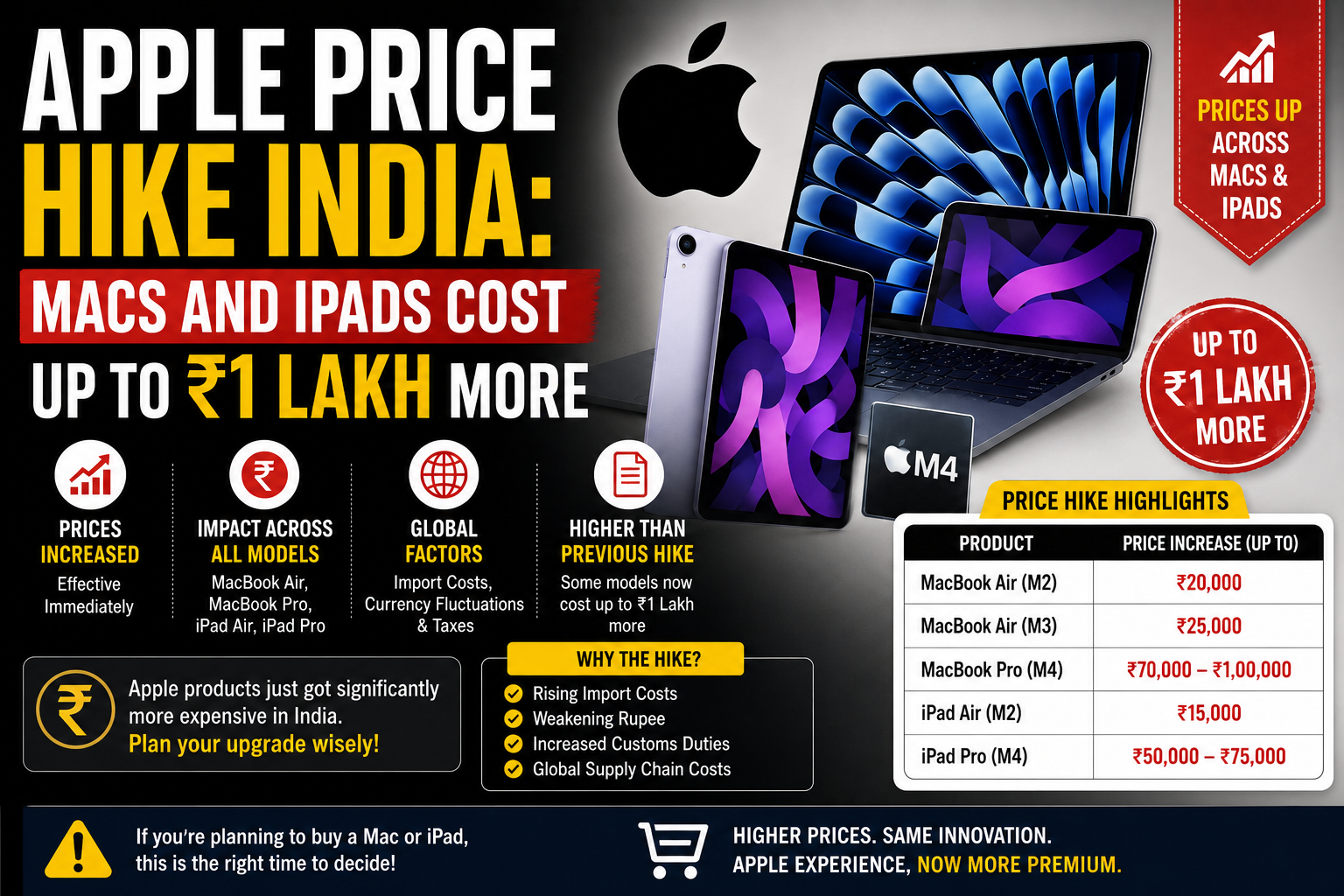
MUMBAI — Premium hardware acquisitions have become noticeably more expensive for tech enthusiasts and creative professionals across India. Over the past few weeks, Apple has quietly executed a series of sharp upward price revisions across its higher-tier hardware lineup, impacting the financial planning of buyers eye-ing top-spec configurations.
Add businessleague.in as a Preferred Source


Also Read | The Expiry Gridlock: Deconstructing the Sensex Nifty Marginal Gains June 2026 Close
The pricing adjustments span multiple major product ecosystems, including professional-grade MacBook Pro variants, premium iPads, the Mac Studio, the Mac mini, the HomePod, and the Apple TV network player. While the baseline, entry-level consumer models have remained anchored to their previous price floors, the sticker shock for fully customized or top-end professional machinery is severe, with price premiums climbing by ₹70,000 to nearly ₹1 lakh in certain instances.
The strategic pricing moves come at a critical juncture as the consumer electronics ecosystem transitions toward integrated, on-device artificial intelligence. While Apple has skipped publishing a formal itemized breakdown of the pricing changes, supply chain experts and market strategists point directly to the surging structural costs of building AI-ready hardware.
The True Cost of Localized Artificial Intelligence
The structural core of the price hike lies in the high physical requirements of modern software architectures. Running complex localized machine learning models directly on an individual laptop or tablet requires a complete re-engineering of baseline storage and processing environments.
Siddharth Maurya, Managing Director of Vibhavangal Anukulkara Pvt Ltd, observed that localized execution demands heavy hardware enhancements that carry a distinct manufacturing premium.
“Artificial intelligence gadgets demand greater RAM memory, storage, and chips, which allows them to run complex algorithms directly on the device,” Maurya explained.
Maurya highlighted that the global tech market is currently experiencing intense component competition. Consumer hardware brands are no longer just bidding against traditional device rivals; instead, they are competing directly for allocation from semiconductor fabricators alongside hyperscale cloud providers and AI research syndicates building vast data facilities.
Also Read | The Expiry Gridlock: Deconstructing the Sensex Nifty Marginal Gains June 2026 Close
Key Factors Driving High-End Device Pricing:
• Memory Allocation: Greater physical RAM reserves required to run LLMs locally.
• Infrastructure Rivalry: Personal computing brands competing with enterprise AI data centers for high-bandwidth chips.
• Capital Investment: Billions funneled into custom silicon fabrication, supply chain diversification, and AI security systems.
• Software Value: Factoring in long-term firmware development and continuous algorithmic updates.
Ecosystem Consolidation and a Shift in Asset Valuation
Analysts suggest that these higher price tiers represent a fundamental evolution in how technology companies monetize their products. Rather than just selling a static configuration of raw silicon and aluminum housing, enterprise brands are pricing their systems to capture the long-term productivity value of the integrated software ecosystem.
Rajveer Singh of Thinkarklub pointed out that modern computing systems are increasingly priced based on innovation cycles rather than mere physical assembly.
“The price hike on Apple products isn’t just about specs. It’s about innovation and R&D,” Singh stated, pointing out that years of architectural engineering are factored into custom silicon designs. “When demand is inelastic and brand equity is unmatched, Apple has pricing power. Customers aren’t just buying hardware, they’re buying into an ecosystem.”
Impact Summary on Premium Hardware Configurations:
• Desktop Frameworks (Mac Studio / Mac mini): Specialized multi-core processor builds face structural pricing adjustments.
• MacBook Pro Families: Top-spec configurations face up to ₹1 lakh price increases.
• Premium iPads: High-capacity storage variants see localized margin shifts.
• Entry-Level Categories: Base models remain largely insulated from component-driven increases.
This structural shift signals the launch of a new, highly segmented premium technology cycle. As on-device language models, responsive personal assistants, and real-time generation tools become permanent fixtures of the workflow experience, advanced memory pools and specialized silicon processing units will remain core cost drivers.
For the modern Indian consumer evaluating a high-end hardware investment this year, the underlying economics suggest that pricing pressures are unlikely to ease anytime soon, establishing a higher financial baseline across the broader personal computing industry.
Also Read | The Expiry Gridlock: Deconstructing the Sensex Nifty Marginal Gains June 2026 Close
FAQ
Why do on-device AI tools require so much extra RAM?
Unlike cloud-based AI tools that process your prompts on external servers, on-device systems must load large language models directly into the device’s temporary physical memory. This process requires a significantly larger baseline RAM pool to maintain system speed during multitasking.
Are baseline Apple models also seeing price hikes in India?
No. The recent round of price increases has primarily targeted high-end configurations, specialized desktop processors, and professional-grade portable hardware lines. Entry-level consumer products have largely retained their existing price points.
Can software updates help older hardware run these new AI models?
While basic cloud-linked AI software can run via web browsers or apps on older models, localized processing requires dedicated hardware components, like advanced neural engines and high-bandwidth memory architectures, which older hardware configurations lack.
Is this price increase unique to the Indian retail market?
While the precise currency conversion and local tax architectures impact the final price tags inside India, the underlying cause—a sharp global spike in advanced memory and processor component costs—is an industry-wide issue affecting global technology manufacturing.
Also Read | The Expiry Gridlock: Deconstructing the Sensex Nifty Marginal Gains June 2026 Close
Add businessleague.in as a Preferred Source
🙏 Support Independent Journalism
We keep news free for you.
Most readers support with ₹500 ❤️
or scan QR below

Voluntary contribution. No tax benefits.
DISCLAIMER
We have taken all measures to ensure that the information provided in this article and on our social media platform is credible, verified and sourced from other Big media Houses. For any feedback or complaint, reach out to us at businessleaguein@gmail.com