8th Pay Commission: Defense Employee Federation Demands New DA, DR Formula and Fitment Factor Overhaul
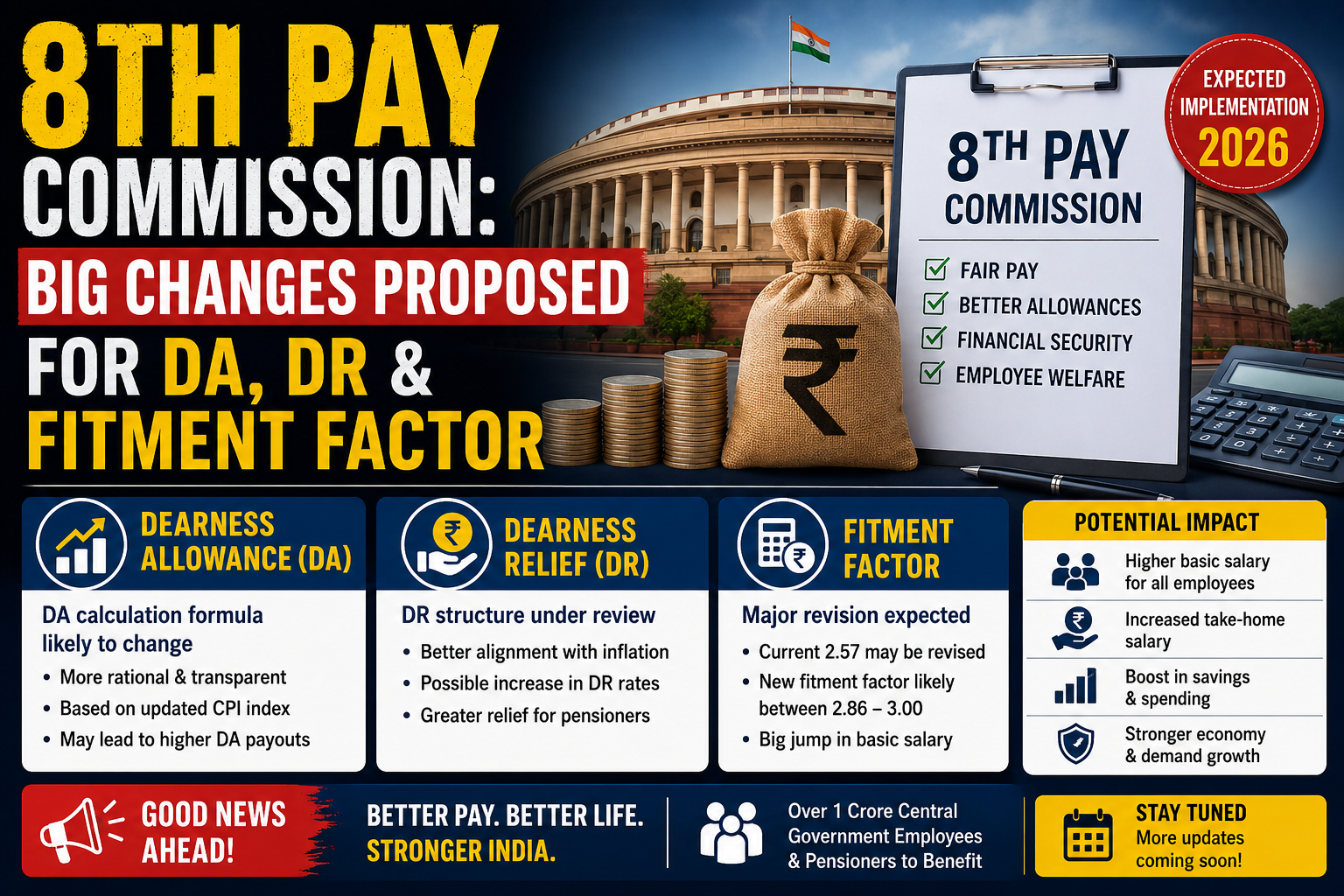
NEW DELHI — Structural discussions surrounding the implementation of the 8th Pay Commission have gathered significant momentum. The All India Defence Employees Federation (AIDEF) has formally submitted a second detailed memorandum to the commission, demanding a comprehensive review of the calculations governing Dearness Allowance (DA) for active central government employees and Dearness Relief (DR) for pensioners.
Add businessleague.in as a Preferred Source


The federation contends that the long-standing formula used by the government has failed to keep pace with changing consumer realities, leading to a widening gap between official compensation adjustments and actual household costs.
Currently, both DA and DR revisions are anchored to the All India Consumer Price Index for Industrial Workers (AICPI-IW). This framework evaluates the average rate of inflation over a trailing 12-month window to insulate government personnel from volatile macroeconomic shifts.
Also Read | Grid Calibration: Analyzing the Official RRB NTPC Graduate CBT 2 Exam Date 2026
However, the AIDEF asserts that changing consumer spending habits mean this generalized indicator no longer accurately reflects the precise cost pressures squeezing modern working families and retirees.
The Core Friction: Flaws in the Updated Inflation Basket
A major point of contention highlighted in the federation’s proposal is the updated weight distribution introduced in the revised Consumer Price Index basket during the 2022-23 assessment cycle.
Under the revised index structure, the statistical weight allocated to fundamental necessities like food and beverages was reduced to 36.75 percent. Simultaneously, federal statisticians increased the proportional importance given to broader service sectors, including housing, advanced healthcare, transportation networks, digital communications, and technology services.
Key Shifts in the Post-2022 Inflation Assessment Framework:
• Food & Beverages: Accounting for 36.75% of total index weight.
• Growing Weight Allocations: Concentrated in housing, digital services, transport, and commercial healthcare.
• Structural Misalignment: High-volume essential expenses (medicines, rent, basic education) carry an understated impact on final numbers.
• Resulting Vulnerability: Low- to mid-level government employees experience an inflation burden higher than the official index shows.
The AIDEF argues that this re-weighting inadvertently disadvantages low- and middle-income government employees. Families within these salary bands continue to funnel a large percentage of their monthly disposable income directly into volatile baseline necessities such as daily food supplies, vital prescription drugs, higher education, urban rent, and primary medical treatments. Because the official index dilutes these categories, the federation argues that the recorded inflation numbers remain lower than the real-world expenses faced by employees.
Also Read | Grid Calibration: Analyzing the Official RRB NTPC Graduate CBT 2 Exam Date 2026
Pensioners Hit Hard by Rising Healthcare Costs
The memorandum places a sharp focus on the financial pressures facing elderly beneficiaries. Pensioners are uniquely vulnerable to targeted economic inflation because senior households face rising healthcare costs. A major portion of their monthly pension is routinely used to cover rising health insurance premiums, routine clinical tests, specialized pharmaceutical management, and long-term caregiving services.
AIDEF's Proposed Structural Reforms:
1. Custom Indicator: Form an independent Cost of Living Index tailored to government workers and retirees.
2. Targeted Metrics: Ground DA and DR changes in the actual spending habits of public-sector households.
3. Fitment Factor Overhaul: Revise the core fitment multiplier to absorb multi-year inflation and healthcare costs.
4. Future-Proofing: Lock in realistic salary and pension baselines to sustain real-world purchasing power.
Because the general DR adjustments do not scale to match the compounding cost of medical procedures, the purchasing power of retired personnel is experiencing structural erosion.
To address this issue, the AIDEF has proposed creating a distinct, specialized Cost of Living Index engineered specifically for central government employees and retirees. This system would tie allowance adjustments directly to the specific spending patterns of public-sector households rather than broad macroeconomic indicators.
Furthermore, the federation has urged the 8th Pay Commission to re-evaluate the fitment factor—the mathematical multiplier used to scale base pay rates across different pay matrices during transitions between commissions. By factoring in healthcare inflation and actual living costs into this multiplier, the union aims to secure more sustainable salary and pension foundations for the coming decade.
The 8th Pay Commission is currently evaluating these proposals alongside a wide array of representations from various employee unions and pension syndicates nationwide, setting the stage for major structural updates to India’s public sector remuneration framework.
Also Read | Grid Calibration: Analyzing the Official RRB NTPC Graduate CBT 2 Exam Date 2026
FAQ
What is the primary role of the fitment factor in a Pay Commission transition?
The fitment factor is a standard multiplier used to calculate the updated basic salary and pension levels when shifting to a new pay scale structure. It is designed to lift the baseline pay of employees to align with multi-year economic growth and cumulative inflation.
Why is the AIDEF dissatisfied with the AICPI-IW index?
The federation argues that the updated AICPI-IW index understates reality because it reduced the statistical weight of food and beverages. Since low- and middle-income families spend a large part of their income on essentials, the official index indicates a lower inflation rate than what families actually experience.
Will the proposed Cost of Living Index apply to state government employees?
While Pay Commissions are officially formed to structure central government pay scales, state governments across India traditionally follow or adapt the central framework for their own state-level employee pools after a short delay.
When are the final recommendations of the 8th Pay Commission expected to take effect?
Once the commission concludes its review of union proposals, it will submit a comprehensive report to the central government. Following cabinet reviews and formal approvals, the implementation timelines and any retroactive pay structures will be announced via official notifications.
Also Read | Grid Calibration: Analyzing the Official RRB NTPC Graduate CBT 2 Exam Date 2026
Add businessleague.in as a Preferred Source
🙏 Support Independent Journalism
We keep news free for you.
Most readers support with ₹500 ❤️
or scan QR below

Voluntary contribution. No tax benefits.
DISCLAIMER
We have taken all measures to ensure that the information provided in this article and on our social media platform is credible, verified and sourced from other Big media Houses. For any feedback or complaint, reach out to us at businessleaguein@gmail.com