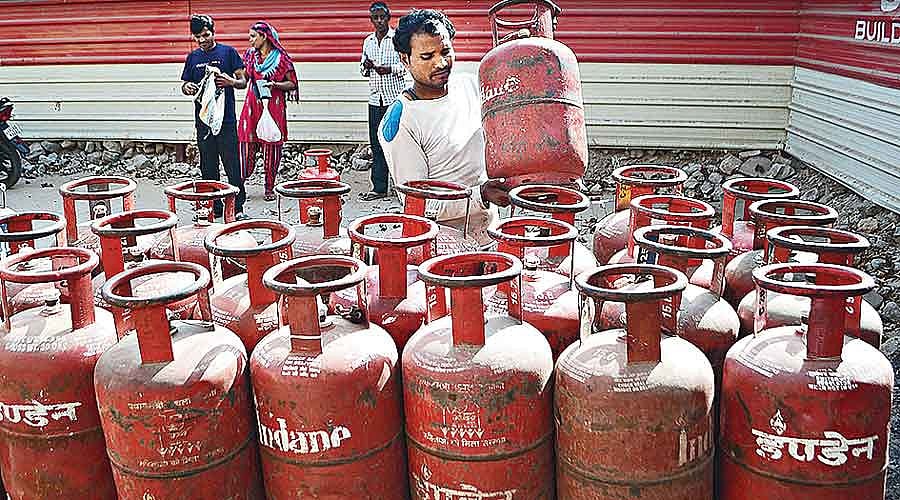
NEW DELHI — In a major development for India’s service and manufacturing sectors, the Ministry of Petroleum and Natural Gas has fully restored liquefied petroleum gas (LPG) supplies to commercial consumers to pre-crisis levels. The policy change completely unwinds the emergency rationing networks established during the recent Middle East conflict, signaling that regional energy security fears are subsiding as international trade corridors clear.
Add businessleague.in as a Preferred Source


The decision brings immediate operational relief to high-volume commercial fuel users, including hotels, restaurants, and specialized industrial facilities that had faced severe fuel allocations over the last few weeks.
Alongside the full normalization of packed non-domestic cooking gas, the government has partially relaxed bans on bulk LPG distribution, allowing heavy industrial users to draw up to 50 percent of their baseline, pre-crisis consumption levels.
Also Read | 19TH ROZGAR MELA: WORLD WANTS TO JOIN INDIA’S ‘VIKAS YATRA’, SAYS PM MODI
The Strategic Diversion: Balancing Homes vs. Industry
The supply crunch began when localized military hostilities in the Middle East threatened shipping routes. Because India relies on Middle Eastern markets for approximately 90 percent of its total cooking gas imports, New Delhi quickly deployed defensive economic measures to safeguard voters and working-class households.
Using legal tools under the Essential Commodities Act, the Centre ordered domestic refiners to divert crucial and hydrocarbon streams away from lucrative petrochemical manufacturing, forcing those chemical baselines entirely into consumer-grade LPG production.
LPG Supply Stabilization Roadmap:
• Phase 1 (Crisis Onset): Complete suspension of bulk industrial LPG; commercial packed gas restricted to safeguard domestic kitchens.
• Phase 2 (Mid-Crisis): Gradual restoration of commercial lines to 70 percent, though key industrial sectors faced 50 percent caps.
• Phase 3 (Current Status): 100 percent restoration for non-domestic packed LPG; bulk industrial lines relaxed to 50 percent capacity.
The emergency directives significantly changed internal manufacturing margins for major private refiners, including companies like Reliance Industries, which had to throttle high-yield petrochemical output to maintain public utility fuel pools.
With fresh import cargoes safely arriving and domestic production turning a corner, authorities are shifting strategies. The ministry will reduce the mandatory internal refinery diversion of and streams, allowing the petrochemical industry to recover its primary raw materials. However, this recovery is bound by a strict structural safety limit: domestic LPG output must remain above 40,000 tonnes per day.
Also Read | 19TH ROZGAR MELA: WORLD WANTS TO JOIN INDIA’S ‘VIKAS YATRA’, SAYS PM MODI
Long-Term Structural Shift Toward Piped Gas
Even as energy networks stabilize, the central government is leveraging the structural lessons learned during the crisis to accelerate long-term infrastructure transitions. The Ministry has made it clear that returning to baseline allocations is a stabilization measure, not a permanent endorsement of commercial liquid gas usage.
“The government remains committed to expanding PNG connectivity. Commercial and bulk consumers who have already shifted to piped natural gas (PNG) will continue to remain on PNG,” the ministry statement emphasized.
Refinery Operational Parameters Under New Directives:
• Aggregate Indigenous Production Floor: Minimum 40,000 tonnes of LPG per day.
• Enforcement Body: Center of High Technology (CHT) to govern organization-specific stream allocations.
• Administrative Action: Unified cross-OMC database tracking commercial consumption habits to improve future strategic planning.
To ensure the policy shift rolls out smoothly across state lines, the Secretary of the Ministry of Petroleum and Natural Gas has formally written to the Chief Secretaries of all States and Union Territories.
State-run Oil Marketing Companies (OMCs) are now under orders to build a single, cross-corporate database tracking commercial and bulk fuel buyers. This data framework will serve dual purposes: providing clear logistics mapping during future global energy blockades, and building a structured roadmap to systematically migrate eligible commercial hubs off containerized gas and onto regional Piped Natural Gas (PNG) networks.
FAQ
Why did the Middle East conflict impact India’s commercial cooking gas availability so rapidly?
India depends on imports from the Middle East for roughly 90 percent of its cooking gas supply. When regional stability was compromised, the government took immediate steps to prioritize residential kitchens, temporarily cutting or limiting allocations for non-domestic users.
What are C3 and C4 streams, and why do they matter to petrochemical companies?
(Propane) and (Butane) are hydrocarbon gases produced during oil refining. They serve as the foundational building blocks for both LPG fuel blends and high-value petrochemical items like plastics and synthetic rubbers. When the government diverted these streams to boost fuel volumes, it forced manufacturing cutbacks across the chemical sector.
Are businesses allowed to switch back to LPG if they already have a Piped Natural Gas (PNG) connection?
No. The Petroleum Ministry’s updated policy framework explicitly mandates that commercial and bulk consumers who have migrated to Piped Natural Gas (PNG) must stay on the pipeline network to reduce structural pressure on the country’s liquid fuel reserves.
How does the government plan to prevent future commercial fuel shocks?
Alongside accelerating the shift toward domestic piped gas infrastructure, state-run oil marketing companies are assembling a shared, unified commercial consumer database. This data framework is designed to optimize supply planning and improve resource management during future import shortages.
Also Read | 19TH ROZGAR MELA: WORLD WANTS TO JOIN INDIA’S ‘VIKAS YATRA’, SAYS PM MODI
Add businessleague.in as a Preferred Source
🙏 Support Independent Journalism
We keep news free for you.
Most readers support with ₹500 ❤️
or scan QR below

Voluntary contribution. No tax benefits.
DISCLAIMER
We have taken all measures to ensure that the information provided in this article and on our social media platform is credible, verified and sourced from other Big media Houses. For any feedback or complaint, reach out to us at businessleaguein@gmail.com