
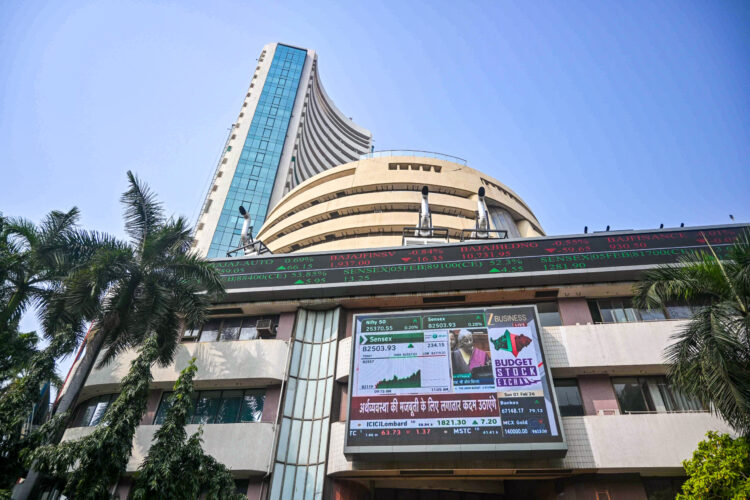
Easing crude oil prices trigger a massive 2% rally across automotive manufacturing lines before late-afternoon contract liquidations drag small-cap and mid-cap indices into negative territory.
Add businessleague.in as a Preferred Source


The institutional trading floors, derivative settlement blocks, and high-frequency electronic brokerage networks that drive India’s primary equity benchmarks have navigated a volatile monthly derivatives closing cycle. Closing their terminal lines for the day on Thursday afternoon, June 25, 2026, the National Stock Exchange (NSE) and Bombay Stock Exchange (BSE) recorded quiet, flat adjustments under the headline Sensex Nifty marginal gains June 2026 sheet. The blue-chip NSE Nifty 50 crawled up by just 34.35 points, or 0.14 per cent, to finish at 24,056.00, while the 30-share BSE Sensex added 109.25 points, or 0.14 per cent, to anchor its final calculation at 77,100.47.
The minor final gains mask a dramatic session characterized by a sharp multi-hour market reversal.
During early morning trade, a sharp drop in international energy prices sent a wave of optimism across local desks.
The Sensex charged upward by more than 811 points—touching an intra-day high of 77,803.18—while the Nifty rose to 24,261.60.
However, this 1% rally ran straight into intense selling pressure during the final 90 minutes of trade, as a wave of derivative contract closures forced institutional fund managers to aggressively lock in profits.
Also Read | Viral Trump Lookalike Buffalo Rescue: Saved From Eid Sacrifice
The Strategy Architecture: Tracking the Defensives vs. Heavyweight Shift
The dramatic market reversal split the sectoral landscape down the middle, transforming consumer defensives into a critical buffer while cyclical industries faced heavy liquidations.
1. The Automotive and FMCG Protective Shield
The shining light of the session emerged from heavy industries that benefit directly from lower commodity bills.
The Nifty Auto index jumped more than 2%, led by a 4.82% surge in aviation and travel heavyweights, alongside strong gains for auto majors like Mahindra & Mahindra and Maruti Suzuki.
Concurrently, the Nifty FMCG cluster added 0.7%, drawing steady defensive support from firms like Hindustan Unilever as investors parked capital in stable, consumer-focused lines to shield against near-term market turbulence.
2. The Cyclical Commodity and Tech Pullback
Conversely, export-focused and energy segments faced intense selling pressure in afternoon trade.
The Nifty Metal index led the day’s losses, driven downward by sharp drops in commodity heavyweights like Hindalco Industries.
Similarly, the Nifty IT and Nifty Oil and Gas indices experienced steady liquidations, with major components like Oil and Natural Gas Corporation (ONGC), Power Grid Corporation, and Tech Mahindra dragging the final benchmarks lower.
Slicing Through the High-Frequency Equity and Index Sheets
The underperformance of broader, riskier market tiers shows that buying stayed highly selective, focusing on stable front-line giants rather than speculative small-cap spaces:
| Monitored Market Indicator | Baseline Opening Value | Day’s Peak Value Achieved | Verified Closing Standard | Absolute Net Change % | Active Sector Trend Status |
| BSE Sensex Benchmark | 77,391.07 Points | 77,803.18 Points | 77,100.47 Points | +0.14% Gain | Closes flat as afternoon derivative liquidations wipe out early advances. |
| NSE Nifty 50 Index | 24,125.85 Points | 24,261.60 Points | 24,056.00 Points | +0.14% Gain | Preserves the key 24,050 support level despite high expiry volatility. |
| Nifty Bank Tracker | 58,493.85 Points | 58,706.05 Points | 58,177.05 Points | +0.05% Gain | Supported quietly by steady accumulation across top-tier private lenders. |
| Nifty MidCap 100 | 54,120.00 Points | 54,280.00 Points | 53,822.00 Points | -0.55% Loss | Underperforms significantly; local retail traders reduce risk positions. |
| Nifty SmallCap 100 | 16,450.00 Points | 16,510.00 Points | 16,372.00 Points | -0.47% Loss | Reflects a weak broader market layout; 19 Sensex components close lower. |
Also Read | Viral Trump Lookalike Buffalo Rescue: Saved From Eid Sacrifice
The Macro Foundations: Easing Crude Oil vs. Earnings Anxieter
The underlying forces moving the markets point to a complex outlook for the next quarter.
On the positive side, Brent crude fell 1.26% to $72.81 per barrel, hitting its lowest level in several weeks as supply disruption concerns continue to ease following the de-escalation of the West Asia shipping crisis.
The underlying text of the institutional tracking logs shows that while lower oil provides a fantastic buffer for the Indian rupee, it isn’t enough to sustain long-term upward momentum on its own.
With Foreign Institutional Investors (FIIs) offloading equities worth ₹1,843.40 crore in recent sessions, domestic markets are facing near-term headwinds.
Investment houses are closely watching an uneven monsoon distribution pattern across central farming belts, warning that delayed rain cycles could stall a recovery in rural consumer spending and lead to mixed corporate earnings when Q1 results drop next month.
Five Sequence Steps Investors Must Execute to Navigate Expiry Volatility
To ensure your investment capital remains fully protected against sudden intra-day market reversals, avoiding execution traps and tracking high-liquidity stock entries successfully, apply this five-step sequence:
Ultimately, navigating modern equity markets requires looking past volatile intra-day chart lines to focus on large-scale macroeconomic trends. While sovereign policy planners resolve crucial physical infrastructure updates—such as the high-level SIT probe tracking structural building safety failures in Lucknow this week—capital markets are focused on managing global energy developments.
By keeping your portfolios weighted toward resilient large-cap names, utilizing lower energy costs to find hidden manufacturing value, and planning your execution around derivative calendars, you can navigate choppy waters safely.
This disciplined approach protects your wealth, preserves your investment performance, and keeps your trading strategy perfectly aligned as the subcontinental economy enters a vital corporate earnings cycle.
FAQ Section
What caused the sharp reversal from early gains during the Thursday stock session?
The sudden afternoon reversal was driven by monthly F&O (Futures and Options) expiry volatility. Institutional traders and automated funds aggressively squared off their active derivative positions in the final 90 minutes of trade, taking quick profits at higher levels and erasing an impressive 811-point surge on the Sensex.
Why did automotive manufacturing stocks drastically outperform alternative sectors today?
The automotive segment received a powerful boost from a drop in international energy prices, with Brent crude slipping 1.26% to $72.81 per barrel. Lower oil costs directly reduce manufacturing input bills and freight overhead for automakers, sparking a strong 2% rally across the Nifty Auto index.
How did broader market segments perform compared to the frontline blue-chip benchmarks?
Broader market segments underperformed the major frontline benchmarks significantly. Cautious retail sentiment and targeted profit booking caused the Nifty MidCap index to close 0.55 per cent lower, while the Nifty SmallCap index dropped 0.47 per cent, showing that buying remained highly selective.
Also Read | Viral Trump Lookalike Buffalo Rescue: Saved From Eid Sacrifice
End….
Add businessleague.in as a Preferred Source
🙏 Support Independent Journalism
We keep news free for you.
Most readers support with ₹500 ❤️
or scan QR below

Voluntary contribution. No tax benefits.
DISCLAIMER
We have taken all measures to ensure that the information provided in this article and on our social media platform is credible, verified and sourced from other Big media Houses. For any feedback or complaint, reach out to us at businessleaguein@gmail.com