
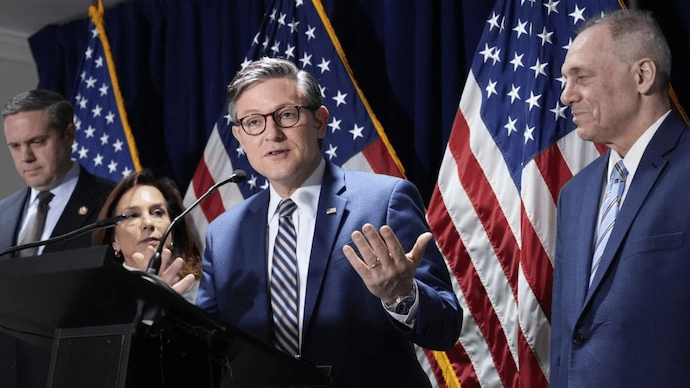
Now the US Iran war powers deadline expires today, May 1. This legal threshold forces the President to seek Congressional approval for military action. Therefore, House Speaker Mike Johnson faced tough questions about the 60-day limit Thursday. He insists the United States is not at war with Iran. Meanwhile, global markets remain on edge as the conflict’s legal status hangs in the balance.
Add businessleague.in as a Preferred Source


Also Read |Tamil Nadu Voter List Purge: 97 Lakh Names Deleted in SIR Phase 1
The May 1 Deadline: Why Today Matters
Now the legal clock has finally run out for the Trump administration. Today marks 60 days since the President officially notified Congress of military strikes. Therefore, under the War Powers Resolution, the US must now withdraw its forces.
First, the law requires specific Congressional authorization after two months of hostilities. Next, the administration has not yet secured this formal vote. Thus, every military action from this point forward faces a legal challenge.
Meanwhile, Speaker Mike Johnson is playing down the significance of the date. Therefore, he claims the nature of the mission has changed.
So what happens if the US stays?
First, constitutional scholars warn of a massive executive overreach. Next, lawsuits from members of Congress could follow. Thus, the May 1 deadline is a massive test for the balance of power in Washington.
Finally, the world is watching to see if the law still holds.
The War Powers Resolution of 1973 Explained
Now we must look at the history of this vital law. Congress passed the War Powers Resolution in 1973 to limit presidential power. Therefore, it prevents the White House from starting “forever wars” without oversight.
First, the President must notify Congress within 48 hours of any military strike. Next, the 60-day clock begins immediately upon that notification. Thus, the law creates a “use it or lose it” period for military force.
Meanwhile, the President can ask for a 30-day extension for safety reasons. Therefore, the total legal window is 90 days. Still, the administration must show they are actively withdrawing.
So the law is clear on paper.
First, it mandates a full withdrawal if Congress stays silent. Next, it gives the legislative branch the “final say” on war. Thus, today’s expiration creates a massive constitutional friction point.
Mike Johnson’s NBC Interview: ‘Not at War’
Now Speaker Mike Johnson spoke to NBC News about this brewing crisis. He appeared very reluctant to challenge the White House today. Therefore, he chose his words with extreme care.
First, Johnson claimed the US has no “active, kinetic military bombing” occurring now. Next, he stated that the administration is simply trying to broker a peace. Thus, he believes the 60-day limit does not apply to the current situation.
Meanwhile, he refused to get in front of sensitive negotiations. Therefore, he is giving the President more room to maneuver.
So what about the ongoing blockade?
First, Johnson dismissed the idea that “policing” counts as war. Next, he argued that Congress has no role in “moving things along” right now. Thus, he is effectively sidelining his own chamber’s power.
Finally, his position has angered both anti-war Democrats and some conservative hawks.
Also Read |Tamil Nadu Voter List Purge: 97 Lakh Names Deleted in SIR Phase 1
Pete Hegseth and the ‘Ceasefire Pause’ Theory
Now Secretary of Defense Pete Hegseth has a different legal theory. He told lawmakers that a ceasefire effectively stops the clock. Therefore, the May 1 deadline might be irrelevant in his eyes.
First, Hegseth argues that hostilities must be “active” to trigger the law. Next, he believes a pause in firing resets or stops the 60-day timer. Thus, the administration can maintain forces indefinitely without a vote.
Meanwhile, legal experts are skeptical of this “pause” theory. Therefore, they point out that the law mentions “hostilities,” not just active bombing.
So the White House counsel is now reviewing the matter.
First, they must decide if a ceasefire legally ends a “conflict.” Next, they must verify if the Strait of Hormuz blockade counts as a “hostility.” Thus, the legal team is working overtime to avoid a constitutional crisis.
How the Conflict Began: February 28 Strikes
Now we must remember how this war started. Hostilities exploded on February 28 with a massive joint strike. Therefore, the US and Israel targeted several Iranian cities.
First, the operation led to the death of Supreme Leader Ali Khamenei. Next, several senior military officials were killed in the raid. Thus, Iran responded with immediate fury.
Meanwhile, Iran launched retaliatory attacks on US bases in the Gulf. Therefore, the region plunged into the most dangerous conflict in decades.
So the President notified Congress of these strikes on March 2.
First, that document set the May 1 deadline in stone. Next, it confirmed that the US was in a “kinetic conflict.” Thus, the administration cannot easily claim they were never at war.
The Strait of Hormuz: Policing or Warfare?
Now the Strait of Hormuz remains the biggest sticking point. Iran continues to block this vital commercial shipping route. Therefore, US naval forces are heavily involved in the area.
First, Speaker Johnson calls this “policing.” Next, Iran views it as a direct act of war. Thus, the two sides are in a stalemate.
Meanwhile, about 20% of the world’s oil passes through this strait. Therefore, the US navy is trying to force the route open.
So does “policing” a blockade count as war?
First, the War Powers Act covers any situation where forces are “imminent” in hostilities. Next, the presence of armed warships in a combat zone usually qualifies. Thus, the administration’s legal defense is on very thin ice.
Finally, any exchange of fire today would immediately break the “ceasefire” defense.
Also Read |Tamil Nadu Voter List Purge: 97 Lakh Names Deleted in SIR Phase 1
The 30-Day Extension: Will Trump Use It?
Now there is one “escape hatch” left for the President. The 1973 law allows for a 30-day extension. Therefore, the administration could push the deadline to June 1.
First, the President must certify that the extension is necessary for safety. Next, he must show that withdrawal is underway. Thus, it is not a “free pass” to continue fighting.
Meanwhile, Donald Trump has not yet indicated his plans. Therefore, the legal community is waiting for an official announcement.
So why not just ask Congress for a vote?
First, a vote on war is politically risky. Next, the administration might not have the numbers to win. Thus, they prefer the “ceasefire pause” theory over a formal debate.
Finally, using the extension would at least offer a temporary legal shield.
Market Reaction to the Legal Uncertainty
Now global markets are reacting to this legal vacuum. Oil prices remain at record highs today. Therefore, the uncertainty in Washington is feeding the energy crisis.
First, traders fear that an unauthorized war could lead to a massive escalation. Next, they worry about the legality of US naval protection for tankers. Thus, shipping insurance rates are staying elevated.
Meanwhile, the S&P 500 showed signs of nervousness Thursday afternoon. Therefore, investors want a clear answer on the US Iran war powers deadline.
So the “not at war” stance offers little comfort.
First, the physical reality in the Gulf remains dangerous. Next, the legal reality in DC remains messy. Thus, the “risk premium” on oil will not go away soon.
Finally, the deadline expiration tonight will be a major trigger for Monday’s market opening.
Common Questions (FAQ)
1. What is the US Iran war powers deadline today? Now today, May 1, is the final day of the 60-day limit set by the War Powers Resolution. Therefore, the President must legally withdraw forces without Congressional approval.
2. Why does Speaker Johnson say we are not at war? First, he claims there is no “active bombing” right now. Next, he says a ceasefire is in place. Thus, he argues the legal clock has stopped.
3. What happens if the President ignores the deadline? Meanwhile, it could trigger a constitutional crisis. Therefore, Congress might sue the administration or cut off funding for the operation.
4. Can the President get more time? So yes. The law allows for a 30-day extension for the “safety” of troops. Still, the President has not yet exercised this option.
5. How did the US Iran war powers deadline begin? First, the clock started on March 2. This followed the February 28 strikes on Tehran. Therefore, the 60-day period ends exactly today.
6. Does the Strait of Hormuz blockade affect the law? Finally, yes. Naval engagement in the strait usually counts as “hostilities.” Therefore, the administration’s “policing” claim is legally controversial.
Also Read |Tamil Nadu Voter List Purge: 97 Lakh Names Deleted in SIR Phase 1
End…
Add businessleague.in as a Preferred Source
🙏 Support Independent Journalism
We keep news free for you.
Most readers support with ₹500 ❤️
or scan QR below

Voluntary contribution. No tax benefits.
DISCLAIMER
We have taken all measures to ensure that the information provided in this article and on our social media platform is credible, verified and sourced from other Big media Houses. For any feedback or complaint, reach out to us at businessleaguein@gmail.com