


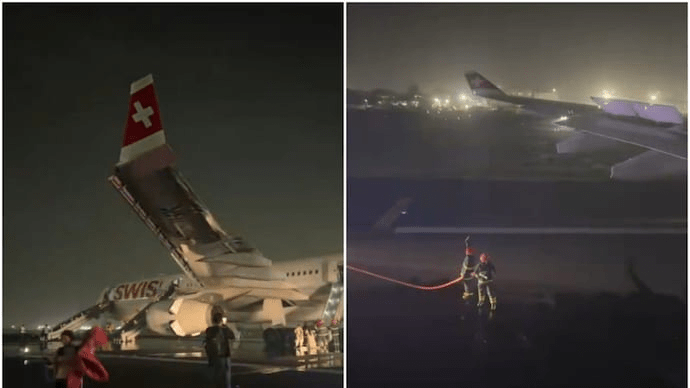
Now the safety protocols of one of Europe’s most prominent carriers were put to the ultimate test in the Indian capital. On Sunday, April 26, 2026, a Zurich-bound Swiss flight takeoff abort Delhi airport emergency occurred after a high-speed engine fire was detected. Specifically, the Airbus A330-300 was accelerating for liftoff at 1:00 AM when the crew initiated a “Rejected Takeoff” (RTO). Therefore, the resulting runway emergency led to a frantic evacuation of 245 people via emergency slides, leaving four passengers and one crew member injured.
Add businessleague.in as a Preferred Source


Meanwhile, social media has been flooded with footage of the incident, capturing the intense moments as passengers fled the smoking aircraft on Runway 28.
But for the airline, stylised as SWISS, the focus has now shifted to a deep-dive investigation into why a 14-year-old aircraft suffered such a catastrophic mechanical failure.
Also Read |Tamil Nadu Voter List Purge: 97 Lakh Names Deleted in SIR Phase 1
High-Speed Abort: The Critical Seconds on Runway 28
Now we must analyze the physics of the Swiss flight takeoff abort Delhi airport event. An aborted takeoff at high speed is one of the most demanding maneuvers a pilot can perform.
Deceleration at the Limit
First, the aircraft was accelerating for liftoff on Runway 28 when the engine fire was confirmed. Then, the pilots had to apply maximum braking force to bring the heavy A330 to a halt before the runway ended. Thus, the heat generated by the brakes often causes smoke, which was initially reported as coming from the landing gear. Next, the detection of an engine fire at 104 knots—well into the high-speed regime—required an immediate and decisive stop. Therefore, the crew’s rapid response prevented a potential disaster during the initial climb.
Emergency Evacuation: Slides Deployed Amid Panic
Now, once the aircraft came to a stop, the threat of fire necessitated an immediate exit. The cabin crew swung into action to deploy the emergency slides on both sides of the fuselage.
Rapid Response in the Dark
First, ground staff and emergency personnel assisted the 232 passengers, including four infants, in exiting the plane. Then, visuals from the scene showed passengers being instructed to move away from the smoking aircraft as quickly as possible. Thus, the evacuation was completed in a matter of minutes, though the speed of the slide descent contributed to localized injuries. Next, the presence of smoke from the port side of the main wheel added to the urgency of the situation. Therefore, the evacuation was carried out under the assumption of an imminent fire risk.
Casualty Update: Current Status of Hospitalized Passengers
Now the airline has provided a clarified report on the injuries sustained during the evacuation. While initial figures were inconsistent, the latest update confirms the human impact of the emergency.
Hospitalization and Recovery
First, four passengers remain in the hospital for observation and treatment. Then, one cabin crew member suffered a sprained ankle during the slide deployment process. Thus, while the majority of the 245 people on board were unharmed, the evacuation was not without physical cost. Next, SWISS has expressed its regret for the distress caused to those currently receiving medical care. Therefore, the airline’s ground team is providing on-site support to the hospitalized guests until they are cleared for travel.
Also Read |Tamil Nadu Voter List Purge: 97 Lakh Names Deleted in SIR Phase 1
The Flightradar24 Data: Analyzing the 104-Knot Trigger
Now flight tracking data provides a precise look at the sequence of events. According to Flightradar24, the 14-year-old Airbus A330-300 had reached a significant speed before the brakes were slammed.
The Abort Sequence
First, the tracking platform shows the aircraft reaching 104 knots—roughly 192 km/h—before the takeoff was rejected. Then, the sharp deceleration is visible on the telemetry as the plane came to a standstill on the runway. Thus, the Swiss flight takeoff abort Delhi airport incident occurred at a “V1” speed threshold where the decision to abort is most critical. Next, the age of the aircraft (14 years) will likely be a focal point for investigators looking into component fatigue. Therefore, the digital footprint of the flight will be a primary piece of evidence for the Directorate General of Civil Aviation (DGCA).
Engine Snag vs. Landing Gear Smoke: The Technical Conflict
Now there were conflicting early reports regarding where the fire or smoke originated. Sources initially pointed to the landing gear, but later data suggested an internal engine failure.
Port Side Observation
First, smoke was observed from the port side of the main wheel. Then, initial inputs suggested that the landing gear was the source of the emergency. Thus, it is possible that the engine fire caused hydraulic or brake issues that resulted in wheel smoke. Next, the airline’s spokesperson referred to the incident as a “snag in the engine,” which confirms a power-plant failure. Therefore, the investigation will need to determine if the fire started in the engine and spread, or if the braking action itself caused secondary fires.
Airline Accountability: SWISS Regrets Inaccurate Initial Reports
Now, in an unusual move for a major carrier, SWISS expressed regret over the inaccurate injury figures provided in its initial press release.
Transparency and Corrections
First, the airline clarified that the number of hospitalized passengers was four, correcting previous internal estimates. Then, they emphasized their commitment to fully understanding the root cause of the engine fire. Thus, the carrier is aiming to maintain transparency as the probe begins. Next, they apologized for the significant “inconvenience” caused to the Zurich-bound travelers. Therefore, the airline is working to rebuild passenger trust following the late-night trauma on the tarmac.
Also Read |Tamil Nadu Voter List Purge: 97 Lakh Names Deleted in SIR Phase 1
Operational Impact: Why Delhi Airport Stayed on Schedule
Now, despite the drama on the runway, Indira Gandhi International Airport managed to keep its other operations running smoothly.
Runway Management
First, the disabled A330 came to a stop on Runway 28, which was immediately secured by emergency services. Then, airport authorities diverted other scheduled departures and arrivals to the remaining runways. Thus, the Swiss flight takeoff abort Delhi airport event did not lead to a total shutdown of India’s busiest hub. Next, the special reception teams handled the 232 passengers without clogging the main terminal areas. Therefore, the airport’s contingency planning ensured that the emergency was contained without cascading delays for other airlines.
Alternate Solutions: How Flyers are Continuing to Zurich
Now the airline’s immediate priority has been the welfare and re-routing of the stranded passengers. All guests have been provided with individual solutions to continue their journey.
Guest Recovery Steps:
-
Accommodation: All 232 passengers were moved to nearby hotels within hours of the incident.
-
Rebooking: SWISS has utilized its Lufthansa Group network to rebook flyers onto alternative flights.
-
Personal Support: Airline staff remain on-site at hotels and the hospital to assist infants and elderly travelers.
-
Communication: The carrier remains in constant contact with the guests to ensure all lost baggage and personal items are returned.
First, the airline was able to find a seat for every guest to eventually reach Zurich. Then, the infants on board were given specialized care during the transition. Thus, the logistics of a mass cancellation were handled with professional efficiency. Next, the aircraft remains grounded in Delhi for a technical audit. Therefore, the passengers are expected to reach their destination with a 24-48 hour delay.
Common Questions Answered
What caused the Swiss flight to abort takeoff in Delhi? Now, an engine fire was detected while the aircraft was accelerating at 104 knots. Therefore, the pilots initiated an emergency stop on the runway.
Were there any injuries during the evacuation? First, four passengers were hospitalized with minor injuries, and one crew member suffered a sprained ankle. Thus, 240 people exited the plane safely.
How many people were on board the flight? Next, there were 232 passengers, including four infants, and 13 crew members on the Airbus A330-300.
Did the Delhi airport shut down after the incident? So no. Airport operations remained unaffected as emergency services secured the aircraft on Runway 28 while other runways stayed open.
What happens to the passengers now? Finally, SWISS has accommodated them in hotels and rebooked them on alternate flights to Zurich. Therefore, their journeys will continue shortly.
Also Read |Tamil Nadu Voter List Purge: 97 Lakh Names Deleted in SIR Phase 1
End…
Add businessleague.in as a Preferred Source

