


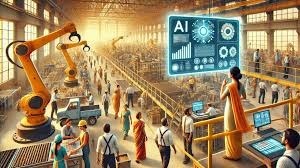
As AI moves beyond factory floors into white-collar domains, India faces a unique challenge: balancing its high-growth services sector with a massive informal workforce. On Tuesday, March 10, 2026, the Indian Council for Research on International Economic Relations (ICRIER) released a policy brief by Payal Malik and Nikita Jain that moves the debate from “apocalyptic job loss” to “strategic choice.”
Add businessleague.in as a Preferred Source


The paper utilizes Indian databases like KLEMS and PLFS to argue that the effect of AI on employment is not predetermined by the technology itself, but by the institutional and policy frameworks India chooses to build today.
Also Read |Tamil Nadu Voter List Purge: 97 Lakh Names Deleted in SIR Phase 1
The Structural Lens: Four Categories of Impact
The researchers categorize the Indian economy into four segments to assess AI’s “adjustment capacity.”
-
Knowledge-Intensive Services: High exposure; AI will likely augment human capabilities but requires rapid upskilling to avoid job nature shifts.
-
Manufacturing: Opportunities for upgrading through “servicification” (integrating services into production) alongside targeted automation.
-
Public/Social Sectors: Potential for massive productivity gains in governance and service delivery.
-
Employment-Intensive/Low-Productivity: Low immediate displacement risk, but high risk of productivity exclusion.
The PIE Framework: A Strategy for Labor
To navigate the transition, ICRIER proposes the Productivity–Inclusivity–Entrepreneurship (PIE) framework:
-
Productivity: Steering AI toward augmentation rather than substitution.
-
Inclusivity: Using Digital Public Infrastructure (DPI) to ensure MSMEs and startups can access AI resources, preventing concentration in “Big Tech.”
-
Entrepreneurship: Incentivizing the creation of new human tasks and occupational categories through incubators and accelerators.
Also Read |Tamil Nadu Voter List Purge: 97 Lakh Names Deleted in SIR Phase 1
Knowledge Services vs. Manufacturing
The paper highlights a divergence in how AI will manifest in different industries. In the IT and knowledge sectors, the demand is shifting toward “hybrid skill profiles”—combining domain expertise with prompt engineering. In manufacturing, AI is seen more as a tool for precision and supply chain optimization, which could paradoxically lead to more high-skill service jobs within factory environments.
Exclusion Risk in Informal Sectors
A primary concern raised is the “automation trap.” In India’s informal and low-skill sectors, the danger isn’t that robots will take jobs tomorrow, but that these workers will be left behind as the rest of the economy accelerates. Without access to shared computing facilities and cloud credits, small players will be unable to participate in the “AI-for-Bharat” dividend.
Reality Check
The ICRIER study is a necessary pivot toward “choice-based” economics. Still, the weak employment elasticity in India (growth not translating to jobs) means that even if AI creates 69 million new tasks globally by 2028, there is no guarantee they will land in India without a radical overhaul of the education system. Therefore, while the PIE model is theoretically sound, its success depends on overcoming the massive skill gap where only a tiny fraction of the current workforce has undergone formal AI training.
The Loopholes
The paper calls for an “AI-for-Labour” model. In fact, this is a “Policy-Lag Loophole”—technology moves at the speed of code, while Indian labor laws and curriculum updates move at the speed of bureaucracy. Therefore, by the time a “Nodal Agency” is fully functional, the first wave of displacement in back-office roles may have already peaked. Still, the “DPI Loophole” remains; leveraging Digital Public Infrastructure is India’s “secret weapon” to democratize AI, potentially allowing a tea-stall owner or a small farmer to use AI tools that were previously only available to Fortune 500 companies.
Also Read |Tamil Nadu Voter List Purge: 97 Lakh Names Deleted in SIR Phase 1
What This Means for You
If you are a professional in the services sector, don’t fear the machine, learn to “pilot” it. First, realize that prompt engineering and data analytics are no longer “extra” skills—they are becoming the baseline for entry-level white-collar work. Then, if you are an MSME owner, understand that access to shared AI infrastructure will soon be a policy right you can demand under the emerging “AI-for-All” framework.
Finally, understand that the “Nature of Work” is shifting. You should expect your role to involve more “supervisory” and “creative” tasks as AI takes over routine data processing. Before you invest in a traditional degree, check for short-term AI-augmentation certifications that align with ICRIER’s findings on “demand for skilled mid-level workers.”
What’s Next
The Ministry of Electronics and IT (MeitY) is expected to review the “Nodal Agency” recommendation by the end of March 2026. Then, look for the rollout of AI-specific DPI modules (like Bhashini for vernacular AI). Finally, expect ICRIER to publish a follow-up case study on the Indian IT sector’s resilience as the 2026 hiring cycle concludes.
Also Read |Tamil Nadu Voter List Purge: 97 Lakh Names Deleted in SIR Phase 1
End…
Add businessleague.in as a Preferred Source

