
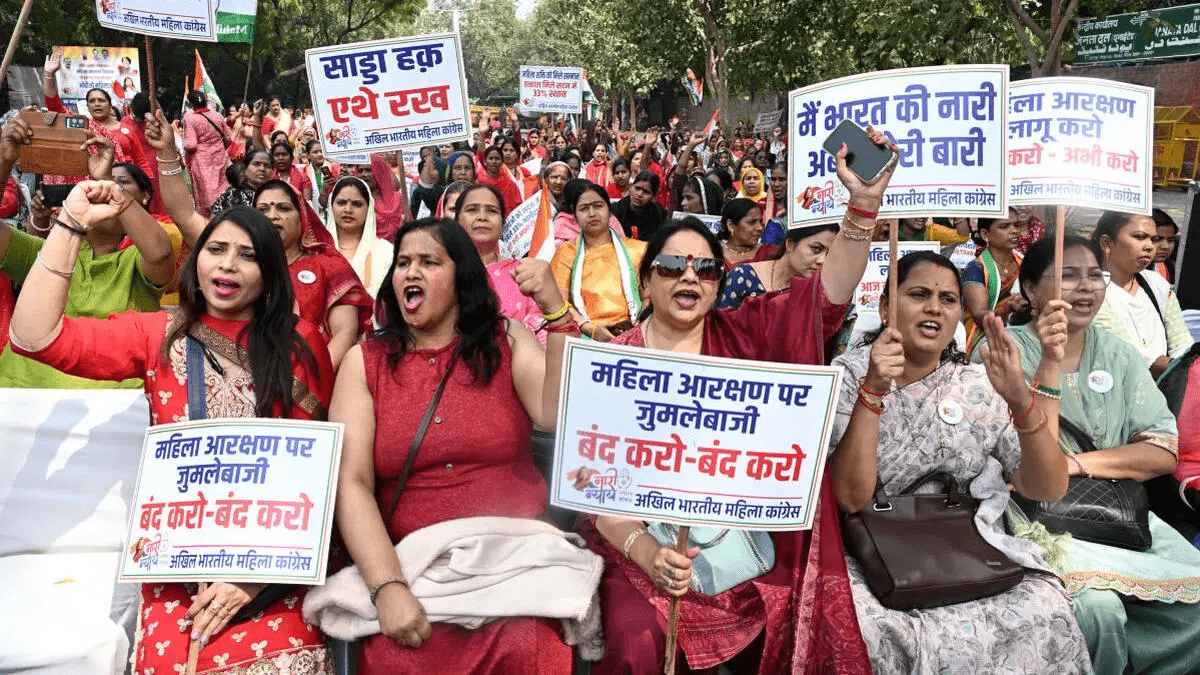
Now the corridors of power are buzzing with a new, high-stakes constitutional maneuver that critics are labeling a “Trojan Horse.” As the government prepares for a special session from April 16–18, the Women’s Reservation Bill delimitation 2026 controversy has taken center stage. First, the stated goal is to advance the implementation of the 128th Amendment Bill for the 2029 Lok Sabha elections. Therefore, the administration is framing this as a historic victory for “Nari Shakti.” Meanwhile, investigative analysts argue that the hidden agenda is to accelerate the redrawing of constituency boundaries—a process previously deferred until after 2031. This move could fundamentally reshape India’s institutional architecture to favor the ruling dispensation.
Add businessleague.in as a Preferred Source


Also Read |Tamil Nadu Voter List Purge: 97 Lakh Names Deleted in SIR Phase 1
The Trojan Horse: Why the Timing Reeks of Cynicism
Now we must analyze the “top-dressing” of this legislative push. First, the special session is being convened just a week before critical assembly polls in Tamil Nadu and West Bengal. Therefore, the timing suggests a tactical move to force Opposition leaders away from the campaign trail.
Next, the government has yet to share the text of the “important Bill” with parliamentarians or the public. Thus, the aura of secrecy fuels suspicions that women’s representation is merely a ploy.
Meanwhile, the strategy appears designed to “wrong-foot” the Opposition. Therefore, the Women’s Reservation Bill delimitation 2026 is being used to create a narrative advantage. So if the Opposition asks for transparency, they are framed as being against the women’s cause.
Unpacking the Modification: Delimitation Meets the 2011 Census
So what is the “catch” hidden in the proposed modification? First, the new Bill reportedly links women’s reservation to a fresh delimitation based on the nearly 15-year-old Census of 2011. Therefore, it bypasses the constitutional provision that prohibits new delimitation before the next official Census data (post-2026).
Next, the plan involves expanding the size of the Lok Sabha by one-and-a-half times. Thus, every state would see a proportionate increase in seats, but the underlying boundaries would be redrawn.
The Delimitation Formula:
-
Census Base: Reverting to 2011 data to justify immediate shifts.
-
Expansion: 50% increase in total Lok Sabha seats.
-
Timeline: Completion of all redrawing before the 2029 elections.
Meanwhile, this move would allow the government to alter the ” institutional architecture” of electoral democracy. Therefore, the Women’s Reservation Bill delimitation 2026 is the engine driving this rushed boundary overhaul.
The Double Deferral: From 2039 to a Rushed 2029
Now let’s look at why this “emergency” is sudden. First, the 2023 amendment built in a “double deferral”—linking reservation to both a new Census and subsequent delimitation. Therefore, it originally seemed that women wouldn’t get their share until at least 2039.
Next, this provided an “assurance” to current male leaders that their careers wouldn’t be affected for another decade. Thus, the sudden rush to implement it by 2029 is a 180-degree turn in policy.
Meanwhile, the Prime Minister claims this “cannot be deferred any longer.” Therefore, the Women’s Reservation Bill delimitation 2026 is being marketed as a correction of past delays. So the question remains: why was it deferred in 2024 but suddenly essential for 2029?
Also Read |Tamil Nadu Voter List Purge: 97 Lakh Names Deleted in SIR Phase 1
Gerrymandering Fears: Lessons from Assam and J&K
So what is the real danger of early delimitation? First, critics point to the recent experiences in Assam and Jammu & Kashmir as templates for “nationwide gerrymandering.” Therefore, there are deep fears that boundaries will be tilted to favor the ruling party.
Next, a fresh delimitation allows for the selective grouping of voter bases. Thus, the BJP could potentially secure a permanent majority by redrawing the very map of Indian democracy.
Meanwhile, the “shouting matches” in Parliament could become even more lopsided if Hindi-speaking states gain numerical superiority through these shifts. Therefore, the Women’s Reservation Bill delimitation 2026 is viewed as a tool for political hubris. So the “Nari Shakti” label might just be the wrapping for a very different package.
Article 334A: The Simple Path vs. The Complex Ploy
Now we should consider the alternative. First, if the government truly wanted to advance women’s representation, they could simply repeal Article 334A(1). Therefore, the link to the Census and delimitation would be broken instantly.
Next, a simple amendment could provide for fixing women’s seats by a draw of lots for 2029. Thus, no complex redrawing of boundaries would be required.
The Simple Route:
-
Repeal: Remove the linkage to Census/Delimitation in Article 334A.
-
Implementation: Use a draw of lots for existing seats in 2029.
-
Consensus: Accept the long-standing demand for an OBC sub-quota.
Meanwhile, the government has chosen the more complex, contentious path. Therefore, the Women’s Reservation Bill delimitation 2026 is likely about the “delimitation” half of the equation rather than the “women” half.
The Federal Compact: Hindi vs. Non-Hindi State Representation
So what happens to the balance between states? First, if delimitation is based on 2011 population proportions, it could abrogate the “unwritten federal compact” that holds the Union together. Therefore, states that successfully controlled their population (mostly in the South) would be punished with less representation.
Next, increasing the numerical difference between Hindi and non-Hindi states would alter the core nature of our Union. Thus, the move risks alienating large swaths of the country.
Meanwhile, the government may argue that a proportionate increase maintains the balance. Therefore, the Women’s Reservation Bill delimitation 2026 is a test of India’s federal resilience. So the “rush” does not augur well for the diverse interests of the state.
Also Read |Tamil Nadu Voter List Purge: 97 Lakh Names Deleted in SIR Phase 1
Opposition Dilemma: Peak Campaign Distractions in WB and TN
Now we must analyze the “cynicism” of the schedule. First, the special session is set for April 16, just as the West Bengal and Tamil Nadu assembly polls hit their peak. Therefore, every Opposition MP sitting in Delhi is an MP not campaigning in their home state.
Next, this forces a choice: stay and fight for the “Federal Compact” in Parliament, or leave and risk being labeled as “anti-women.” Thus, it is a masterclass in political maneuvering.
Meanwhile, the lack of an all-party meeting proves that a “spirit of consensus” is not the goal. Therefore, the Women’s Reservation Bill delimitation 2026 is being used as a tactical hammer. So the “femocratic” legitimation is being used for purely ulterior motives.
Social Justice or Slogans? The Missing OBC Sub-Quota
Finally, what about the “egalitarian” promise? First, the current provision lacks a cross-cutting reservation for the OBCs within the one-third quota. Therefore, the “social justice” mentioned by the PM remains a slogan rather than a reality for millions.
Next, the Opposition has consistently demanded this sub-quota to ensure that the reservation doesn’t just benefit the elite. Thus, its absence is a major point of friction.
The Social Justice Gap:
-
SC/ST: Current provision includes a sub-quota.
-
OBC: Completely excluded from the internal reservation.
-
Elite Bias: Risk of the “top-dressing” only benefiting a small segment of women.
Meanwhile, the government remains silent on this specific demand. Therefore, the Women’s Reservation Bill delimitation 2026 is seen as an incomplete project of empowerment. So the “work culture” of equality is still missing its most inclusive piece.
Common Questions Answered
What is the Women’s Reservation Bill delimitation 2026 controversy? Now it centers on the government linking women’s quotas to an early redrawing of constituency boundaries based on the 2011 Census. Therefore, critics fear it is a ploy for gerrymandering.
Why is there a special session from April 16–18? First, to pass a constitutional amendment that advances the implementation of women’s reservation to 2029. Thus, it moves the timeline up from 2039.
What is Article 334A? Next, it is the provision that linked women’s reservation to the completion of the next Census and delimitation. Therefore, it acted as a “double deferral” mechanism.
How does this affect Hindi and non-Hindi states? So an early delimitation could increase the representation of Hindi-speaking states relative to the South. Thus, it risks breaking the federal compact of the Union.
Why is the Opposition calling it a ‘Trojan Horse’? Finally, because the Bill’s text is secret, and the timing disrupts ongoing assembly polls. So they believe the “Nari Shakti” label masks a move to secure a permanent majority for the BJP.
Will there be an OBC sub-quota? Actually, the current Bill does not include an OBC sub-quota. Therefore, it remains a major point of contention between the government and the Opposition.
Also Read |Tamil Nadu Voter List Purge: 97 Lakh Names Deleted in SIR Phase 1
End…
Add businessleague.in as a Preferred Source
🙏 Support Independent Journalism
We keep news free for you.
Most readers support with ₹500 ❤️
or scan QR below

Voluntary contribution. No tax benefits.
DISCLAIMER
We have taken all measures to ensure that the information provided in this article and on our social media platform is credible, verified and sourced from other Big media Houses. For any feedback or complaint, reach out to us at businessleaguein@gmail.com