


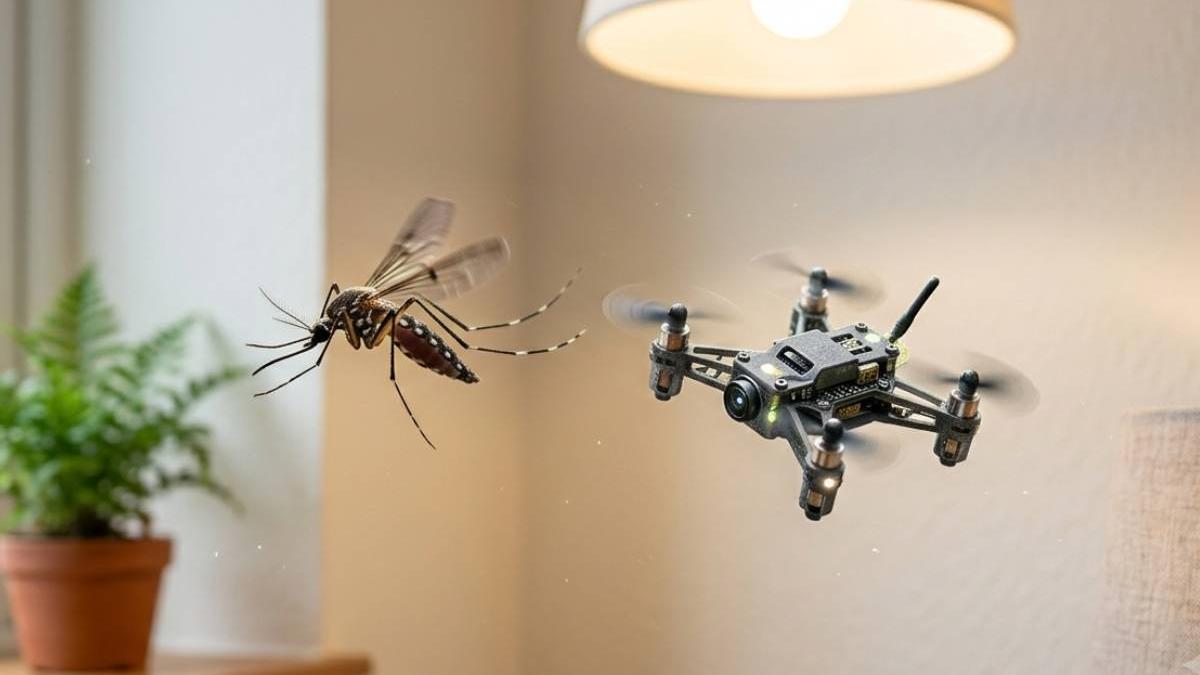
Built by US startup Tornyol, the palm-sized quadcopter uses car-style ultrasonic sonar and miniature microphones to track unique wingbeat signatures without relying on cameras.
SAN FRANCISCO — In what plays out like a scene ripped straight from a futuristic Hollywood screenplay, technology is taking a decidedly aggressive turn against one of humanity’s most persistent and deadly pests. Tornyol, a San Francisco-based hardware startup backed by elite accelerator Y Combinator, has announced the first successful autonomous mid-air intercept by its signature 40-gram micro-drone.
Add businessleague.in as a Preferred Source


Company co-founder Alex Toussaint shared video evidence of the milestone on social media, showcasing a palm-sized prototype tracking, chasing, and colliding with a flying moth in a controlled testing environment. While a moth served as the initial proof-of-concept target, Tornyol’s ultimate objective is to deploy swarms of these miniature aerial sentries to completely clear urban zones of disease-carrying mosquitoes without spraying a single drop of chemical insecticide.
1. Ditching Cameras for Sound: How the Tech Works
Most autonomous aircraft navigate using optical cameras, which struggle heavily when tracking tiny, erratic targets like insects in shifting lighting conditions. To circumvent this, Tornyol’s engineers engineered a system that mimics a bat’s echolocation. The 40-gram drone—roughly the weight of a standard golf ball—recommissions ordinary smartphone components and vehicle parking sensors to navigate.
🎛️ The Sensor Array:
🔊 Ultrasonic Phased-Array Sonar ➔ Emits high-frequency pulses to paint a physical map of the room.
🎙️ Smartphone Microphones       ➔ Listens carefully for acoustic feedback and insect noise.
🧠 Custom Signal AI             ➔ Isolates the unique Doppler shift created by moving wings.
By measuring the precise frequency of the wingbeats, the onboard system can theoretically differentiate between a harmful mosquito, a harmless housefly, or a ecologically beneficial honeybee—preventing collateral damage to local ecosystems. Once a target is identified, the drone closes the gap and uses its high-speed plastic propellers to shred the insect mid-flight.
2. Moving From the Laboratory to the Real World
While the automated hit marks a massive leap forward for miniature autonomous flight, the company acknowledges that significant development hurdles remain before consumer deployment. The July 14 test operated on a “hardware-in-the-loop” setup. External infrared motion-capture cameras and a standalone computer processed the data before sending flight corrections back to the drone.
System Comparison: Current Prototype vs. Final Planned Commercial Release
| System Feature | Laboratory Test Phase (Current) | Final Targeted Commercial Build |
| Sensing & Data Processing | Handled by external tracking cameras and an offboard computer. | Fully embedded, independent onboard chips handling all calculations. |
| Target Size Baseline | Large, slower-moving moths inside a clean, white test room. | Tiny, ultra-fast mosquitoes navigating windy, complex outdoor spaces. |
| Flight Autonomy Limit | Highly restricted range tied to external signal loops. | 3 to 5-minute autonomous patrols before landing on a pod base station to recharge. |
The Planned Operation Blueprint for Tornyol Fleets
The company’s vision transitions the traditional reactive pest control model into a continuous, network-driven defensive perimeter.
📈 Economic and Public Health Potential: Mosquito-borne illnesses like malaria and dengue are linked to roughly 700,000 deaths annually on a global scale. Tornyol frames its autonomous fleet concept as a massive cost-saving measure for public health, claiming that a network of just 10 micro-drones could effectively protect a full square kilometer of an urban area at a fraction of the cost of current larvicide programs. Preorders have officially opened with a refundable deposit ahead of a targeted US release, giving consumers a choice between a flat hardware buyout or an ongoing monthly subscription model.
Add businessleague.in as a Preferred Source

