Financial Strangulation: US Naval Blockade of Iranian Ports Cuts Oil Revenue by $5.8 Billion
Washington’s aggressive maritime dragnet forces an unprecedented 84% collapse in crude exports, leaving millions of barrels stranded in floating sea storage as ceasefire talks lock down.
Add businessleague.in as a Preferred Source


A continuous US naval blockade of Iranian ports has severely impacted the Islamic Republic’s core financial networks. It has forced crude oil exports down to their lowest level in more than six years and cost Tehran an estimated $5.8 billion in lost maritime trade revenue over the last two months alone. The aggressive maritime containment strategy, launched under direct orders from President Donald Trump, is shifting the dynamic of regional ceasefire negotiations by cutting off the funds needed to sustain Iran’s domestic wartime economy.
The unilateral blockade was implemented on April 13, 2026, as part of a high-pressure campaign to force Tehran into accepting strict, long-term conditions for a permanent peace treaty following weeks of direct military conflict. While Iranian diplomats have denounced the interception and diversion of its commercial cargo ships as an illegal act of state-sponsored piracy, US Central Command (CENTCOM) war vessels have maintained a tight operational line, cutting off access for the state’s traditional shadow-fleet tankers and international buyers.
Also Read | Viral Trump Lookalike Buffalo Rescue: Saved From Eid Sacrifice
From Market Boom to Absolute Export Collapse
The dramatic decline in oil revenues underscores the effectiveness of modern naval interdiction when deployed against economies reliant on raw commodity exports. Before the blockade took effect, Tehran had successfully capitalized on the energy market chaos it helped create. Following the outbreak of multi-nation hostilities on February 28, Iran restricted access through the vital Strait of Hormuz, causing global energy benchmarks to spike and temporarily pricing out rival Gulf exporters like Saudi Arabia and the UAE.
However, that initial economic advantage completely disappeared once the US Navy established its maritime line.
According to shipping tracking matrices and regional trading ledgers, Iranian crude and condensate exports plummeted from a comfortable average of 1.84 million barrels per day (bpd) in March to less than 300,000 bpd by the end of May. Evaluating these figures against a conservative market benchmark of $90 per barrel, daily oil revenues crashed from roughly $165 million down to a mere $27 million—representing a massive 84% reduction in direct cash generation within a 60-day window.
Millions of Barrels Stranded in Floating Sea Storage
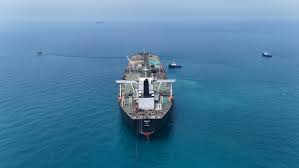
Because state-backed oil rigs cannot instantly halt extraction without risking permanent structural damage to underground reservoirs, Iran has been forced to store its unsold crude on its domestic tanker fleet. The resulting logistical bottleneck has turned parts of the Persian Gulf into an expansive parking lot for stranded vessels.
| Maritime Storage Sector Location | Stranded Volume Assets | Current Operational Status & Constraints |
| Total Global Floating Storage | ~147 Million Barrels | Loaded onto dark-fleet tankers; experiencing high maintenance insurance premiums. |
| Stranded Inside the Persian Gulf | ~67 Million Barrels | Anchored securely behind the active US Navy interdiction line. |
| Onshore Tank Terminal Reserves | Near Absolute Capacity | Kharg Island holding facilities full; bottlenecking interior production pipelines. |
The restricted shipping routes have cut off access to key Asian trade hubs, leaving China—Tehran’s largest trading partner—unable to receive its typical monthly crude allocations.
Also Read | Viral Trump Lookalike Buffalo Rescue: Saved From Eid Sacrifice
A Battle of Macroeconomic Endurance
The primary question facing international intelligence desks is one of pure economic endurance. While the loss of billions in oil revenues limits Iran’s ability to fund its regional military proxies, the ongoing closure of the Strait of Hormuz continues to squeeze the global economy.
Because roughly 20% of global petroleum and liquefied natural gas (LNG) supplies flow through this single narrow waterway, keeping alternative Gulf producers from exporting at maximum capacity preserves an uncomfortably high floor for international energy prices.
Diplomatic Standoff: US Secretary of State Marco Rubio reinforced Washington’s unyielding position during a Senate foreign relations hearing this week, stating that the naval dragnet will remain active until the shipping lanes are cleared of hostile infrastructure. “If they are going to shut down the Strait for everybody, we are going to shut down the Strait for them,” Rubio clarified.
With indirect, Pakistan-mediated peace talks stalled over Western demands regarding uranium enrichment limits, the open-ended blockade functions as a continuous economic vice. If the current export restrictions continue through the summer, the severe lack of incoming foreign currency will likely trigger rapid domestic inflation across Iran, forcing its leadership to choose between long-term economic collapse or signing a comprehensive peace agreement on Washington’s terms.
FAQ Section
Why did the United States launch a naval blockade against Iranian ports?
The United States deployed its naval forces on April 13, 2026, to cut off Iran’s primary economic revenue stream. The strategic goal is to apply maximum financial pressure to force Tehran into signing a comprehensive peace treaty that includes strict limits on its nuclear enrichment programs.
How much oil revenue has Iran lost due to the maritime blockade?
During the months of April and May 2026 alone, the blockade cost Tehran an estimated $5.8 billion in lost crude oil revenues, dropping its daily export income by 84% as shipments fell below 300,000 barrels per day.
What is happening to the unsold oil that Iran is still producing?
With its primary export lines blocked, Iran has been forced to store its excess crude at sea. Roughly 147 million barrels of oil are currently held in floating storage aboard commercial tankers, with 67 million barrels stuck inside the Persian Gulf and Gulf of Oman.
Also Read | Viral Trump Lookalike Buffalo Rescue: Saved From Eid Sacrifice
End…
Add businessleague.in as a Preferred Source
🙏 Support Independent Journalism
We keep news free for you.
Most readers support with ₹500 ❤️
or scan QR below

Voluntary contribution. No tax benefits.
DISCLAIMER
We have taken all measures to ensure that the information provided in this article and on our social media platform is credible, verified and sourced from other Big media Houses. For any feedback or complaint, reach out to us at businessleaguein@gmail.com