


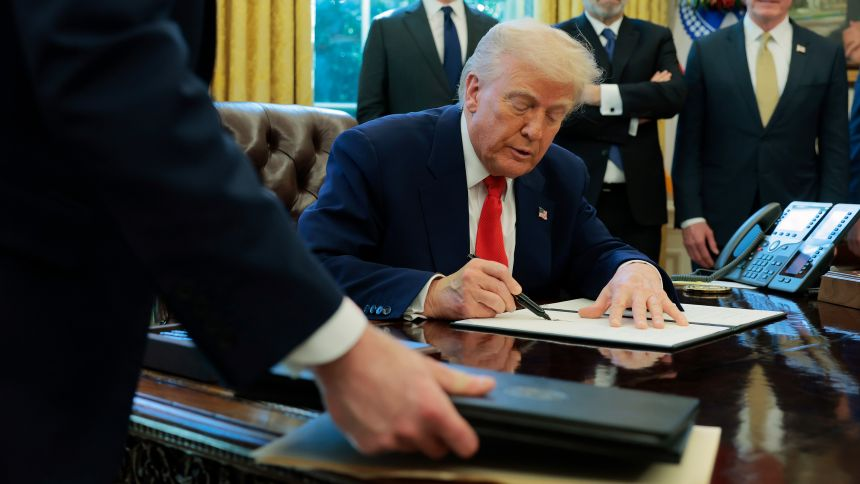
Now the delicate boundaries separating supreme federal executive authority from private financial market speculation are facing an unprecedented institutional stress test. Official compliance documents released by the U.S. Office of Government Ethics (OGE) reveal that President Donald Trump executed a staggering 3,642 distinct securities transactions during the first three months of the year. Therefore, the immense scale of this trading blitz has sent deep shockwaves through traditional Washington oversight committees and veteran Wall Street compliance desks alike. Meanwhile, aggregate volume metrics across the 113-page filing locate the total capital movement somewhere between $220 million and $750 million. Following these disclosures, the systematic accumulation of tech and defense assets has evolved into a central flashpoint for transparency advocates.
Add businessleague.in as a Preferred Source


Also Read |Tamil Nadu Voter List Purge: 97 Lakh Names Deleted in SIR Phase 1
The Algorithmic Flurry: Breaking Down the Unprecedented 3,642 Transactions
Now the absolute frequency of the trading patterns documented inside the federal filings breaks with all established historical presidential precedents. Wall Street asset managers are noting that executing roughly 60 trades per business session mirrors the behavior of institutional desks. Therefore, retail tracking boards are scrambling to decode the underlying intent of the massive capital reallocation program.
First, the sheer velocity of the transactions instantly surprised long-term market monitors. Matthew Tuttle, the Chief Executive Officer of Tuttle Capital Management, explained to Bloomberg that the volume resembles an algorithm-driven hedge fund setup. Tactics like this imply a highly dynamic asset rotation model that capitalizes on micro-movements across core economic sectors.
So the massive transaction volume stands in sharp contrast to the opening months of his second administration term. Back then, the executive portfolio prioritized steady fixed-income instruments and steered completely clear of individual equities. Meanwhile, the current approach exposes hundreds of millions of dollars directly to private market fluctuations. Therefore, the OGE filing establishes an intensely active financial profile for the current president.
Perfect Policy Timing: Parsing the Nvidia and AMD Semiconductor Purchases
Nowhere does the structural overlap between federal statecraft and private equity growth generate more intense scrutiny than within the global technology theater. The official disclosure sheets show that the portfolio executed highly precise, multi-million dollar accumulation loops targeting top-tier silicon designers. Therefore, the timing of these buys has triggered intense policy debates inside Washington.
First, records show a major Nvidia stock buy, valued between $500,000 and $1 million, was securely processed on January 6. Next, precisely one week later, the Commerce Department officially green-lit specific chip export exceptions allowing sales to Chinese buyers. Thus, the mechanical necessity of tracking export changes was perfectly anticipated by the portfolio’s automated managers
[January 6, 2026] ──► Seven-Figure Nvidia Stock Position Opened Legally
         │
         ▼ (Exactly One Week Later)
[January 13, 2026]──► Commerce Department Approves China Advanced Chip Export Waivers
         │
         ▼
[Market Expansion]──► Nvidia Shares Move Substantially Higher on Global Exchanges
So an identical structural pattern manifested within advanced holdings targeting Advanced Micro Devices (AMD) during the exact same processing window. A separate $1 million to $5 million Nvidia block was also recorded on February 10, mere days before a massive cloud delivery infrastructure deal with Meta went public. Meanwhile, opposition ethics panels are demanding an audit of internal department communication channels. Therefore, the semiconductor timing remains a central pillar of the ongoing controversy.
The Defense Pipeline: Tracking Palantir and Axon Institutional Windsor Deals
Now the financial tracking extends deeply into sectors that rely entirely on federal appropriations and domestic law enforcement procurement choices. The OGE documents reveal that the portfolio established an early, aggressive entry point into advanced data analytics and security hardware providers. Therefore, the commercial windfalls flowing to these specific brands are facing intense public analysis.
-
Strategic Defense Asset Placements:
-
Palantir Technologies: A minimum $260,000 accumulation path initiated early on January 6.
-
Axon Enterprise: Large-scale seven-figure buying options processed smoothly on February 10.
-
The DHS Catalyst: Palantir landed a $1 billion software contract to support border management logistics in February.
-
The ICE Mandate: Immigration enforcement announced a massive $220 million long-term procurement contract for Axon hardware.
-
First, these highly lucrative agency allocations instantly escalated the underlying value of both technical brands on Wall Street boards. Next, the close integration between the chosen platforms and the administration’s core policy initiatives raises deep structural conflict questions. Thus, the defense pipeline demonstrates how direct executive mandates can interact with corporate equity values.
Also Read |Tamil Nadu Voter List Purge: 97 Lakh Names Deleted in SIR Phase 1
The Dell Controversy: Seven-Figure Bets Ahead of Public Endorsements
Now the single most intensely debated transaction sequence within the entire 113-page filing involves an elite computing hardware legacy giant. The regulatory sheets clarify that beginning on February 10, the portfolio executed multiple seven-figure purchases of Dell Technologies shares. Therefore, market players are scrutinizing the subsequent public interactions connecting the executive branch to the company’s founders.
First, look at the timeline: following the heavy position-building phase, the president publicly praised Dell’s manufacturing infrastructure during an open White House press event on May 8. Next, the firm’s common equity tokens jumped by approximately 12 per cent within a single trading session post-speech. Thus, the mechanical necessity of separating private asset ownership from the power of the bully pulpit was severely strained.
So the narrative encounters further complexity due to external corporate philanthropic patterns logged late last year. The Dell family had separately finalized a massive $6.25 billion donation targeting the administration’s core retirement initiative back in December 2025. Meanwhile, government watchdog groups are utilizing this specific timeline to argue that the current STOCK Act guardrails provide zero real defense against executive insider benefits.
Crypto Inflows: Leveraging the Pro-Digital Asset Executive Framework
Now the structural diversification of the presidential holdings has also successfully expanded into the decentralized financial ecosystem. The OGE filings indicate that the portfolio established meaningful positions inside top-tier cryptocurrency infrastructure networks during the early winter months. Therefore, the administration’s intensely pro-crypto executive orders are running completely parallel to private asset accumulation.
The Digital Asset Positioning Matrix:
-
The Infrastructure Base: Seven-figure securities purchases tracking directly into Bitcoin miner MARA Holdings.
-
The Liquidity Gateways: Direct position allocations established inside Coinbase and Robinhood platforms.
-
The Trustee Catalyst: Robinhood was designated as the foundational trustee for the newly launched “Trump Account” federal retirement plan.
-
The Market Response: Digital asset valuations scaled vertically following the launch of a national strategic Bitcoin reserve.
First, this aggressive entry into blockchain enterprises guarantees that the portfolio benefits directly from the ongoing structural deregulation of digital finance. Next, selecting specific private platforms to manage state-sponsored retirement portals creates immense volume boosts for those chosen corporate partners. Thus, the crypto inflows perfectly capture the administration’s broader economic philosophy.
The Blind Trust Debate: Dissecting the Trump Family Management Architecture
Now the underlying governance challenge fueling this national debate stems from a deep departure from traditional executive arrangements. Ever since the Lyndon Johnson administration, modern American presidents have systematically placed their private fortunes into absolute blind trusts managed entirely by independent outside custodians. Therefore, the current framework draws consistent fire from transparency monitors.
-
The Trump Organization Management Layout:
-
Trustee Identity: Assets are legally held inside a trust administered primarily by Donald Trump Jr.
-
Executive Re-Entry: The trust clauses permit the president to resume absolute direct management at any chosen hour.
-
Policy Overlap: Family business operations continue to actively move forward in sectors directly affected by federal rulings.
-
Ethics Loophole: Avoids using independent financial managers who operate completely isolated from family communication channels.
-
First, this customized layout means that the principal beneficiary maintains total visibility regarding his underlying wealth structure. Next, critics like Donald K. Sherman of CREW argue that the design intentionally prioritizes private asset accumulation over public accountability standards. Thus, the lack of an authentic blind trust perimeter keeps conflict-of-interest concerns continuously active across the capital.
Also Read |Tamil Nadu Voter List Purge: 97 Lakh Names Deleted in SIR Phase 1
The Index Defense: Analyzing the White House Index Replication Counter-Narrative
Now in the face of escalating criticism from congressional committees, the White House has deployed a highly technical asset management defense. Senior spokespersons directed all incoming media inquiries directly to the headquarters of the Trump Organization in New York. Therefore, the administration is attempting to de-politicize the trading data by describing the volume as entirely automated.
First, corporate representatives emphasized that neither the president nor his immediate relatives possess any advance knowledge of individual daily trades. Next, the legal team asserted that the accounts are managed exclusively through fully discretionary programs running index replication models. Thus, they argue that the high transaction frequency is merely the mechanical necessity of an algorithmic software stack matching broader market baskets.
So the automated narrative aims to neutralize accusations of direct insider positioning ahead of sensitive cabinet votes. Meanwhile, quantitative finance experts point out that index-tracking funds rarely execute highly concentrated, seven-figure single-day bets on specific defense or semiconductor names. Therefore, the index defense sets up a highly sophisticated debate that will continue to challenge federal ethics investigators through the upcoming legislative sessions.
FAQ: Understanding the President’s Historic 2026 Financial Disclosures
1. How many stock trades did President Trump disclose for the first quarter of 2026?
Now, the official Office of Government Ethics (OGE) documents reveal that the portfolio executed a total of 3,642 securities transactions during Q1.
2. What is the total estimated value of the stock trades uncovered in the filings?
First, the aggregate financial volume of the disclosed trades spans dynamically between a minimum of $220 million and $750 million.
3. Which specific tech and semiconductor stocks were heavily accumulated?
So, the filings document extensive seven-figure position building inside premier tech leaders, including Nvidia, Oracle, Broadcom, and AMD.
4. Why are ethics watchdogs concerned about the timing of these stock trades?
Next, several major transactions occurred mere days before major federal policy actions, such as the Commerce Department green-lighting Nvidia and AMD chip exports to China.
5. How are the president’s private investments currently managed while he is in office?
Now, his assets are held within a trust managed by his son, Donald Trump Jr., which critics note allows the president to resume direct control at any time rather than utilizing a true blind trust.
6. What official explanation did the Trump Organization provide for the trading volume?
Finally, a spokesperson asserted that the holdings are run by third-party financial managers using automated systems that replicate recognized market indexes, meaning neither Trump nor his family direct individual trades.
Also Read |Tamil Nadu Voter List Purge: 97 Lakh Names Deleted in SIR Phase 1
End….
Add businessleague.in as a Preferred Source

