


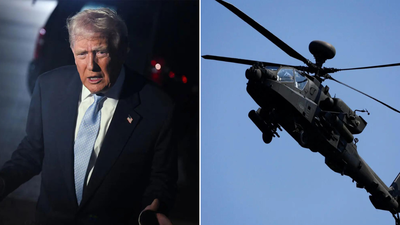
Fighter jets pound coastal air defense lines and radar nets after an innovative Task Force 59 sea-drone operation rescues two downed American pilots off the coast of Oman.
Add businessleague.in as a Preferred Source


The volatile, high-stakes military stand-off in West Asia has escalated into direct kinetic warfare. Following a directive issued by President Donald Trump, the United States Central Command (CENTCOM) launched a sweeping wave of targeted US strikes Iran Strait of Hormuz 2026 operations on Tuesday evening. The aerial bombardment targeted Iranian military positions along the Islamic Republic’s southern coastline, hitting back after an American attack helicopter went down in the strategic waterway.
The retaliatory strikes began precisely at 5:00 PM US Eastern Time (2100 GMT), utilizing a mix of advanced Air Force and Navy fighter jets deployed across regional airbases and aircraft carriers. Speaking to ABC News shortly after the aircraft returned to formation, President Trump characterized the military deployment as an absolute necessity.
“I believe the response should be very strong, very powerful, and that’s what this one is,” Trump stated, confirming the targets were chosen to cripple localized anti-aircraft infrastructures.
Also Read | Viral Trump Lookalike Buffalo Rescue: Saved From Eid Sacrifice
The Mid-Air Collision and the Historic Sea-Drone Rescue
The immediate trigger for the localized war wave occurred on Monday evening. A U.S. Army AH-64 Apache attack helicopter was executing a routine patrol mission over the Strait of Hormuz—enforcing Washington’s strict blockade on Iranian crude oil shipments—when it collided with an Iranian surveillance drone. The impact forced the helicopter down into the waters near Oman’s coast.
In a historic milestone for autonomous military logistics, the rescue of the two stranded aviators was executed entirely by an uncrewed surface vehicle. Operating under the command of the U.S. Navy’s specialized Task Force 59, an autonomous 24-foot “Corsair” drone boat manufactured by Saronic Technologies successfully located the pilots in the dark, pull-housing them aboard before they were safely hoisted to a hovering transport helicopter. Both crew members are in stable, uninjured condition.
Mapping the Target Footprints Along the Coastal Strip
The precision strikes hit roughly 20 distinct targets located across the shoreline of Hormozgan province. According to official CENTCOM damage briefs and Iranian news agency logs, the primary ordnance targeted structural command systems rather than civilian housing areas.
| Target Geographic Zone | Confirmed Impact Type | Structural Infrastructure Hit | Reported Local Status |
| Qeshm Island Facility | Precision Guided Ordnance. | Surveillance radar installations and tracking hubs. | Air defenses activated; extensive structural damage logged. |
| Bandar Abbas Port Outer Grid | Multi-Jet Missile Wave. | Mobile ground-control stations and communication lines. | Continuous explosions reported across primary naval bases. |
| Sirik County (Bemani Sector) | Surface Bombardment. | Tactical air defense batteries and two clean water storage tanks. | Ground structures fully leveled; local supply loops disrupted. |
| Jask County Entrance Node | Multi-Screener Kinetic Attack. | Deep-fringe tracking arrays and maritime radars. | Shook regional coastlines, forcing local evacuations. |
The sudden multi-city bombardment immediately triggered widespread panic across Iran’s southern shipping terminals, with state broadcaster IRIB confirming that automated air defense networks were fired rapidly across the coast to counter the incoming supersonic fighter groups.
Also Read | Viral Trump Lookalike Buffalo Rescue: Saved From Eid Sacrifice
The Regional Backlash: Base Bombardments and Ceasefire Threats
The immediate impact of the American airstrikes has severely threatened a shaky, two-month-old regional ceasefire that had held precariously since early April. Iran’s military command launched an immediate counter-strike, using the Khatam al-Anbiya joint command center to target U.S. and allied installations across the Middle East.
The Islamic Revolutionary Guard Corps (IRGC) claimed it hit 21 separate American military targets. This counter-offensive included a drone strike against the U.S. Fifth Fleet headquarters in Bahrain, which forced the local interior ministry to sound public air-raid sirens, though local officials claim the incoming targets were successfully shot down by air defense barriers.
Concurrently, Israeli Army Commander Eyal Zamir warned that Israel’s defense forces stand fully prepared to leverage this distraction to strike a “much more significant and powerful blow” against Iran’s domestic nuclear enrichment networks.
With energy secretary Chris Wright confirming that global shipping traffic through the Strait of Hormuz is facing massive security premiums, the next 48 hours will be critical for international mediators. Analysts are working behind the scenes to restore the fragile truce before this tit-for-tat cycle pulls the entire region into an all-out, unmanageable war.
FAQ Section
What caused the US strikes Iran Strait of Hormuz 2026 operations?
The strikes were ordered by President Donald Trump in direct retaliation for the downing of a U.S. Army AH-64 Apache attack helicopter over the Strait of Hormuz. The helicopter crashed after colliding with an Iranian surveillance drone while executing a maritime blockade patrol.
What specific targets were hit inside southern Iran?
The U.S. military targeted nearly 20 high-value military installations across Hormozgan province. These included active air defense batteries, ground-control communication stations, and surveillance radar nets across Qeshm Island, Bandar Abbas, Sirik, and Jask.
How were the two downed American pilots rescued from the water?
The two pilots were pulled from the Gulf waters in a historic operation executed by the U.S. Navy’s Task Force 59. An autonomous, 24-foot “Corsair” drone boat located the aviators within two hours of the crash, providing safe extraction before transferring them to a recovery helicopter.
Also Read | Viral Trump Lookalike Buffalo Rescue: Saved From Eid Sacrifice
End…
Add businessleague.in as a Preferred Source

