


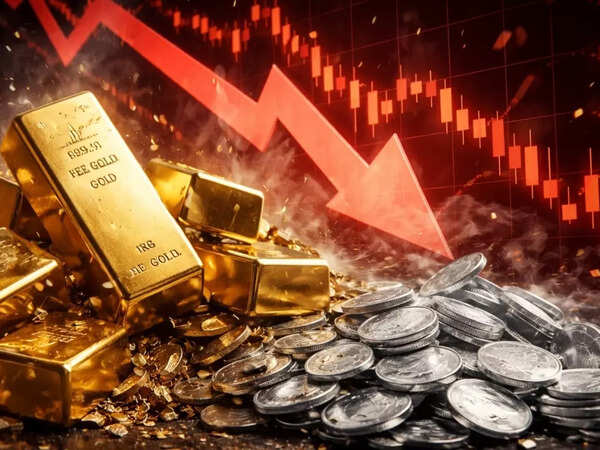
A surging greenback, hawkish signals from the Bank of Japan, and strong U.S. macro data spark a multi-asset liquidation wave, overriding the immediate safe-haven premium of the widening US-Iran conflict.
Add businessleague.in as a Preferred Source


The historic bull run that pushed precious metals to record-breaking peaks across the sub-continent has experienced a sudden disruption. In a high-volume trading session on Wednesday, June 10, 2026, multi-asset portfolio managers triggered a major liquidation wave, resulting in a dramatic gold silver price fall India 2026 event. The correction pushed domestic gold futures out of their multi-week consolidation zones, dragging the yellow metal cleanly below the psychologically significant baseline of ₹1.5 lakh per 10 grams.
The verified market tracking logs highlight an aggressive cross-commodity sell-off. Standard domestic gold contracts plummeted by ₹2,677 or 1.76%, settling at ₹1,49,766 per 10 grams.
Concurrently, the destruction across the industrial silver sector was even more pronounced. Physical silver contracts crashed by a staggering ₹4,347 or 1.82%, closing the evening session at ₹2,34,181 per kilogram. This correction marks an 11-week low that has reshaped immediate support-level projections across major wealth management firms.
Also Read | Viral Trump Lookalike Buffalo Rescue: Saved From Eid Sacrifice
The Macroeconomic Catalyst: The Three-Front Monetary Shock
The primary driver behind this sudden commodities retreat is not a reduction in physical demand, but a fundamental realignment of international monetary policy expectations.
Stronger-than-expected labor data coming out of the United States, paired with high existing home sales metrics, has completely upended Wall Street’s previous economic assumptions.
According to data pulled from the CME FedWatch Tool on Wednesday afternoon, international fixed-income desks are now pricing in a greater than 70% probability of an absolute Federal Reserve interest rate hike by December 2026.
Because gold and silver function as non-yielding assets that do not provide fixed coupon payouts, they face immediate competitive headwinds when sovereign bond yields step higher. This asset rotation has pushed global spot gold down by 1.9% to hover near $4,181 per ounce, while August delivery futures settled low at $4,204.70.
Geopolitical Friction: The US-Iran Conflict Vector
What makes this commodities crash unique is that it occurred right alongside a major escalation of armed conflict in the Middle East. Following the downing of a US Army Apache helicopter near the Strait of Hormuz on Monday, American forces launched powerful retaliatory strikes against Iranian air defenses and port installations in Bandar Abbas and Qeshm Island.
Tehrak’s forces hit back immediately, launching missile barrages against a U.S. military base in Jordan and 21 other Gulf locations.
Normally, an open exchange of fire between nuclear and regional powers would trigger an immediate rush into safe-haven assets, driving gold prices up. However, the market dynamics of this conflict have had the opposite effect.
The escalating border skirmishes have pushed crude oil prices significantly higher, sparking fears of a fresh wave of global inflation. This inflation risk reinforces expectations that central banks will maintain tighter monetary policies and higher interest rates for a longer period, neutralizing gold’s traditional safe-haven appeal and exposing it to broad-based institutional liquidation.
Also Read | Viral Trump Lookalike Buffalo Rescue: Saved From Eid Sacrifice
Technical Support Profiles and the Base Metals Split
A comprehensive technical study released by Kotak Neo Commodity Research shows that the selling pressure extended well beyond the borders of India.
| Precious & Base Metal Class | International Spot Pricing | Single-Session Drop Magnitude | Next Immediate Floor Support Target |
| Spot Gold (XAU/USD) | $4,181 per Ounce | Slipped by 1.90% overall. | Critical trend line pivot fixed at $4,100. |
| Spot Silver (XAG/USD) | $64.01 per Ounce | Plunged 2.10% mid-session. | Standard moving-average shelf at $61.50. |
| Platinum Bullion | $1,667.92 per Ounce | Tumbled by 3.40% sharply. | Support testing limits near $1,610. |
| Palladium Elements | $1,204.24 per Ounce | Down 1.50% in the day. | Long-term accumulation valley at $1,150. |
| Industrial Copper | $13,615 per Tonne | Held relatively stable. | Supported by long-term structural AI demand. |
While precious metals faced steady liquidation, the industrial base metals market showed considerable resilience. Copper prices stabilized near $13,615 per tonne, bucking the downward trend.
This stability is driven by massive, multi-year demand forecasts linked directly to global artificial intelligence infrastructure development. China’s recent announcement of a targeted 2 trillion yuan investment in data center infrastructure has assured base metal producers of a steady demand pipeline for high-grade copper wiring, balancing out near-term macroeconomic pressures.
With all eyes now fixed on the upcoming U.S. Consumer Price Index (CPI) inflation print, commodities traders are preparing for further market swings. If the inflation figures come in hotter than expected, it will provide further ammunition for the Federal Reserve’s hawkish policy path.
This scenario could trigger a secondary drop below the $4,100 support shelf, forcing retail savers who accumulated gold during recent geopolitical spikes to brace for an extended period of market corrections through the end of the year.
FAQ Section
What primary factors caused the sudden gold silver price fall India 2026 event?
The primary driver of the price drop is a hawkish shift in global interest rate expectations, accelerated by strong U.S. labor and housing market data. This data convinced more than 70% of traders that the Federal Reserve will raise rates by December, strengthening the U.S. dollar and drawing capital out of non-yielding precious metals.
Why didn’t the widening US-Iran military conflict push gold prices higher?
While military conflicts usually boost gold’s safe-haven appeal, this confrontation has simultaneously driven crude oil prices higher, increasing global inflation risks. This inflationary pressure forces major central banks—including the Federal Reserve and the Bank of Japan—to maintain higher interest rates, which fundamentally hurts gold’s long-term investment value.
What are the next critical technical support levels to watch for gold?
International market analysts are keeping a close eye on the $4,100 per ounce support level. Technical research models indicate that a clean break below this line would shift the long-term trend, potentially opening the door for a further slide toward the $3,500 mark by the end of the year.
Also Read | Viral Trump Lookalike Buffalo Rescue: Saved From Eid Sacrifice
End…
Add businessleague.in as a Preferred Source

