


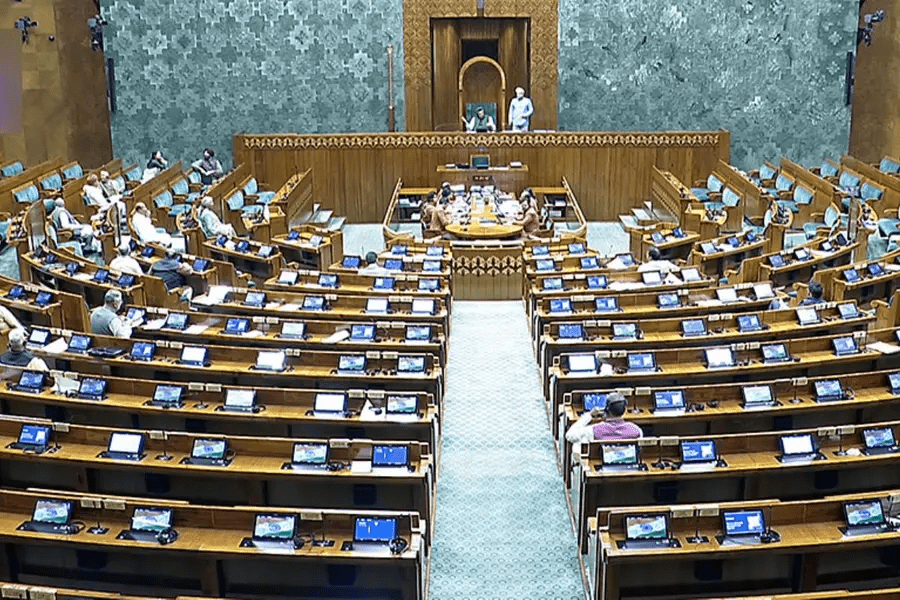
Running until August 13, the legislative sitting will test the NDA’s newly boosted floor strength against crucial two-thirds special majority benchmarks.
NEW DELHI — The high-stakes Monsoon Session of Parliament is officially scheduled to commence on July 20 and will run through August 13, 2026. Parliamentary Affairs Minister Kiren Rijiju confirmed the dates on Saturday, announcing that President Droupadi Murmu has formally approved the executive recommendation to summon both the Lok Sabha and the Rajya Sabha.
Add businessleague.in as a Preferred Source


Described by leadership as an opportunity for “meaningful debate, discussion, and decisions on issues of national importance,” the nearly four-week session is poised to become an intense political battlefield. The ruling National Democratic Alliance (NDA) is preparing to reintroduce landmark constitutional upgrades that fell short of passing in previous sittings.
Also Read | Amarnath Yatra 2026 Begins: Complete Registration Rules, Health Guidelines, and Entry Requirements
The Big Three: Landmark Bills Headed to the Floor
The legislative focus of the upcoming session centers around three highly consequential, structurally transformative proposed laws. Because they involve structural alterations to national governance frameworks, they require a strict Special Majority (two-thirds of members present and voting in both chambers):
High-Priority Constitutional Lineup
├── 130th Constitution Amendment: Automatic removal of a PM or CM if jailed for over 30 days
├── Women's Reservation Implementation: 33% quota allocation in Lok Sabha and assemblies
└── Delimitation Bill: Redrawing constituency map boundaries based on population metrics
1. The 30-Day Arrest Rule (130th Amendment Bill)
This unprecedented anti-corruption framework seeks to introduce an automatic disqualification clause for the nation’s highest executive seats. Under its provisions, any sitting Prime Minister or state Chief Minister will be automatically removed from office if they remain under judicial or police custody for 30 consecutive days or more in connection with specified serious offenses.
2. Women’s Reservation & 3. The Delimitation Link
The long-awaited Women’s Reservation Bill seeks to permanently secure a 33% quota for women within the Lok Sabha and state assemblies. While opposition parties broadly favor the quota concept, fierce floor debates are expected over the Delimitation Bill. The opposition vehemently opposes the government’s strategy of linking the activation of women’s seats to a fresh redrawing of constituency lines, arguing the population-based change could unfairly shrink the parliamentary footprint of southern states.
Mathematical Floor Test: Does the NDA Have the Numbers?
While the ruling coalition holds a comfortable simple majority to seamlessly clear ordinary legislative items like the proposed Foreign Contribution (Regulation) Act (FCRA) amendment, achieving the two-thirds threshold for constitutional overhauls will require delicate consensus-building.
The alliance’s floor metrics have shifted dynamically over the past few weeks due to regional political realignments:
| Legislative Chamber | Total Active Seats | Simple Majority Line | NDA Assured Tally (2026) | Two-Thirds Threshold Required |
| Lok Sabha | 543 | 272 | ~330 Members (Boosted by Shinde-Sena mergers) | ~362 Votes |
| Rajya Sabha | 242 | 122 | 151 Members (Includes 10 Nominated/Independents) | 162 Votes |
To bridge the 11-vote deficit looming over the Upper House and the margin gaps inside the Lok Sabha, the ruling alliance will need to court independent regional heavyweights. Neutral blocks like the Biju Janata Dal (BJD) and the YSR Congress Party (YSRCP), which have historically provided tactical support to national public safety legislation, are expected to act as the ultimate deciders for this session’s flagship bills.
Also Read | Amarnath Yatra 2026 Begins: Complete Registration Rules, Health Guidelines, and Entry Requirements
Frequently Asked Questions (FAQs)
What are the official dates for Parliament’s Monsoon Session 2026?
The session will formally begin on July 20, 2026, and is scheduled to wrap up after 25 days of legislative business on August 13, 2026.
Why is the opposition opposing the Delimitation Bill?
Opposition blocks argue that redrawing electoral boundaries based on modern population figures will disproportionately increase the parliamentary seats of northern states while lowering the relative voting weight and political representation of southern states that successfully implemented family planning policies.
What happens if the 130th Constitution Amendment Bill passes?
If passed into law, it will establish a legal ceiling preventing any jailed political executive (PM or CM) from governing behind bars for more than 30 days under serious criminal or corruption charges, enforcing a clean succession line.
Also Read | Amarnath Yatra 2026 Begins: Complete Registration Rules, Health Guidelines, and Entry Requirements
Add businessleague.in as a Preferred Source

