
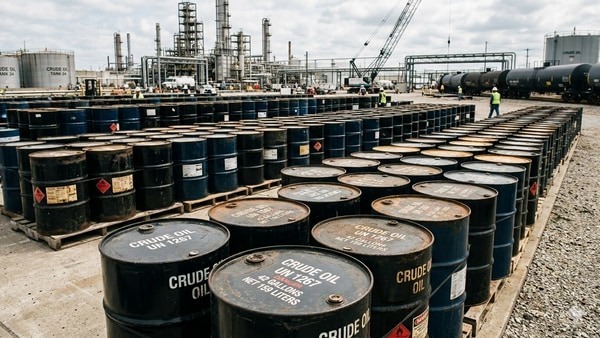
The global energy market has entered a state of high alert following the start of Operation Epic Fury and the subsequent killing of Iran’s Supreme Leader. On Monday, March 2, 2026, oil prices staged a violent rally as news broke of direct kinetic attacks on commercial shipping. The primary catalyst was a missile strike on the Skylight, a Palau-flagged tanker, just five nautical miles north of Oman’s Khasab Port.
Add businessleague.in as a Preferred Source


With insurance premiums for the region climbing by 50% and major lines like Maersk and NYK suspending all transits, the world’s most critical “energy artery” is effectively clogged.
Also Read |Tamil Nadu Voter List Purge: 97 Lakh Names Deleted in SIR Phase 1
The Skylight Attack: A Spark in the Powder Keg
The attack on the Skylight has direct implications for India, as 15 of the 20 crew members on board are Indian nationals.
-
The Damage: The vessel was hit by an Iranian projectile while attempting to enter the Strait. While all crew members were evacuated, four sustained injuries.
-
The “Illegal” Label: Iranian state media claimed the tanker was sinking after attempting to “illegally” pass through the waterway, signaling that Tehran is now enforcing a de facto blockade.
The “Practical Shutdown” of the Strait of Hormuz
Though Iran hasn’t officially declared the Strait closed, the market is treating it as such.
-
Insurance Void: Lloyd’s of London and other major insurers have halted coverage for voyages in the Persian Gulf, making it commercially impossible for most tankers to sail.
-
Traffic Jam: Satellite monitors show hundreds of tankers anchored on either side of the Strait (in the Gulf of Oman and the Persian Gulf), wary of becoming the next target.
-
The Pipeline Pressure Valve: Saudi Arabia and the UAE are attempting to bypass the Strait using overland pipelines to the Red Sea, but these can only handle about 40% of the total seaborne flow.
Also Read |Tamil Nadu Voter List Purge: 97 Lakh Names Deleted in SIR Phase 1
India’s Strategic Dilemma: Crude vs. LPG
India is the world’s third-largest oil importer, and its energy security is structurally tied to the stability of the Gulf.
-
The Crude Buffer: India maintains Strategic Petroleum Reserves (SPR) sufficient for roughly 10–15 days, supplemented by commercial stocks for another week.
-
The LPG Crisis: Unlike crude, India has no strategic reserves for LPG (Cooking Gas). With 85% of LPG imports transiting the Strait, any prolonged disruption could lead to immediate domestic shortages.
-
LNG Impact: Nearly 60% of LNG used as feedstock for Indian fertilizer (Urea) plants comes from Qatar via this route, threatening the upcoming sowing season.
The Russian Pivot: India’s Emergency Alternative
To mitigate the “Hormuz Risk,” New Delhi is reportedly considering a rapid re-engagement with Moscow.
-
Sanction Maneuver: While India had reduced Russian oil intake to 21.2% in January 2026 (due to US trade deal pressures), the current crisis may force Washington to turn a blind eye to increased Russian purchases.
-
The “Floating Reserve”: There are currently 9.5 million barrels of Russian oil sitting in Asian waters that could be diverted to Indian ports within days, avoiding the Middle East chokepoint entirely.
Also Read |Tamil Nadu Voter List Purge: 97 Lakh Names Deleted in SIR Phase 1
Reality Check
The price surge to $80 is a “fear premium.” Still, the fundamentals of the market were actually in a surplus before the strikes began. Therefore, if the US-Israel “decapitation strike” leads to a quick transition in Iranian leadership, prices could crash back to $70 just as fast. In fact, the OPEC+ increase of 206,000 bpd is a symbolic gesture of stability, but it cannot replace the 15–20 million barrels that move through Hormuz daily.
The Loopholes
The US and India signed a trade deal in February that limited Russian oil purchases. In fact, this is a “Security Loophole”—the agreement likely contains clauses that suspend these limits during a global energy emergency. Therefore, India can legally pivot back to Russia without “breaking” its promise to the Trump administration. Still, the “LPG Loophole” remains the most dangerous; while India can find alternative crude, finding alternative LPG suppliers outside the Gulf is logistically difficult due to specialized shipping requirements.
Also Read |Tamil Nadu Voter List Purge: 97 Lakh Names Deleted in SIR Phase 1
What This Means for You
If you are a consumer in India, prepare for a hike in fuel and cooking gas prices. First, realize that oil marketing companies (OMCs) will likely pass on the 10% crude surge within the next 48–72 hours. Then, if you are an investor, understand that aviation and logistics stocks will be under immense pressure due to fuel surcharges and rerouting.
Finally, understand that LPG delivery might face delays. You should ensure you have a backup cylinder or minimize unnecessary consumption for the next fortnight. Before you fill up your vehicle, check for bulk-buying restrictions, as some states may impose limits to prevent panic hoarding.
What’s Next
The Indian Ministry of External Affairs (MEA) is expected to issue a formal request to Washington for a “sanctions waiver” on Russian crude by Tuesday. Then, look for a meeting of the G7 Energy Ministers to discuss a coordinated release of global strategic reserves. Finally, the OPEC+ group will meet again on April 5, but they may be forced to hold an emergency session earlier if Brent crude touches the $100 mark before the end of the week.
Also Read |Tamil Nadu Voter List Purge: 97 Lakh Names Deleted in SIR Phase 1
End…
Add businessleague.in as a Preferred Source
🙏 Support Independent Journalism
We keep news free for you.
Most readers support with ₹500 ❤️
or scan QR below

Voluntary contribution. No tax benefits.
DISCLAIMER
We have taken all measures to ensure that the information provided in this article and on our social media platform is credible, verified and sourced from other Big media Houses. For any feedback or complaint, reach out to us at businessleaguein@gmail.com