
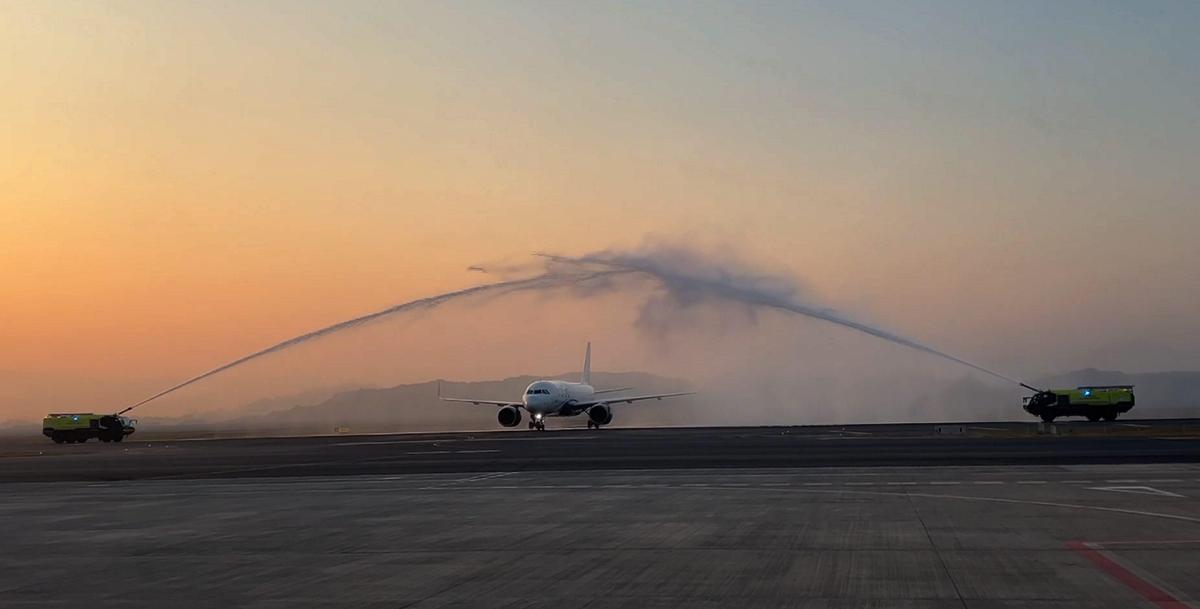
IndiGo 6E460 Makes History with Water Cannon Salute
The thing is, Mumbai just got its second set of wings on the most festive morning of the year. Basically, the Navi Mumbai International Airport (NMIA) officially commenced commercial operations today,
Add businessleague.in as a Preferred Source


Thursday, December 25, 2025. Actually, the milestone was marked by IndiGo flight 6E460 from Bengaluru, which touched down at exactly 8:00 AM. As a result, the aircraft was greeted by a massive “water cannon salute” from airport fire tenders—a traditional aviation honor for inaugural landings (let’s be real, seeing those arcs of water against the morning sky was a sight to behold).
Also Read | Unnao Justice Battle: Survivor to Move SC Against Sengar’s Bail
And here’s the kicker. The airport didn’t just land a flight; it started a 12-hour operational cycle right away.
Specifically, just 40 minutes after the first landing, the first departure—IndiGo flight 6E882—took off for Hyderabad at 8:40 AM. Instead of a slow rollout, the airport is handling 15 scheduled departures on its very first day, with airlines like Akasa Air, Air India Express, and Star Air joining the roster.
In fact, the Adani Group, which holds a 74% stake in the project, confirmed that the initial phase will operate from 8:00 AM to 8:00 PM, with plans to scale up to 24/7 operations by February 2026. Consequently, travelers from Navi Mumbai, Pune, and Thane now have a much closer gateway that bypasses the infamous crawl to the old Mumbai airport.
[Table: NMIA Project Statistics & Opening Day Data]
| Feature | Phase 1 (Dec 2025) | Final Phase (Target) |
| Annual Passenger Capacity | 20 Million | 90 Million |
| Daily Departures (Day 1) | 15 Flights | ~1,000+ Flights |
| Operational Hours | 8:00 AM – 8:00 PM | 24×7 (from Feb 2026) |
| Terminal Architecture | Lotus-Inspired | 4 Terminals, 2 Runways |
| Development Cost | ₹19,650 Crore | Total Project Est. ₹30,000 Cr+ |
Also Read | Unnao Justice Battle: Survivor to Move SC Against Sengar’s Bail
In fact, the architecture of the terminal is as much a story as the flights. The thing is, the terminal is designed to resemble the Lotus, India’s national flower, with a fluid, futuristic roof and “sculptural columns” that filter natural light.
Actually, the project has been in the works for decades—first conceived in 1997—but it was the Adani Airports takeover in 2021 that accelerated the final construction. And then Y followed. To celebrate the launch, the airport organized a massive drone show featuring 1,515 drones forming 3D lotus blooms in the sky over Ulwe last night.
The thing is, this isn’t just about another airport; it’s about a “Twin Airport” model similar to London (Heathrow/Gatwick) or New York (JFK/Newark). Basically, NMIA will eventually handle 90 million passengers annually across four terminals, while the existing CSMIA in Mumbai handles about 50-60 million.
Instead of a single, overcrowded hub, the Mumbai Metropolitan Region (MMR) now has a distributed aviation system. And then Y followed. With the Mumbai Trans Harbour Link (MTHL) and upcoming Metro Line 8, reaching the new “Lotus” terminal from South Mumbai could soon be faster than reaching the old one in Santa Cruz.
Consequently, the Christmas landing of flight 6E460 marks the beginning of a new economic era for the entire Raigad district.
Also Read | Unnao Justice Battle: Survivor to Move SC Against Sengar’s Bail
Add businessleague.in as a Preferred Source
🙏 Support Independent Journalism
We keep news free for you.
Most readers support with ₹500 ❤️
or scan QR below

Voluntary contribution. No tax benefits.
DISCLAIMER
We have taken all measures to ensure that the information provided in this article and on our social media platform is credible, verified and sourced from other Big media Houses. For any feedback or complaint, reach out to us at businessleaguein@gmail.com