
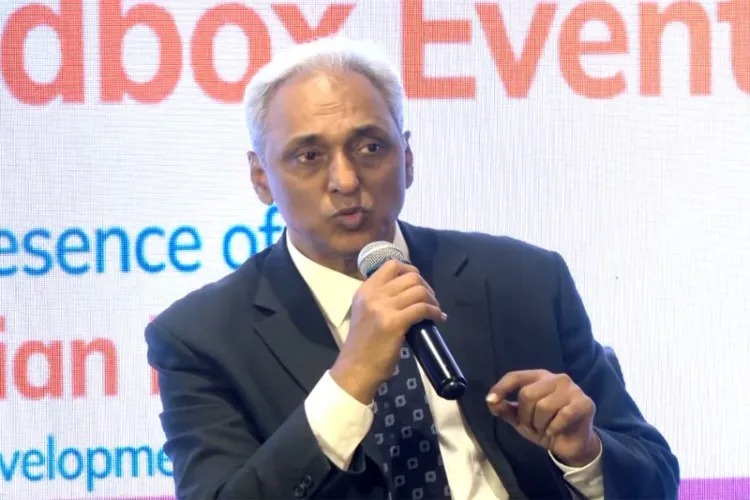
In a move to redefine the “National Pension System” from a rigid retirement bucket into a flexible financial tool, ICICI Pension Fund has launched NPS Swasthya Equity Plus. Unveiled by PFRDA Chairperson Sivasubramanian Ramann, the scheme is an experiment under the regulatory sandbox designed to address the “missing middle”—citizens who are too young for senior citizen benefits but struggle with rising out-of-pocket medical costs.
Add businessleague.in as a Preferred Source


Unlike the standard NPS, which locks away funds until age 60 with limited partial withdrawals, NPS Swasthya creates a “pension-smart account” that functions as a secondary health buffer without compromising the long-term compounding of a retirement corpus.
Also Read |Tamil Nadu Voter List Purge: 97 Lakh Names Deleted in SIR Phase 1
Bridging the “Health-Pension Gap”: How SEP Works
The primary objective remains retirement, but the architecture is built for modern volatility.
-
Asset Allocation: Between 70% and 100% of the corpus is invested in equities, aiming for aggressive 15-year growth.
-
Complementary Role: PFRDA officials emphasized that this is not a replacement for medical insurance but a “primary mitigator” for costs that insurance often misses, such as diagnostics and pharmacy bills.
-
Mandatory Pairing: Under PFRDA rules, a subscriber must maintain a Common Scheme NPS account alongside the Swasthya account.
Withdrawal Mastery: 25% Liquidity for Health
The most disruptive feature of NPS Swasthya is its liquidity. While regular NPS limits partial withdrawals to just four times over a lifetime, Swasthya allows unlimited withdrawals up to the 25% limit of the subscriber’s own contributions.
-
Eligibility: The first withdrawal is permitted once the cumulative contribution reaches ₹50,000.
-
Emergency Exit: In extreme cases where medical expenses exceed 70% of the corpus, a 100% premature withdrawal is allowed, which then closes the Swasthya account and moves any remaining balance back to the Common Scheme.
Also Read |Tamil Nadu Voter List Purge: 97 Lakh Names Deleted in SIR Phase 1
The Apollo Partnership: Digital Healthcare Ecosystem
The scheme is integrated into the Apollo 24/7 digital platform. Withdrawals are authenticated via OTP and disbursed directly to the Apollo network through KFintech, ensuring that the funds are used specifically for their intended healthcare purpose.
-
Perks: Subscribers get preferential discounts on pharmacy orders, diagnostics, and consultations within the Apollo ecosystem.
-
Physical Pilot: While the app works nationwide, physical hospital and pharmacy benefits are currently live in Bengaluru and Hyderabad.
Reality Check
The high equity allocation (up to 100%) is a double-edged sword. Still, over a 15-year horizon, equity historically outperforms other assets. Therefore, while your healthcare buffer is “market-linked” and could fluctuate, it offers the best chance to beat medical inflation. In fact, PFRDA chief Ramann noted that this is a “small supplement”—meaning if the stock market dips during your medical emergency, your “buffer” might be smaller than anticipated.
The Loopholes
The ₹50,000 threshold is a “cumulative contribution,” not a one-time deposit. In fact, this is a “low-barrier loophole” designed to include younger professionals. Therefore, you can build the buffer slowly over time. Still, the “direct-to-provider” payment model is a strategic loophole-closer; you cannot withdraw the cash to your personal bank account for non-medical use—the money goes straight to Apollo via KFintech to prevent the misuse of pension savings.
Also Read |Tamil Nadu Voter List Purge: 97 Lakh Names Deleted in SIR Phase 1
What This Means for You
If you are over 40 (the target segment for transfers from common schemes), this is your chance to ring-fence your health savings. First, evaluate your current out-of-pocket (OPD) expenses; if you spend heavily on tests and medicines, the discounts and liquidity here are superior to standard NPS. Then, apply via the ICICI Pension Fund website or the Apollo 24/7 app.
Finally, realize that this is a Proof of Concept. You should be prepared for potential modifications or even discontinuation if the pilot fails, in which case your corpus would simply merge back into your regular NPS. Before committing, check if your preferred local doctors are part of the Apollo network to maximize the 10-15% discounts offered to “Swasthya” users.
What’s Next
The PFRDA will monitor the pilot phase in Bengaluru and Hyderabad for the next 12 months. Then, based on “learnings from the PoC,” the scheme may be expanded to other hospital networks like Max or Fortis. Finally, look for the rollout of “Conservative Swasthya” options with higher debt components for older subscribers later in 2026.
Also Read |Tamil Nadu Voter List Purge: 97 Lakh Names Deleted in SIR Phase 1
End…
Add businessleague.in as a Preferred Source
🙏 Support Independent Journalism
We keep news free for you.
Most readers support with ₹500 ❤️
or scan QR below

Voluntary contribution. No tax benefits.
DISCLAIMER
We have taken all measures to ensure that the information provided in this article and on our social media platform is credible, verified and sourced from other Big media Houses. For any feedback or complaint, reach out to us at businessleaguein@gmail.com