
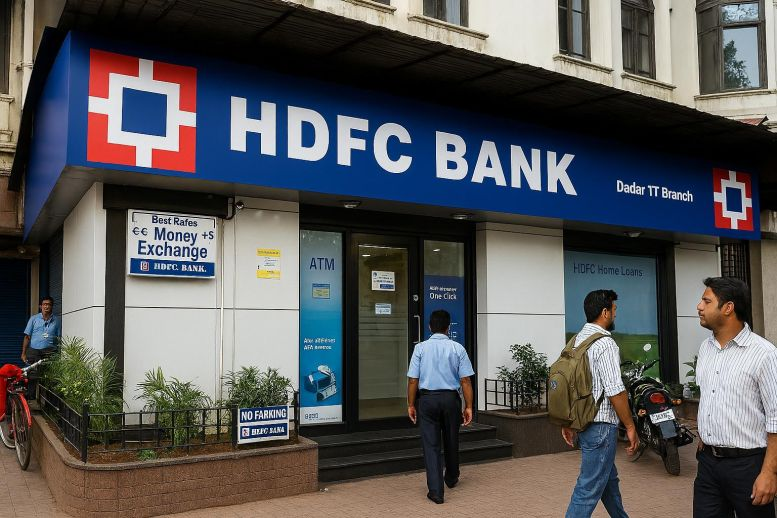
Now a highly controversial corporate governance dispute has triggered immediate turbulence across the domestic financial markets. A sudden, high-volume HDFC Bank share decline dominated the National Stock Exchange early Wednesday afternoon. Specifically, the private banking giant saw its equity value tumble by nearly 2.5 percent during active intraday trading sessions. The market correction followed intense media leaks alleging deep financial misalignments within the lender’s accounting departments. Therefore, institutional asset managers are reviewing their long-term banking portfolios to calculate immediate risk exposures today.
Add businessleague.in as a Preferred Source


Today, changing investor perceptions are forcing a defensive public clarification from corporate headquarters. Bank spokesmen moved quickly to reject all public assumptions of systemic accounting failures or executive culpability.
Un-challenged media leaks regarding premier corporate books are officially a dead concept.
Also Read |Tamil Nadu Voter List Purge: 97 Lakh Names Deleted in SIR Phase 1
The Intraday Correction: Mapping the Sudden Capital Drop
Now the physical behavior of the banking indices altered rapidly as institutional desks processed the morning rumors. The current wave of the HDFC Bank share decline represents a direct response to highly specific allegations published by financial investigative reporters. Therefore, retail trading associations are calling for absolute transparency from the bank’s internal compliance desks to prevent prolonged panic selling cycles.
Officials say the domestic equity markets are operating with heightened sensitivity due to macro-economic adjustments across Asia. Before Wednesday’s sharp pricing adjustments took effect, the stock maintained a comfortable consolidated trading baseline over several weeks. Now, the sudden generation of corporate doubt has broken through key technical support lines. Thus, the bank’s core valuation hits a temporary blockade before management can satisfy the strict parameters of market regulators.
“The assumptions of wrongdoing based on selective material are entirely misplaced,” an official corporate spokesperson confirmed. Still, the rapid sell-off leaves everyday derivative traders facing substantial margin-call pressures before the closing bell rings.
The Financial Velocity
First, consider the immense monetary scale of the capitalization loss logged within a brief two-hour trading window. The active parameters of the HDFC Bank share decline dragged the absolute share value down by ₹18.75 per unit. Next, look at the precise timestamp of the heaviest institutional volume dumps. Around 2:11 PM, the stock locked its intra-day low at exactly ₹760.15 on primary trading screens.
So the brand suffers a sharp blow to short-term investor sentiment.
Notably, rebuilding confidence among international fund houses demands immediate face-to-face clarification sessions with senior treasury directors. In this instance, the painful footprint of the HDFC Bank share decline highlights the extreme danger of unverified disclosures. As a result, global wealth aggregators are pausing their automated accumulation algorithms until full internal balance sheets receive a clean bill of health.
The Trading Floor Climate
大量 of terminal brokers executed high-velocity stop-loss orders as the stock charts breached the 2.4 percent downward mark today. Because of the high stakes, any secondary leak regarding corporate tax investigations would force a massive retirement of futures contracts before sunset.
Otherwise, the central management office maintained its standard rigid focus on reassuring the public through formal exchange notifications. Supervisors refused to let speculative commentary run un-checked on major financial television loops. Thus, the giant banking institution enters the late week phase with a highly active public relations defense.
The MSRDC Interest Mismatch: Dissecting the Marketing Trail
Now we must examine the specific transactional mechanics that caused the initial non-compliance allegations inside the organization. The baseline trigger behind the HDFC Bank share decline centers on a highly complicated series of payments directed to a prominent state agency. Therefore, forensic accounting teams are auditing the past two fiscal years to verify matching authorization codes.
The Routing Allegation
First, look at how investigative journals mapped the suspicious cash movements between corporate departments. The reports claim that the bank owed substantial differential interest payments on massive corporate deposits maintained by the Maharashtra State Road Development Corporation (MSRDC). Next, analysts allege that instead of directly crediting these earnings to the state agency’s treasury accounts, the funds traveled down an alternative corporate pathway.
So the network allegedly routed the ₹45 crore balance through its internal marketing budget.
The Safety Campaign
Subsequently, the financial sheets claim the diverted funds were logged as official commercial contributions toward a localized road safety awareness campaign. The bank allegedly distributed the capital across four independent local advertising vendors to clear the outstanding balances silently.
Consequently, the current coverage of the HDFC Bank share decline focuses heavily on these hidden marketing entries. Critics argue that the arrangement was openly discussed during senior management panels hosted in the presence of Managing Director and CEO Sashidhar Jagdishan. Thus, the transaction trail points directly toward the highest tiers of corporate leadership.
Also Read |Tamil Nadu Voter List Purge: 97 Lakh Names Deleted in SIR Phase 1
Corporate Management Defends Its Strict Oversight Networks
Now the administrative response from the executive suites is challenging the validity of the leaked document chains. The strategic mitigation of the HDFC Bank share decline relies on establishing the absolute durability of internal audit controls. Therefore, corporate compliance directors are releasing detailed process guidelines to counter the fraud narrative.
The Norm Compliance
First, the management explicitly asserted that the bank follows an incredibly robust internal oversight, audit, and verification framework. They stated that all issues brought to the board’s attention are systematically dealt with in accordance with established banking norms. Next, look at the strict structural sequencing applied during any internal review phase.
So a full, objective post-review process is always completed before any final administrative determination occurs.
Rejecting Culpability
“We strongly reject any hasty assumptions of culpability based on highly selective materials,” the official media brief announced this afternoon. This positioning aims to convince the public that a routine internal review does not equal a declaration of real corporate guilt.
Think again if you think the private lender is conceding any operational failures to the press room. In reality, the corporate command is protecting its market valuation by emphasizing its historic compliance record. Therefore, the defense block aims to halt the slide of the equity stock instantly.
The Executive Departure: Analyzing the Resignation of Atanu Chakraborty
Now historical boardroom adjustments from the previous quarter are providing a highly dramatic context for today’s market drop. The continuous escalation of the HDFC Bank share decline is deeply tied to a sudden leadership void logged on March 18. Therefore, corporate governance scholars are tracing previous executive friction points to locate the ultimate origin of the crisis.
The Value Clash
First, former non-executive chairman Atanu Chakraborty abruptly stepped down from his premier seat before his official tenure concluded. He openly cited deep, unresolved differences regarding underlying corporate values and institutional ethics as the primary driver for his departure. Next, look at how the bank’s active management group responded to this dramatic moral stance.
So a tense public disagreement materialized between the board factions.
| Corporate official | Role Designation | Official Stance on the Dispute |
| Sashidhar Jagdishan | Managing Director & CEO | Asserts that all internal accounting issues follow standard verification and formal post-determination codes |
| Atanu Chakraborty | Former Non-Executive Chair | Vacated his administrative seat while citing deep personal differences over core corporate values and ethics |
| Keki Mistry | Interim Board Chairman | Maintains that the bank’s daily operations and governance structures remain entirely stable under pressure |
Gone are the days of experiencing quiet boardroom transitions inside the private banking sector without facing immediate, punishing market liquidations.
Also Read |Tamil Nadu Voter List Purge: 97 Lakh Names Deleted in SIR Phase 1
Interim Stabilization: Keki Mistry Steps Into the Boardroom Apex
Now the implementation of immediate structural stabilization measures is the primary priority for the remaining directors. The strategy to reverse the ongoing HDFC Bank share decline relies heavily on the reputation of seasoned financial veterans. Therefore, the board has placed an iconic industry figure at the head of the emergency management panel.
The Interim Anchor
First, following the shock departure of the previous chair, the company appointed Keki Mistry to function as interim chairman. Mistry possesses decades of elite operational experience managing large-scale corporate mergers and housing finance portfolios. Next, look at his initial public messaging to international institutional investment blocks.
So the interim head maintains that the bank’s daily governance and field operations remain completely stable.
The Operational Shield
Consequently, the administration is using Mistry’s corporate weight to assure the markets that daily credit operations face zero interruption risks. Think again if you think a minor leadership shuffle cannot fix an intense market confidence crisis. In reality, placing a highly trusted veteran at the apex of the board slows down the panic of large mutual funds. Thus, the interim appointment shields the primary asset base safely.
Central Banking Clearances Shield the Long-Term Market Profile
Now the final component of the bank’s corporate defense relies on authoritative report cards distributed by central regulators. The ultimate trajectory of the HDFC Bank share decline depends on whether the sovereign banking supervisor identifies any structural safety violations. Therefore, macroeconomic observers are reviewing previous federal checkup logs today.
The Federal Finding
First, the Reserve Bank of India previously evaluated the lender’s internal accounting books during a routine spring audit sweep. The central banking authority explicitly stated that there were zero material concerns regarding the bank’s governance or on-road conduct. Next, look at how this federal clearance acts as a shield against current media claims.
So the official regulatory data suggests that the bank maintains adequate capital cushions to survive minor operational disputes.
The Final Balance
The combination of robust internal audit committee reviews, veteran interim leadership, and explicit backing from the central bank forms a strong defensive wall.
Simple as that.
The comprehensive data surrounding the transaction shows that while short-term sentiment remains volatile, the core banking architecture stands completely safe. Thus, the temporary HDFC Bank share decline represents a brief seasonal alignment rather than a permanent loss of operational utility.
Meanwhile, the electronic stock tickers await tomorrow’s opening bell.
Also Read |Tamil Nadu Voter List Purge: 97 Lakh Names Deleted in SIR Phase 1
End…
Add businessleague.in as a Preferred Source
🙏 Support Independent Journalism
We keep news free for you.
Most readers support with ₹500 ❤️
or scan QR below

Voluntary contribution. No tax benefits.
DISCLAIMER
We have taken all measures to ensure that the information provided in this article and on our social media platform is credible, verified and sourced from other Big media Houses. For any feedback or complaint, reach out to us at businessleaguein@gmail.com