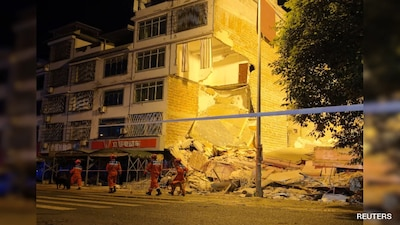
Now a sudden tectonic shift has triggered an immediate humanitarian response in southern China. A sharp 5.2-magnitude earthquake struck South China’s Liunan District of Liuzhou early Monday morning, May 18, 2026, sending terrified residents fleeing into the streets for survival. Therefore, the Guangxi Zhuang Autonomous Region has been placed under a high-alert emergency framework to manage the unfolding crisis. Meanwhile, the China Earthquake Networks Centre (CENC) confirmed that the tremor originated at 12:21 AM local time at a highly hazardous, shallow depth of 8 kilometers. Following the structural failures left in the wake of the shockwave, rescue teams are treating immediate rubble clearance as a mechanical necessity to find trapped survivors.
Add businessleague.in as a Preferred Source


Also Read |Tamil Nadu Voter List Purge: 97 Lakh Names Deleted in SIR Phase 1
Midnight Panic: Shockwave Dynamics Across the Liunan District
Now the quiet hours of early Monday morning were shattered by a violent rolling motion beneath the earth’s crust. The suddenness of the 5.2-magnitude tremor left local families with only seconds to react as residential structures began vibrating intensely. Therefore, apartment towers across the Liunan District emptied within minutes as panic gripped the urban population.
First, the primary vertical displacement waves traveled rapidly through the dense sub-soil layers of Liuzhou. Next, the midnight timing amplified the chaos, forcing thousands to flee into the dark open avenues wearing minimal clothing. Thus, the immediate focus of municipal wardens shifted toward organizing clear assembly zones in public parks.
So the initial rumbling was accompanied by loud grinding noises from shifting masonry layers. This visual and auditory shock caused widespread alarm that spread instantly to neighboring sectors. Meanwhile, local communication boards lit up with thousands of safety check-ins from anxious family networks. Therefore, the opening minutes established a highly tense environment across the entire autonomous region.
Casualty Log: Tracking Fatalities and Hospitalization Data
Now according to the latest official briefings from the Liuzhou earthquake relief headquarters, the human toll remains tightly monitored. Emergency doctors have confirmed two fatalities resulting directly from falling debris during the initial structural shifting. Therefore, localized medical alerts have been deployed to ensure rapid processing of incoming trauma cases.
First, field technicians identified that four separate individuals required immediate hospitalization for non-life-threatening lacerations and bone fractures. Next, clinical teams report that these patients have been stabilized inside regional emergency centers and are recovering steadily. Thus, the clinical infrastructure successfully avoided getting overwhelmed by a massive wave of casualties.
So the preservation of life remains the absolute core objective for the processing units on the ground. Meanwhile, social service agencies are providing immediate grief counseling to the families of the deceased. Therefore, while the loss of life is deeply felt, rapid medical triage has successfully mitigated further escalating health hazards.
Structural Integrity: 13 Collapses and the Status of Critical Utilities
Now the material devastation left by the shockwave is highly concentrated across older residential quarters. Official infrastructure logs confirm that exactly 13 independent buildings suffered catastrophic structural collapses during the peak acceleration phase. Therefore, architectural review boards are facing an immediate requirement to inspect surrounding structural bases.
Critical Infrastructure Operational Matrix:
-
Power Grid: Maintained 100% operational status with zero transmission failures.
-
Water & Gas Lines: Intact; pressure safety valves operated perfectly across all lines.
-
Telecom Networks: Sustained connectivity blocks; cellular towers bypassed minor overloads.
-
Transit Corridors: Major highways and bridge arteries cleared of debris and fully open.
First, state broadcaster CCTV highlighted that despite the residential destruction, core industrial networks remained active. Next, automated shutoff mechanisms inside gas pipelines prevented secondary fire outbreaks from developing along damaged blocks. Thus, the mechanical necessity of keeping main lines alive was fully achieved by municipal engineering systems.
Also Read |Tamil Nadu Voter List Purge: 97 Lakh Names Deleted in SIR Phase 1
Level-IV Mobilization: Beijing Activates Central Crisis Control
Now the scale of the regional disturbance has triggered an immediate response from central executive channels in Beijing. The Ministry of Emergency Management along with the State Council officially activated a Level-IV emergency response configuration before dawn. Therefore, specialized national work teams have been dispatched to assume direct guidance of all local relief operations.
First, this national coordination ensures that supplementary financial and physical assets can be routed to Guangxi without structural delays. Next, the China Earthquake Administration initiated a corresponding Level-III response matrix to anchor scientific tracking operations. Thus, regional units are now linked directly to supreme command consoles via high-definition video conferencing setups.
So the administrative synchronization prevents any local resource allocation gaps from slowing down the field units. Meanwhile, specialized seismologists are analyzing real-time data feeds to predict any potential fluctuations in local pressure lines. Therefore, the state’s multi-layered response framework provides a solid baseline for rapid community recovery.
The Search Matrix: Deploying Life Detectors and K9 Teams for the Missing
Now the most critical field operation is currently unfolding around the perimeter of a single collapsed residential layout. Emergency crews are working under extreme stress to locate a single missing citizen who remains unaccounted for in official logs. Therefore, the area has been sealed off to allow high-precision sensory tracking gear to operate without external noise.
-
Tactical Search Equipment Engaged:
-
Acoustic Life Detectors: Tuning into micro-vibrations and breathing signatures beneath heavy concrete blocks.
-
K9 Rescue Units: Deploying specialized scent-tracking search dogs to pinpoint human presence.
-
Aerial Surveillance Drones: Mapping shifting structural lines from high-angle vectors.
-
Heavy Hydraulic Excavators: Safely lifting massive load-bearing slabs without disturbing lower air pockets.
-
First, the Liuzhou fire and rescue brigade deployed 51 specialized vehicles and 315 elite personnel directly to the epicenter coordinates. Next, technicians are working in alternating shifts to maintain a continuous, 24-hour clearing operation. Thus, the mechanical necessity of rapid rubble processing is being balanced carefully against survivor safety.
Seismological Footprints: Understanding the Hazards of Shallow Depths
Now macro-level earth scientists are pointing out that the magnitude of an event doesn’t tell the whole story. The primary reason this specific 5.2-magnitude tremor caused such an immediate impact is its exceptionally shallow hypocenter depth of 8 kilometers. Therefore, the destructive kinetic energy had very little rock distance to travel before hitting surface foundations.
First, shallow quakes systematically deliver significantly sharper vertical ground accelerations than deeper seismic variants. Next, this means that even mid-tier magnitudes can easily breach the shear tolerances of older brick constructions. Thus, the mechanical necessity of strict seismic building codes is being highlighted across all local media outlets.
So the CENC tracking grid has recorded multiple low-level aftershocks rippling through the Guangxi fault lines over the last twelve hours. Meanwhile, community sensors are streaming continuous ground-tilt metrics back to the central data hubs in Beijing. Therefore, the shallow nature of the threat requires a highly vigilant monitoring posture from regional engineers.
Also Read |Tamil Nadu Voter List Purge: 97 Lakh Names Deleted in SIR Phase 1
Regional Inspections: Mandatory Post-Quake Safety Audits Enforced
Now as thousands of displaced citizens wait inside temporary shelter zones, municipal heads are enforcing strict re-entry codes. Regional authorities have been legally ordered to verify the structural integrity of every building within a two-kilometer radius of the epicenter. Therefore, no families will be permitted to return to their homes until a formal clearance certificate is issued.
First, engineering teams are searching for hidden stress cracks along primary load-bearing pillars and foundational walls. Next, school campuses and medical facilities are receiving top priority to ensure public service continuity can be preserved safely. Thus, these mandatory field audits act as a vital shield against secondary structure failures from incoming aftershocks.
So the city administration is collaborating with public insurance groups to fast-track damage assessment declarations. Meanwhile, emergency food and clean water distribution centers are operating at maximum capacity to sustain the 7,000 relocated residents. Therefore, these comprehensive safety checks ensure that the recovery phase proceeds under total technical excellence.
FAQ: Vital Questions on the May 2026 Liuzhou Earthquake
1. What was the exact magnitude and location of the China earthquake today? Now, the earthquake registered a magnitude of 5.2 on the Richter scale, striking the Liunan District of Liuzhou, Guangxi Zhuang Autonomous Region.
2. Why did a 5.2-magnitude earthquake cause buildings to collapse? First, because the quake originated at an exceptionally shallow depth of 8 kilometers, which allows seismic shockwaves to hit surface structures with maximum force.
3. How many casualties and structural damages have been officially confirmed? So, official logs confirm two fatalities, four injuries requiring hospitalization, one missing resident, and the complete collapse of 13 buildings.
4. What emergency response level has been activated by Beijing? Next, the Ministry of Emergency Management and the State Council have activated a centralized Level-IV emergency response to guide field operations.
5. Are local utilities like water and electricity still working in Liuzhou? Now, yes. State media reports confirm that all essential infrastructure—including power, water, gas, and communications networks—continues to operate completely normally.
6. How many residents were displaced and where are they currently located? Finally, more than 7,000 residents were successfully evacuated and relocated to safer, temporary shelter zones managed by local rescue headquarters.
Also Read |Tamil Nadu Voter List Purge: 97 Lakh Names Deleted in SIR Phase 1
End….
Add businessleague.in as a Preferred Source
🙏 Support Independent Journalism
We keep news free for you.
Most readers support with ₹500 ❤️
or scan QR below

Voluntary contribution. No tax benefits.
DISCLAIMER
We have taken all measures to ensure that the information provided in this article and on our social media platform is credible, verified and sourced from other Big media Houses. For any feedback or complaint, reach out to us at businessleaguein@gmail.com