


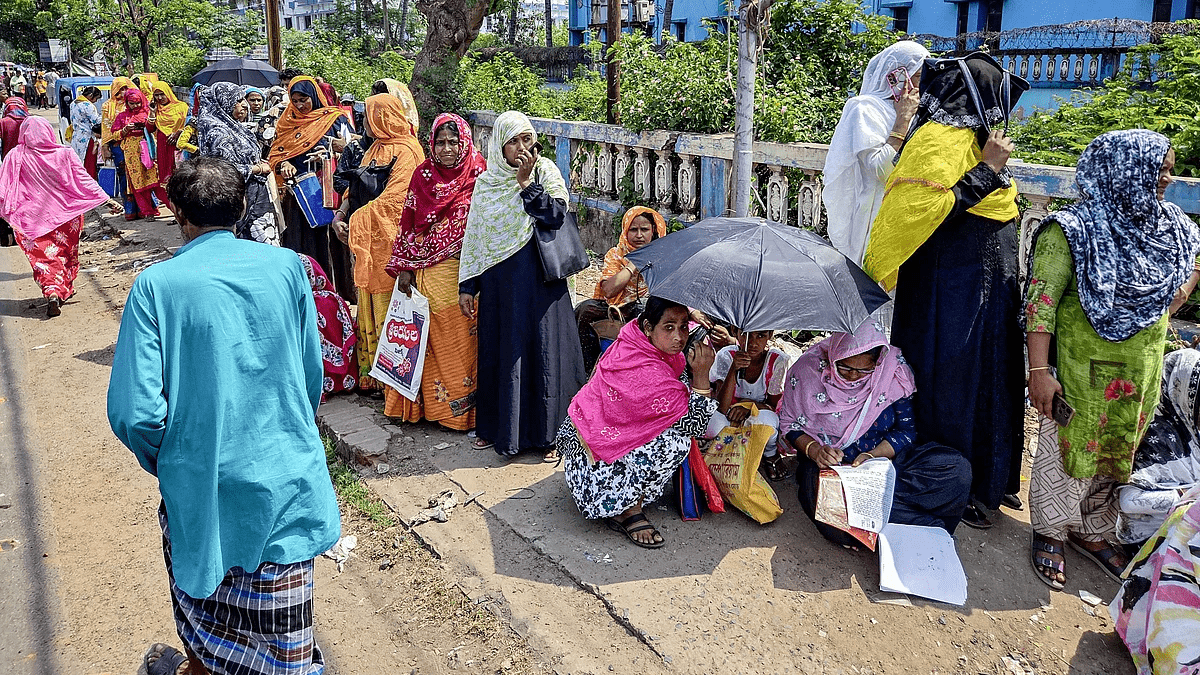
Now the highest court has clarified the limits of judicial intervention in the middle of a massive electoral crisis. In a high-stakes hearing this Monday, the Bengal voter exclusion Supreme Court 2026 ruling rejected a plea to allow 27 lakh people to cast their ballots while their appeals remain pending. First, the bench argued that granting such a concession would create a legal paradox, requiring the suspension of voting rights for 7 lakh others whose inclusions are being challenged. Therefore, as the state moves toward a critical election, the immediate fate of millions of excluded voters remains locked within the tribunal system. Meanwhile, the court has signaled it will “apply its mind” later if these deletions materially alter the final poll outcomes.
Add businessleague.in as a Preferred Source


Also Read |Tamil Nadu Voter List Purge: 97 Lakh Names Deleted in SIR Phase 1
The 34 Lakh Dilemma: Why the Court Said No
Now we must examine the specific logic that led Chief Justice Surya Kant and Justice Joymalya Bagchi to their decision. First, the court was presented with a report from Calcutta High Court Chief Justice Sujoy Paul. Therefore, the data confirmed that a staggering 34.35 lakh appeals are currently pending before the tribunals.
Next, the bench noted that if they allowed the 27 lakh excluded people to vote, they would logically have to stop the 7 lakh people whose inclusion has been challenged. Thus, the Bengal voter exclusion Supreme Court 2026 ruling emphasizes a “balance of inconvenience.”
Meanwhile, Justice Kant elaborated that 55 per cent of objections have already been rejected, allowing those voters to remain on the list. Therefore, any blanket order would disrupt the established rights of those who have already cleared the initial hurdle. So the court chose to avoid “bogging down” the tribunal members even further.
The Margin of Victory: Post-Poll Intervention Signals
So what happens if the deletions actually change who wins? The bench offered an intriguing oral observation. First, the judges stated they would “apply our mind” if the large-scale deletions are deemed to have affected the outcomes. Therefore, the Bengal voter exclusion Supreme Court 2026 issue could return in the form of election petitions.
Next, Justice Bagchi proposed a hypothetical scenario where the margin of victory is only 2 per cent, but 15 per cent of the mapped electorate was unable to vote. Thus, the court is keeping a door open for post-election scrutiny.
Intervention Criteria:
-
Outcome Shift: If the number of deletions outnumbers the winning margin.
-
Material Effect: If the win-loss gap is smaller than the excluded voter count.
-
Legal Grounds: Candidates filing for cancellation or re-election.
Meanwhile, this observation provides a roadmap for defeated candidates to challenge results. Therefore, the “finality” of the 2026 polls remains subject to a “mathematical audit” by the judiciary.
Logical Discrepancies: The Contentious New Exclusion Category
Now we must analyze the specific “tag” used to remove millions of names. First, the bench expressed deep concern over the “logical discrepancies” category applied during the Bengal SIR. Therefore, it appears that this specific metric was the primary engine behind the mass deletions.
Next, voters who mapped themselves to previous post-SIR rolls were still flagged for these discrepancies in Bengal. Thus, a process meant to simplify inclusion has instead become a barrier.
Meanwhile, the court questioned why voters on the 2002 list were being asked for documents when they were supposed to be “automatically included.” Therefore, the Bengal voter exclusion Supreme Court 2026 case highlights a significant administrative shift in how voter identity is verified. So the “logical” part of the discrepancy is now under judicial review.
Also Read |Tamil Nadu Voter List Purge: 97 Lakh Names Deleted in SIR Phase 1
The Bihar Parallel: Why Bengal’s SIR Implementation Differs
So why is Bengal being treated differently than Bihar? First, Justice Bagchi pointed out that during the Bihar SIR last year, the “logical discrepancy” category was not applied. Therefore, the ECI appears to be using different standards across state lines.
Next, in Bihar, any voter who could map themselves to a previous roll was included without further proof. Thus, the Bengal voter exclusion Supreme Court 2026 hearing exposed a massive inconsistency in the ECI’s national policy.
State Comparison:
-
Bihar (2025): 2002 list members needed zero extra documents; automatic inclusion.
-
Bengal (2026): 2002 list members flagged for “logical discrepancies”; document heavy.
Meanwhile, the ECI’s original notification on SIR reportedly did not even mention questioning the 2002 list. Therefore, the court is demanding to know why the “goalposts were moved” for Bengal voters specifically.
Justice Bagchi on Constitutional vs. Sentimental Rights
Now let’s look at the philosophy driving the bench. First, Justice Bagchi remarked that the right to vote in one’s birth country is “not only constitutional but also sentimental.” Therefore, he is treating the exclusion not just as a legal error, but as a violation of the “due process” that defines a citizen.
Next, he emphasized that appellate tribunals are essential to protect these rights from arbitrary administrative decisions. Thus, the Bengal voter exclusion Supreme Court 2026 case is a test of India’s democratic resilience.
Meanwhile, the court noted that candidates usually get primacy in these appeals because they cannot be denied the right to contest. Therefore, the fact that “ordinary voters” are now seeking similar primacy marks a significant shift in legal history. So the “vigilant voter” is now the center of the court’s attention.
ECI’s Defense: The Proliferation of ‘Aliases’ Argument
So how did the Election Commission justify the shift? First, senior advocate D. Seshadri Naidu argued that those claiming to be on the 2002 list had to prove their identity. Therefore, he claimed many voters are now using “aliases,” necessitating stricter verification.
Next, Justice Bagchi immediately pushed back, accusing the ECI of “improvising” its submissions compared to the Bihar case. Thus, the commission’s credibility is being scrutinized by the bench.
Meanwhile, the ECI maintains that the “logical discrepancy” list is a necessary tool to purge the rolls of fake identities. Therefore, the Bengal voter exclusion Supreme Court 2026 battle is essentially about whether the ECI’s technology is “accurate” or “exclusionary.” So the commission must now defend its “software logic” against constitutional principles.
Also Read |Tamil Nadu Voter List Purge: 97 Lakh Names Deleted in SIR Phase 1
Kalyan Banerjee and the State Support for Appellants
Now we should consider the political alignment in the courtroom. First, senior advocate Kalyan Banerjee, appearing for the Bengal government, threw the state’s weight behind the petition. Therefore, the ruling party in Bengal is actively campaigning for the inclusion of these 27 lakh voters.
Next, Banerjee argued that these individuals are “genuine” and want to exercise their right. Thus, the Bengal voter exclusion Supreme Court 2026 case has become a major flashpoint between the State Government and the central Election Commission.
Meanwhile, the Bengal government argues that the mass deletions are a targeted attempt to influence the poll results. Therefore, the state’s support for the “13 aggrieved individuals” is a strategic move to delegitimize the current rolls. So the legal battle is as much about political survival as it is about voter rights.
Premature Apprehensions? Unpacking the Official Court Order
Finally, what does the official order say? First, the bench dictated that the apprehensions expressed are currently “premature.” Therefore, because the petitioners have already appealed to the tribunals, the court believes the “due process” is still active.
Next, the order clarified that the court is “not expressing any view on the merits.” Thus, the rejection of the voting request is a procedural one, not a judgment on whether the deletions were right or wrong.
Order Summary:
-
Appeals: Petitioners must follow the tribunal path already started.
-
Consequences: If the plea had been allowed, “necessary consequences” (suspending 7 lakh others) would follow.
-
Timeline: Potential for a follow-up hearing next Monday on a request by Shyam Divan.
Meanwhile, the cloud of uncertainty remains over the April 23 and 29 polling dates. Therefore, the Bengal voter exclusion Supreme Court 2026 story is far from over. So the next few days will be a race for the tribunals to clear as many of those 34 lakh files as possible.
Common Questions Answered
What did the Supreme Court decide on the Bengal voter exclusion 2026? Now the court rejected the plea to allow 27 lakh excluded people to vote while their appeals are pending. Therefore, they must wait for the tribunal’s final decision.
Why were the 27 lakh voters excluded? First, most were flagged for “logical discrepancies” during the Special Intensive Revision (SIR). Thus, their identities across different years did not perfectly align in the ECI system.
Will the Supreme Court intervene after the election? Next, the bench orally observed that it might “apply its mind” if the winning margin in any seat is smaller than the number of excluded voters.
What is the ‘Bihar Parallel’ mentioned in court? So in Bihar’s SIR, the ECI did not use the “logical discrepancy” category and allowed automatic inclusion for those on the 2002 list. Therefore, the court is questioning why Bengal is different.
How many appeals are pending in total? Actually, there are 34.35 lakh appeals pending. This includes 27 lakh people seeking to be included and 7 lakh challenging others’ inclusions.
When is the next hearing? Finally, although not officially specified, the court indicated a potential hearing for next Monday on the same matter. So the legal battle continues.
Also Read |Tamil Nadu Voter List Purge: 97 Lakh Names Deleted in SIR Phase 1
End….
Add businessleague.in as a Preferred Source

