
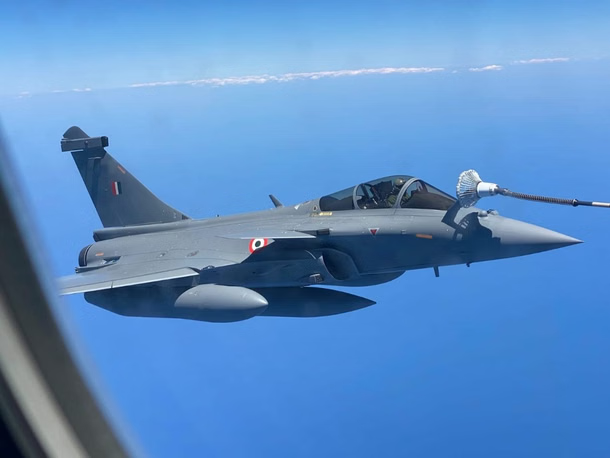
Evaluating fleet versatility and asset mix over sheer numbers, the 2026 WDMMA global index positions India right behind the US and Russia, while flagging critical domestic squadron gaps.
NEW DELHI — The Indian Air Force (IAF) has successfully retained its position as the world’s third-most powerful military aviation arm by country in the latest global rankings released by the World Directory of Modern Military Aircraft (WDMMA). This milestone marks the fifth consecutive assessment since 2022—and the sixth occasion overall—that New Delhi has outflanked China’s People’s Liberation Army Air Force (PLAAF) on the global leaderboard.
Add businessleague.in as a Preferred Source


Also Read | The Constitutional Exit: Analyzing the George Kurian Resignation Council of Ministers Data
The comprehensive 2026 WDMMA report evaluates 129 distinct air services across 103 nations, mapping an aggregate global footprint of more than 48,000 active military aircraft. When assessed by individual service wings, the IAF secures the sixth position globally, sitting comfortably alongside specialized, distributed sub-branches of the United States armed forces and the consolidated Russian Air Force.
1. The True Value Metric: Why Balance Beats Bulk
The WDMMA methodology rejects simple head-to-head calculations that focus exclusively on raw fighter jet tallies. Instead, the directory scores global air arms using its proprietary True Value Rating (TVR) formula. This balanced equation awards heavy statistical weight to tactical versatility, logistics, indigenous aerospace manufacturing depth, future order books, and the ratio of frontline combat fighters to force-multiplying support assets.
WDMMA Evaluation Blueprint:
📐 Fleet Size + 🛠️ Fleet Mix Ratio + 🌐 Logistical Support + 🚀 Indigenisation ➔ 📊 Final True Value Rating (TVR)
By prioritizing fleet diversification over massive, single-role fighter lines, the index places the IAF (TVR: 69.4) ahead of China’s numerically superior PLAAF (TVR: 63.8), despite Beijing maintaining a larger overall inventory. The rating values the presence of specialized missions—such as airborne early warning nets, dedicated trainer lines, tactical transport columns, and electronic warfare platforms—as highly as pure air-superiority capabilities.
Also Read | The Constitutional Exit: Analyzing the George Kurian Resignation Council of Ministers Data
2. Granular Breakdown of the IAF Asset Profile
According to verified data tracking parameters, the IAF operates a versatile, multi-role fleet consisting of 1,716 active aircraft units.
IAF Inventory Mix & Segment Percentages
| Aircraft Fleet Classification | Active Unit Count | Percentage of Total Fleet | Core Structural Components |
| Frontline Fighter Jets | 542 | ~31.6% | Spans 7 distinct operational types; still retains retired MiG-21 baselines in active review logs. |
| Rotary-Wing Fleet | 498 | ~29.0% | Includes 222 workhorse Mi-17 heavy lifters alongside 111 indigenous HAL Dhruv and Rudra variants. |
| Training Platforms | 374 | ~21.8% | Comprises 325 pure training crafts alongside dual-seat conversion variations. |
| Transport Columns | 282 | ~16.4% | Heavy and medium strategic airlift assets managing multi-theater logistical support. |
| Special Mission Assets | 20 | ~1.2% | Dedicated airborne early-warning systems, mid-air refueling tankers, and electronic eavesdropping nodes. |
In stark contrast, the top-ranked United States Air Force (USAF)—which leads the world with a flawless TVR score of 242.9—maintains a heavily skewed fixed-wing structure. While combat fighters and strategic bombers dominate 41% of the American inventory, helicopters account for just 4% of their fleet, whereas transport and utility rotaries make up nearly half (46%) of India’s airborne presence.
3. The Capability Paradox: Critical Deficits Remain
Despite its elite top-three global ranking, defense analysts and the WDMMA report warn that India continues to navigate severe, long-term capability gaps. The most glaring challenge is the service’s shrinking fighter squadron strength:
⚠️ The Squadron Deficit: The IAF currently operates just 29 active fighter squadrons, falling significantly short of its long-term sanctioned defense requirement of 42 squadrons. At an optimized operational metric of 18 aircraft per squadron, the service faces a structural shortfall of roughly 230 combat fighters against its target fleet size of 750 aircraft.
Furthermore, the force suffers from chronic shortages in critical force-multiplier segments, including multi-role mid-air refueling tankers, localized electronic warfare suites, and high-altitude Intelligence, Surveillance, Target Acquisition, and Reconnaissance (ISTAR) assets.
Also Read | The Constitutional Exit: Analyzing the George Kurian Resignation Council of Ministers Data
The Roadmap to Modernisation
To close these vulnerabilities and offset the massive wave of upcoming retirements slated for the 2030s—when over 200 legacy Jaguar, Mirage 2000, and MiG-29 fighters will be permanently phased out—the IAF is pursuing an aggressive dual procurement track.
Also Read | The Constitutional Exit: Analyzing the George Kurian Resignation Council of Ministers Data
Add businessleague.in as a Preferred Source
🙏 Support Independent Journalism
We keep news free for you.
Most readers support with ₹500 ❤️
or scan QR below

Voluntary contribution. No tax benefits.
DISCLAIMER
We have taken all measures to ensure that the information provided in this article and on our social media platform is credible, verified and sourced from other Big media Houses. For any feedback or complaint, reach out to us at businessleaguein@gmail.com