Now the world’s most critical energy lifeline is the setting for a high-stakes maritime confrontation. Following the collapse of the 21-hour Islamabad peace talks, the US blockade of Iran April 2026 has entered a decisive phase. First, President Donald Trump announced on April 12 that the US will interdict any vessels attempting to enter or leave Iranian coastal areas. Therefore, the administration is using a classic naval blockade to counter Iran’s attempts to charge tolls in the Strait of Hormuz. Meanwhile, US Central Command (CENTCOM) has clarified that while Iranian trade is restricted, freedom of navigation for neutral transit remains a top priority.
Add businessleague.in as a Preferred Source


Also Read |Tamil Nadu Voter List Purge: 97 Lakh Names Deleted in SIR Phase 1
Islamabad Fallout: Why Diplomacy Failed on April 12
Now we must examine the sudden collapse of the highly anticipated peace negotiations. First, the 21-hour talks in Islamabad were meant to secure a permanent ceasefire and reopen the Strait of Hormuz. Therefore, the failure of these discussions represents a total breakdown in regional diplomacy.
Next, President Trump claimed that Iran violated a key precondition by effectively keeping the strait restricted through a “toll booth” system. Thus, the transition from talking to blockading happened within hours of the aircraft leaving Pakistan.
Meanwhile, Iranian officials cite the presence of naval mines as the reason for the closure of international lanes. Therefore, the US blockade of Iran April 2026 is being framed by Washington as a necessary enforcement of international law. So the path to peace has been replaced by the roar of carrier jets.
The Tehran Toll Booth: Iran’s Shadow Corridor in the Strait
So how exactly was Iran “restricting” the strait? First, authorities in Tehran advised merchant ships to avoid international lanes and use a corridor through the islands of Qeshm and Larak. Therefore, vessels were forced into Iranian territorial waters where they could be easily interdicted.
Next, shipping authorities have nicknamed this route the “Tehran Toll Booth.” Thus, it is believed that Iran is charging fees for safe passage—a move the US considers maritime extortion.
[Image showing a map of the Strait of Hormuz with a red line indicating the ‘Toll’ corridor]
Meanwhile, less than a dozen ships have braved this new passage since the ceasefire ended. Therefore, the US blockade of Iran April 2026 is a direct response to this “extortionate” maritime strategy. So the US aim is to restore the original, mine-free international shipping lanes.
Defining the Blockade: CENTCOM’s Rules of Engagement
Now let’s look at the legal and operational definitions being used by the US military. First, an April 13 statement from CENTCOM clarified that the blockade is “impartial.” Therefore, it applies to vessels of all nations—enemy or neutral—that are entering or departing Iranian ports.
Next, the US is following the 2022 Commander’s Handbook on the Law of Naval Operations. Thus, they are defining it as a “belligerent operation” to prevent the enemy state from using its coastal areas for trade.
CENTCOM Enforcement Rules:
-
Inbound/Outbound: No ships allowed into or out of Iranian ports.
-
Neutral Transit: Freedom of navigation remains for ships transiting to non-Iranian ports.
-
Area of Operation: Covers all Iranian ports in the Arabian Gulf and Gulf of Oman.
Meanwhile, this specific targeting aims to turn Iran into a “land-locked country.” Therefore, the US blockade of Iran April 2026 is designed to choke the Iranian economy without stopping global oil flows to neutral nations.
Also Read |Tamil Nadu Voter List Purge: 97 Lakh Names Deleted in SIR Phase 1
US Naval Might: 20 Warships and 200 Aircraft Deployed
So what kind of hardware is President Trump bringing to the fight? First, the US already has the USS Abraham Lincoln Carrier Strike Group (CSG) in the Arabian Sea. Therefore, they have a massive aerial and electronic warfare platform ready for immediate deployment.
Next, the USS Ronald Reagan CSG is currently moving to join the fleet. Thus, the US will soon have two full strike groups operating in tandem near the strait.
[Image showing a bird’s-eye view of a US Navy Carrier Strike Group in formation]
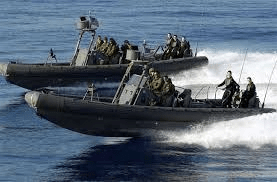
Meanwhile, two Amphibious Ready Groups (ARG)—the USS Iwo Jima and the USS Boxer—provide additional versatility for coastal interdiction. Therefore, with over 20 warships and 200 aircraft, the US blockade of Iran April 2026 is backed by the most powerful navy on the planet. So the message to Tehran is one of overwhelming force.
Mine Clearance: Underwater Drones and the USS Abraham Lincoln
Now the most dangerous part of the mission is the removal of Iran’s sea mines. First, on April 12, two US warships successfully transited the strait to carry out an initial demining operation. Therefore, these are the first US vessels to cross the chokepoint since the war began on February 28.
Next, the Navy is deploying advanced underwater drones for autonomous mine detection and disposal. Thus, they are trying to minimize the risk to human divers in the “red-hot” zone.
Meanwhile, the presence of the USS Abraham Lincoln provides the necessary air cover for these vulnerable demining units. Therefore, the US blockade of Iran April 2026 involves a multi-layered approach to reclaiming the international lanes. So the US is clearing the path while simultaneously closing the gate on Iran.
Iran’s Counter: Ghadir Midget Submarines and Ballistic Missiles
So how will Tehran fight back against a blockade? First, they possess around 20 Ghadir-class midget submarines. Therefore, they can deploy “modern avatars” of the 19th-century Hunley to strike US warships from beneath the waves.
Next, each of these 125-ton submarines carries two 533 mm torpedoes, designed specifically for shallow-water ambushes. Thus, the narrow confines of the strait play into their tactical advantage.
Iran’s Asymmetric Arsenal:
-
Ghadir-class Subs: Low-profile, midget submarines for torpedo strikes.
-
Anti-Ship Ballistic Missiles: Capable of targeting large carriers from the coast.
-
Free-Floating Mines: The most disruptive naval weapons if unleashed in the main channel.
Meanwhile, Iran’s ocean-going navy was largely neutralized in earlier stages of the war. Therefore, they are relying on “coastal bastions” and drones to enforce their own will. So the US blockade of Iran April 2026 will be a test of asymmetric warfare.
Also Read |Tamil Nadu Voter List Purge: 97 Lakh Names Deleted in SIR Phase 1
The ‘Fort vs. Ship’ Paradox: Iran’s Coastal Advantage
Now we must consider the ancient wisdom that “a ship’s a fool to fight a fort.” First, Iran has spent decades turning its coastline into a “powerful fort” filled with missiles and hardened drone bases. Therefore, the US Navy is operating in an environment where the enemy has the “home field” advantage.
Next, all Iran needs to do is target US assets operating in close proximity to their shores. Thus, they don’t need a massive navy to inflict significant damage.
Meanwhile, the US has the technological edge, but the “fort” can stay in place forever while the “ship” must eventually refuel and repair. Therefore, the US blockade of Iran April 2026 is a battle of endurance. So the world is watching to see if the world’s most powerful navy can truly neutralize a “continental fort.”
Economic Stakes: The Lifeline for India, China, and Korea
So who wins or loses if the strait stays closed? First, more than 20% of the world’s oil and gas passes through this narrow gap. Therefore, the majority of this energy flows eastwards to India, China, Japan, and South Korea.
Next, while the US and Europe are less dependent on this specific oil, the global economy is not. Thus, a total shutdown would trigger an energy shock that would dwarf previous crises.
Meanwhile, five of the six GCC countries are entirely dependent on the strait for their survival and exports. Therefore, the US blockade of Iran April 2026 is an attempt to protect the world’s largest oil consumers from Iranian interference. So the success of this blockade is a matter of global economic survival.
Common Questions Answered
What is the US blockade of Iran April 2026? Now it is a naval operation ordered by President Trump to block ships entering or leaving Iranian ports while keeping the Strait of Hormuz open for neutral transit.
Why did the US start the blockade? First, because the Islamabad peace talks collapsed on April 12. Next, the US claims Iran was charging illegal tolls in the strait and refusing to clear mines.
What is the ‘Tehran Toll Booth’? So it is a nickname for a new shipping corridor Iran forced vessels to take through its territorial waters. Thus, they were allegedly charging fees for passage.
Will the US blockade stop all oil in the Strait? Actually, no. CENTCOM has stated they will not impede freedom of navigation for vessels going to non-Iranian ports. Therefore, GCC oil should still flow.
What hardware is the US using for the blockade? Finally, they have two Carrier Strike Groups and two Amphibious Ready Groups. Thus, it’s a massive grouping of over 20 warships and 200 aircraft.
How is Iran fighting back? So they are using Ghadir-class midget submarines, sea mines, and coastal ballistic missiles. Therefore, they are focusing on asymmetric coastal defense.
Also Read |Tamil Nadu Voter List Purge: 97 Lakh Names Deleted in SIR Phase 1
End….
Add businessleague.in as a Preferred Source
🙏 Support Independent Journalism
We keep news free for you.
Most readers support with ₹500 ❤️
or scan QR below

Voluntary contribution. No tax benefits.
DISCLAIMER
We have taken all measures to ensure that the information provided in this article and on our social media platform is credible, verified and sourced from other Big media Houses. For any feedback or complaint, reach out to us at businessleaguein@gmail.com