

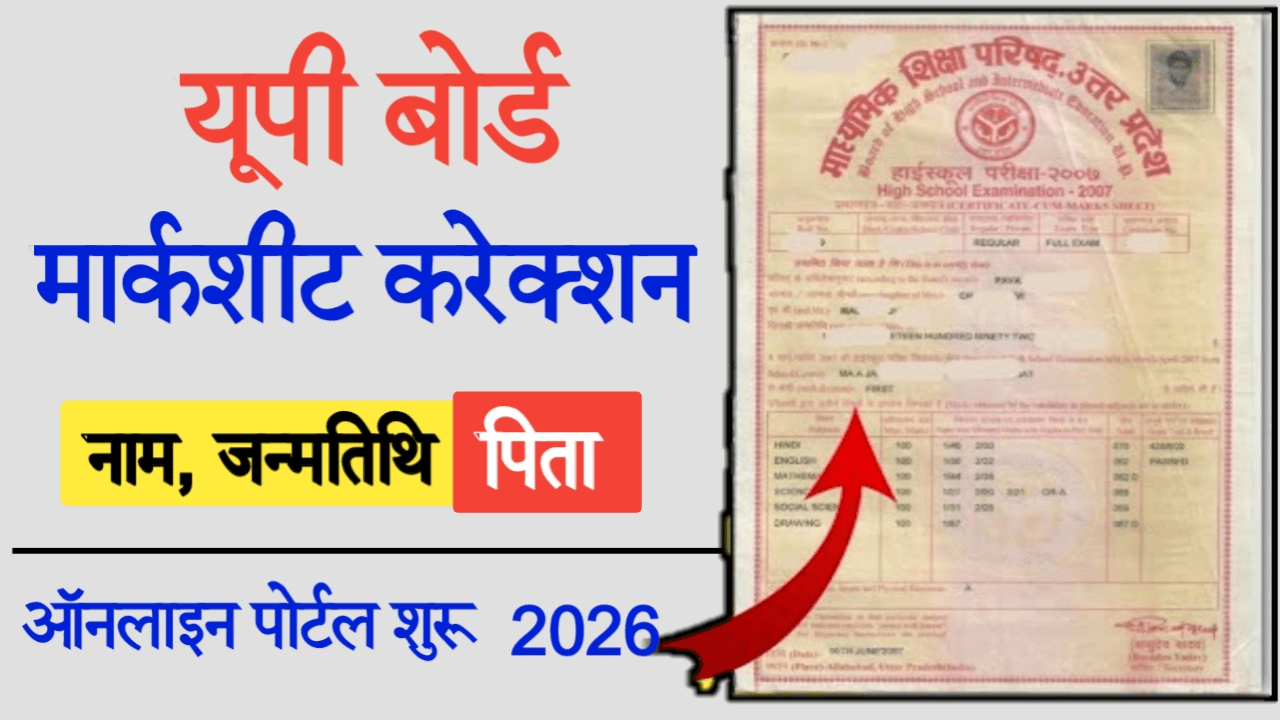
Now the academic journey for lakhs of students in Uttar Pradesh has become significantly smoother thanks to a major digital overhaul. The Uttar Pradesh Madhyamik Shiksha Parishad (UPMSP) has officially introduced a new, easier correction facility for Class 10 and Class 12 marksheets and certificates. Therefore, students who find errors in their official documents after the 2026 result declaration can now resolve them through a modernized system. Meanwhile, this initiative is designed to eliminate the long-standing bureaucratic hurdles that previously delayed college admissions and job applications.
Add businessleague.in as a Preferred Source


Also Read |Tamil Nadu Voter List Purge: 97 Lakh Names Deleted in SIR Phase 1
What is the New Correction Facility? Key Errors Addressed
Now the UPMSP has identified that even minor clerical errors can jeopardize a student’s future. Therefore, the new facility specifically targets the most common mismatches found in academic records. Students can now request updates for:
-
Name Spelling: Rectifying typos in the student’s own name.
-
Parental Information: Correcting errors in Mother’s or Father’s names.
-
Vital Records: Fixing Date of Birth (DOB) discrepancies.
-
Subject Alignment: Adjusting subject details or personal information mismatches.
First, these corrections are essential because academic documents serve as primary identity proof in India. Next, the board aims to ensure that the “Final Marksheet” received by the student is error-free. Thus, the system is designed to catch mistakes before they cause long-term career delays.
How to Apply: The Online Correction Process Explained
Now the process has moved from physical offices to the official digital portal. To apply for a correction, students must follow a structured path that involves their local educational institutions. Therefore, while the application is digital, it remains securely rooted in school verification.
Steps to Request Correction:
-
First, visit the official UPMSP website at upmsp.edu.in.
-
Next, navigate to the “Marksheet Correction” link provided in the notification section.
-
Thus, fill in the required details and upload the supporting documents.
-
Finally, submit the application which is then forwarded to the school principal for verification.
So the Principal and District Inspector of Schools (DIOS) play a vital role in the approval hierarchy. Meanwhile, the digital trail ensures that students can track their application status in real-time. Therefore, the need for “agent” interventions has been completely eliminated.
Legacy of Bureaucracy: Why the Old System Failed
Now it is important to understand the difficulty students faced prior to this reform. Earlier, correcting a single letter in a name often required multiple visits to the District Inspector office or the regional board headquarters. Therefore, the process was notoriously time-consuming and prone to delays.
First, many students would wait for months, sometimes missing admission deadlines for prestigious universities. Next, the heavy reliance on physical paperwork meant that files were easily misplaced or stuck in administrative loops. Thus, the transition to a digital-first approach was a mechanical necessity for the board.
So the 2026 update builds upon smaller pilot projects launched since 2017. Meanwhile, the current system is more robust and offers better user access. Therefore, the “relief” described by the board is a direct response to years of student grievances.
Also Read |Tamil Nadu Voter List Purge: 97 Lakh Names Deleted in SIR Phase 1
Benefits of Digital Reform: Transparency and Speed
Now the modernization of the documentation system offers several immediate advantages for the UP student body. Therefore, the UPMSP is prioritizing “Ease of Service” as a core administrative goal.
Key Advantages:
-
Speed: Faster resolution of document errors compared to the offline era.
-
Transparency: improving visibility into the approval process.
-
Paperwork: Minimizing the need for physical copies and manual signatures.
-
Accessibility: Allowing students in rural areas to apply without traveling to cities.
First, the improved transparency helps in reducing instances of fraud and unauthorized changes. Next, the faster turnaround time is critical during the peak admission months of June and July. Thus, the board is successfully using technology to meet student needs in a timely manner.
Impact on Admissions and Passports: Solving Verification Issues
Now incorrect academic records are more than just an annoyance; they are a legal hurdle. Academic documents are mandatory for passport verification and government job applications. Therefore, even a small spelling mistake can lead to the rejection of a visa or a permanent position.
First, college admissions offices in 2026 use automated verification systems that flag even minor mismatches. Next, the new UPMSP facility allows students to rectify these issues before they reach the verification stage. Thus, the board is actively helping students avoid future legal and professional obstacles.
So the integration of these records with digital lockers is another step toward seamless verification. Meanwhile, students are urged to check their digital marksheets immediately upon the result declaration. Therefore, the window for correction is most effective when used early in the academic cycle.
UP Board’s Broader Digital Push: Tamper-Proof Tech
Now the correction facility is just one part of a larger technology-driven roadmap. The UPMSP has introduced several measures to modernize the entire examination lifecycle. Therefore, the security of student data is now on par with national boards like CBSE.
Modern Reforms Include:
-
Tamper-proof Marksheets: Using QR codes and encrypted digital signatures.
-
Non-tearable Certificates: Utilizing durable materials for longevity.
-
Digital Verification: Allowing employers to verify credentials online instantly.
First, these measures are aimed at reducing the circulation of fraudulent certificates. Next, the non-tearable nature of the physical documents ensures they survive long-term handling. Thus, the UP Board is shedding its traditional image in favor of a tech-forward identity.
Also Read |Tamil Nadu Voter List Purge: 97 Lakh Names Deleted in SIR Phase 1
Mandatory Documents: What You Need for Correction
Now for a successful digital application, you must have the correct supporting evidence ready. Therefore, the board requires specific documents to verify that the requested change is legitimate.
Required Documentation:
-
Original Marksheet: A scanned copy of the document containing the error.
-
Identity Proof: A valid government ID (like a Passport or Voter ID).
-
School Records: A copy of the admission register or TC (Transfer Certificate) showing the correct details.
-
Affidavit: In some cases, a notarized affidavit may be required for significant changes.
First, ensuring that these scans are clear and legible is vital for a quick approval. Next, the Principal will cross-verify these uploads with the physical school records. Thus, the integrity of the board’s database is maintained throughout the process.
FAQ: UP Board Marksheet Correction 2026
1. Where can I apply for UP Board marksheet correction? Now, you can apply through the official UPMSP portal at upmsp.edu.in.
2. Can I change my Date of Birth online? First, yes. The new facility allows for corrections in DOB, provided you have the supporting school and birth records.
3. Do I still need to visit the board office in person? So for most clerical and minor spelling errors, the digital process handles everything. Next, only highly complex or disputed cases might require a physical visit.
4. What is the fee for online correction? Now, you should check the latest notification on the UPMSP website as fees can vary based on the type of correction and the time elapsed since the result.
5. How long does the online correction process take? Finally, while much faster than the old system, it typically takes a few weeks as it requires verification from both the school and the District Inspector (DIOS).
Also Read |Tamil Nadu Voter List Purge: 97 Lakh Names Deleted in SIR Phase 1
End…
Add businessleague.in as a Preferred Source

