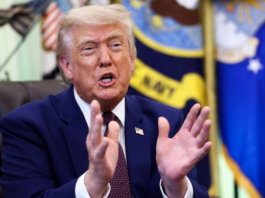

Now the intense undercurrents of the modern tech war have completely overshadowed traditional diplomatic etiquette. In a stunning counter-espionage demonstration at the Beijing airport, the American delegation led by US President Donald Trump systematically discarded every single physical gift, badge, pin, and souvenir provided by their Chinese hosts before boarding Air Force One. Therefore, the dramatic tarmac clearing has exposed the deep layer of structural mistrust separating the two global superpowers. Meanwhile, the absolute directive was dictated by rigid US counterintelligence policies designed to neutralize potential electronic surveillance and hidden tracking bugs. Following a viral video and eyewitness logs, it is clear that geopolitics has left zero room for compromise on national security.
Add businessleague.in as a Preferred Source


Also Read |Tamil Nadu Voter List Purge: 97 Lakh Names Deleted in SIR Phase 1
The Tarmac Purge: How NYP’s Emily Goodin Exposed the Security Sweep
Now the historic clearing of state-level gifts was brought to light by an alert member of the presidential press pool. Emily Goodin, a prominent correspondent for the New York Post, witnessed the entire event firsthand at the airport terminal. Therefore, her real-time description published on the social platform X immediately ignited a global media storm.
First, Goodin documented that members of the US delegation discarded everything provided to them by their Chinese hosts into on-site garbage cans. Next, the directive was described as absolute, leaving no room for sentimental exceptions or diplomatic politeness. Thus, the physical sweep was executed efficiently under the direct supervision of federal protection officers.
So the image of official state souvenirs piling up inside airport trash containers has become an iconic representation of 2026 diplomacy. Meanwhile, the Chinese foreign ministry has maintained a quiet posture regarding the tarmac leak. Therefore, the journalist’s confirmation serves as an unedited look into the raw mechanics of modern counter-surveillance.
Bypassing the Bugs: The Mechanical Necessity of Discarding Pins
Now outside observers might wonder why a simple commemorative badge or metal pin would cause such an aggressive security response. Counterintelligence experts point out that modern micro-electronics allow tracking components to be built into almost any material. Therefore, treating every small item as a potential tracking beacon is a logical mechanical necessity.
First, miniature audio transmitters and passive RF transponders can easily be hidden inside the backing of a protocol badge. Next, these miniature nodes can map out the internal spatial layout of highly sensitive aircraft cabins without leaving an obvious electronic trace. Thus, the strict rule—”nothing made in China goes on board”—is an absolute defensive baseline.
So the security detail treated the gifts not as friendly gestures, but as active surveillance risks. Meanwhile, technical teams have been sweeping the delegation’s luggage using advanced signal detection gear. Therefore, the complete purge of all souvenirs is viewed as the only bulletproof method to achieve absolute containment.
Burner Phone Protocols: Eliminating Trace Infrastructure Footprints
Now the physical disposal of gifts was only the final stage of a highly advanced digital defense protocol implemented for the summit. Throughout the duration of the talks with President Xi Jinping, American delegates operated under strict communication limits. Therefore, standard personal smartphones were entirely barred from accessing local cellular towers.
The Disposable Communication Matrix:
-
The Hardware: Delegation members were equipped with generic, temporary “burner phones.”
-
The Purpose: Allowed basic operational talk without exposing primary corporate or state network profiles.
-
The Fate: Collected on the tarmac and physically crushed before boarding commenced.
-
The Result: Left zero long-term storage data for state-sponsored packet interception units to analyze.
First, using generic temporary devices prevents local sniffing stations from logging sensitive cryptographic signatures. Next, the total destruction of the units ensures that no residual network handshakes can be extracted post-departure. Thus, the temporary phone lifecycle remains a key asset for conducting high-level talks inside foreign territory.
Also Read |Tamil Nadu Voter List Purge: 97 Lakh Names Deleted in SIR Phase 1
Faraday Bag Shielding: Halting Remote Electromagnetic Exploits
Now managing the delegates’ primary communication units required a complete blocking of all wireless signal pathways. While inside Chinese boundaries, all personal electronic devices were forced into specialized, high-tier Faraday bags. Therefore, the hardware was completely isolated from the surrounding electronic ecosystem.
First, these specialized layers utilize a dense metallic grid framework that completely blocks all incoming and outgoing electromagnetic transmissions. Next, this absolute isolation stops remote hacking units from deploying zero-click exploits to install hidden monitoring software. Thus, the bags serve as an impermeable shield against localized data siphoning sweeps.
So the devices remained locked within these dark radio environments until the aircraft reached international airspace. Meanwhile, engineers monitored the logs to ensure no wireless leaking occurred during the ground transfers. Therefore, the deployment of Faraday enclosures is the modern standard for protecting sensitive state secrets.
The Tech-War Paradox: Billion-Dollar Deals vs. State Surveillance
Now the tarmac purge presents a highly fascinating paradox when viewed alongside the macroeconomic outcomes of the visit. At the exact same summit, President Trump finalized a massive trade deal involving China’s commitment to purchase up to 200 Boeing commercial jets. Therefore, multi-billion dollar trade partnerships are moving forward parallel to intense security crackdowns.
First, this dual reality demonstrates that economic cooperation is being heavily separated from national infrastructure protection. Next, while agricultural and aviation markets achieve deep integration, the underlying technology sectors are facing complete decoupling. Thus, a lucrative business deal does not buy a pass for intelligence vulnerabilities.
So the corporate world must learn to navigate this highly segmented global operating environment. Meanwhile, industrial supply lines are adjusting to tougher compliance tracking regarding where specific computer components are made. Therefore, the trash bin on the Beijing tarmac highlights how the geopolitical war allows no room for structural compromise.
Intellectual Property Friction: The Core Driver Behind the Mistrust
Now the underlying driver forcing these extreme tarmac precautions is a decades-long pattern of commercial friction. For years, the United States has leveled consistent accusations against Beijing regarding state-sponsored intellectual property theft and unauthorized data collection. Therefore, the Secret Service protocols are built entirely on historical friction rather than sudden paranoia.
-
Primary Security Threats Logged:
-
Industrial Data Collection: Attempts to access proprietary design files from aerospace and tech delegates.
-
Network Architecture Mapping: Using proximity signals to find entry paths into secure government servers.
-
Acoustic Surveillance: Utilizing tiny microphones embedded in souvenirs to harvest verbal transcripts.
-
First, while Beijing consistently denies executing these digital campaigns, Western defense panels remain entirely unconvinced. Next, the potential cost of a single compromised terminal can easily reach into hundreds of millions of dollars in lost technical excellence. Thus, the physical removal of all host-provided items remains a logical protective response.
Also Read |Tamil Nadu Voter List Purge: 97 Lakh Names Deleted in SIR Phase 1
Air Force One Sanctuary: Preserving the Integrity of the Sky CMO
Now maintaining the absolute physical and electronic purity of Air Force One is a paramount priority for the accompanying military units. The presidential aircraft functions as a flying command center, loaded with highly classified defense communication infrastructure. Therefore, allowing any unverified foreign hardware into that sensitive envelope is an unacceptable risk.
First, even an unpowered passive tracking chip can be activated by external radar sweeps once the plane is airborne. Next, keeping the cabin environment entirely clean ensures that no unauthorized frequencies can jam vital military links. Thus, the airplane is treated as an active sanctuary that must remain free from external hardware corruption.
So the crew enforced the garbage disposal mandate with military precision before the final step-up into the main cabin. Meanwhile, electronic warfare specialists scanned the tarmac path to ensure all tracking attempts were completely blinded. Therefore, the “trash bin protocol” will likely remain standard practice for all future high-risk diplomatic itineraries.
FAQ: Understanding the Air Force One Tarmac Security Mandate
1. Why did Trump’s team throw away all the Chinese gifts at the airport? Now, the delegation discarded the gifts as a counterintelligence measure to eliminate risks of cyber espionage, hidden audio bugs, and passive tracking devices.
2. Who reported the tarmac incident in Beijing? First, the security sweep was captured and verified by New York Post correspondent Emily Goodin, who was covering the summit within the official press pool.
3. What specific items were dumped into the trash cans? So, the delegation disposed of all host-provided items, including protocol pins, commemorative badges, physical souvenirs, and temporary electronic burner phones.
4. How did the US team protect their personal mobile phones? Next, all personal electronic devices were placed inside specialized Faraday bags that completely block all wireless signals to prevent remote hacking or tracking.
5. Did this incident damage the trade deals signed during the summit? Now, no. Despite the security purge, the macroeconomic agreements—including China’s massive purchase of 200 Boeing jets—remain fully intact.
6. Is this the first time the US has taken such precautions with Chinese goods? Finally, while the public execution on the tarmac was unprecedented, the underlying protocol stems from years of US concerns regarding state-sponsored intellectual property violations.
Also Read |Tamil Nadu Voter List Purge: 97 Lakh Names Deleted in SIR Phase 1
End…
Add businessleague.in as a Preferred Source
🙏 Support Independent Journalism
We keep news free for you.
Most readers support with ₹500 ❤️
or scan QR below

Voluntary contribution. No tax benefits.
DISCLAIMER
We have taken all measures to ensure that the information provided in this article and on our social media platform is credible, verified and sourced from other Big media Houses. For any feedback or complaint, reach out to us at businessleaguein@gmail.com