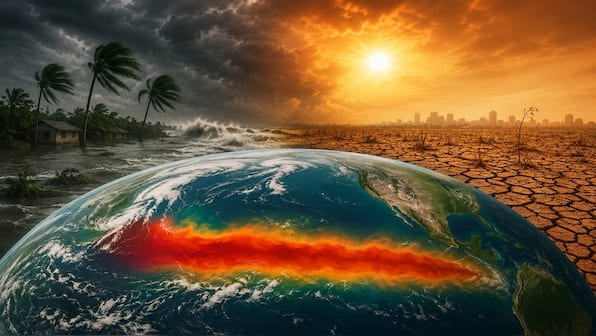
The State of the Climate in Asia report tracks mass loss across all 23 principal Himalayan glaciers while coastal sea levels surge at a dangerous 4.9 mm annually, risking severe urban flooding.
Add businessleague.in as a Preferred Source


The global environmental systems regulating freshwater distribution, agricultural cycles, and coastal safety lines across the world’s most populous continent have entered a highly dangerous phase. Issuing its definitive State of the Climate in Asia report on Thursday, June 18, 2026, the World Meteorological Organization (WMO) delivered a stark WMO Asia climate change report 2026 diagnostic. The climate data reveals that over the 1991–2025 observation window, warming across the Asian landmass grew almost twice as fast compared to the 1961–1990 historical average, locking 2025 in as the second-hottest year ever recorded in continental history.
The structural impact of this rapid warming is moving past simple temperature changes, turning into an active humanitarian and economic challenge for India, China, Japan, and Pakistan.
From record-breaking summer heatwaves that drove up localized temperatures by 14°C in Central Asia to devastating monsoon rains that killed over 1,000 people in Pakistan, erratic weather shifts are putting incredible strain on regional infrastructure.
Faced with a short-term timeline before these climate shifts become permanent, global scientists warn that traditional mitigation strategies must be completely overhauled.
Also Read | Viral Trump Lookalike Buffalo Rescue: Saved From Eid Sacrifice
The Disappearing Third Pole: The Sudden Himalayan Retreat
The most critical structural risk outlined by the international weather agency centers on the rapid melting occurring across the Himalayan and Tibetan Plateau networks.
Known globally as the Earth’s “Third Pole” due to its massive freshwater ice formations outside the polar circles, this geographic system serves as the primary water source for over a billion people downstream.
The data shows that all 23 principal glaciers tracked across the Third Pole experienced significant mass loss, with the fastest melting recorded along the high Tian Shan and Pamir mountain ranges.
In the short term, this accelerated melting fills high-altitude glacial lakes to the breaking point, heavily increasing the risk of sudden Glacial Lake Outburst Floods (GLOFs) that can wipe out downstream mountain villages without warning.
Over the long term, as these ancient ice reservoirs disappear, the steady flow of essential rivers like the Indus, Ganga, and Brahmaputra will drop sharply, threatening agricultural irrigation and drinking water security across India, Nepal, Bhutan, and Pakistan.
Slicing Through the Rising Tide and Coastal Risk Matrix
Beyond the mountain peaks, the oceans surrounding the subcontinent are shifting rapidly, introducing secondary climate risks to major coastal cities and economic hubs:
| Monitored Climate Vector | Historical Global Averages | Recorded Asian Anomalies | Structural Consequence for Indian Cities |
| Annual Sea-Level Rise | 3.6 mm Per Year Baseline | 4.9 mm Per Year Surge | Threatens low-lying coastal metros like Mumbai, Kolkata, and Chennai. |
| Marine Heatwave Expansion | Short-term, localized warm spots. | 10 Million Sq Km Covered | Exceeds the total land area of both the U.S. and China combined. |
| Oceanic Chemistry Shift | Balanced marine pH baselines. | Rapid, severe acidification loops. | Degrades local coral reefs and damages commercial fisheries. |
| Extreme 24-Hr Rainfall | Gradual seasonal water drops. | 10% of annual rain in 24 hours. | Wipes out up to 4% of regional GDP through flash flooding. |
Note: The sudden surge in sea surface temperatures has expanded the danger zone for vulnerable coastal states like Gujarat, Maharashtra, Odisha, Andhra Pradesh, and Tamil Nadu, forcing emergency teams onto high alert to prepare for stronger tropical cyclones.
The underlying text of the WMO review highlights a critical difference in how regional economies survive these weather extremes. In areas with weak meteorological infrastructure, the real-world impact is devastating.
When Cyclone Ditwah struck Sri Lanka, it dumped 10% of the country’s total annual rainfall in a single 24-hour window. Because the island lacked integrated early warning networks, the storm caused over 640 deaths and erased 4% of the country’s total GDP overnight.
Conversely, where advanced multi-hazard forecasting tools were active—such as in China’s Sichuan province—local authorities successfully moved vulnerable populations ahead of time, proving that modern weather networks are essential to saving lives.
Also Read | Viral Trump Lookalike Buffalo Rescue: Saved From Eid Sacrifice
Five Sequence Steps India Is Executing to Weather the Environmental Shift
To protect its dense urban grids, insulate agricultural yields, and shield coastal communities from rising sea levels, India’s environmental task forces are deploying a five-step adaptation plan:
Ultimately, navigating the climate challenges detailed in the WMO Asia climate change report 2026 requires moving quickly from long-term planning to immediate action. As WMO Secretary-General Professor Celeste Saulo warns, the luxury of time has completely expired.
By utilizing advanced forecasting infrastructure, protecting our natural coastal defenses, and investing in drought-resistant agriculture, the country can build a resilient shield against shifting weather patterns.
Taking these proactive system choices protects our vital infrastructure, preserves regional food and water security, and ensures the nation remains on a steady, self-reliant path toward a sustainable future.
FAQ Section
What are the main findings of the newest WMO Asia climate change report 2026?
The World Meteorological Organization’s latest report warns that Asia is warming nearly twice as fast as the historical global average. Key findings include massive freshwater mass loss across all 23 principal Himalayan glaciers, unprecedented marine heatwaves covering 10 million square kilometers, and a rapid 4.9 mm annual sea-level rise along India’s coastlines.
Why does the melting of the Himalayan glaciers directly threaten India’s food security?
The Himalayan glaciers act as the primary freshwater source for India’s largest river systems, including the Indus, Ganga, and Brahmaputra. As these ancient glaciers melt rapidly, it creates a short-term threat of volatile flash flooding downstream, followed by long-term river drying that would devastate irrigation networks across the country’s most productive agricultural zones.
How do modern early warning weather networks affect survival rates during extreme storms?
Modern early warning infrastructure represents the direct difference between life and death. The WMO report highlights that while advanced multi-hazard warning networks in China safely protected communities from severe casualties, the absence of similar forecasting tools in Sri Lanka allowed Cyclone Ditwah to cause over 640 deaths and wipe out 4% of the country’s GDP in a single day.
Also Read | Viral Trump Lookalike Buffalo Rescue: Saved From Eid Sacrifice
End….
Add businessleague.in as a Preferred Source
🙏 Support Independent Journalism
We keep news free for you.
Most readers support with ₹500 ❤️
or scan QR below

Voluntary contribution. No tax benefits.
DISCLAIMER
We have taken all measures to ensure that the information provided in this article and on our social media platform is credible, verified and sourced from other Big media Houses. For any feedback or complaint, reach out to us at businessleaguein@gmail.com