
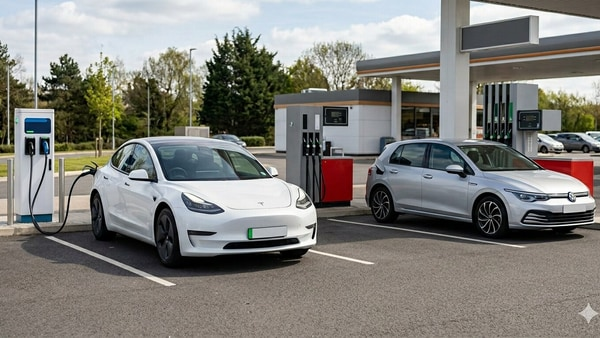
Automotive financial analysts break down the real-world usage limits, revealing why low-mileage private commuters take nearly six years to recover upfront purchase premiums.
Add businessleague.in as a Preferred Source


The commercial narrative driving India’s transition to sustainable transit is facing a major reality check from personal finance analysts. Long promoted as an automated path to vehicle cost savings, the underlying petrol vs EV cost comparison math reveals that electric cars are not a universal financial win. For a large portion of private buyers, the high upfront acquisition premium can take years to recover, turning a green choice into a long-term capital drag.
Ultimately, evaluating true total cost of ownership (TCO) requires looking past basic showroom prices. A realistic financial plan must balance daily distance needs against localized electric rates, while factoring in the hidden investment returns lost when tying up extra capital at purchase.
When calculated cleanly, the numbers show that the benefits of going electric depend entirely on your specific driving habits.
Also Read | Viral Trump Lookalike Buffalo Rescue: Saved From Eid Sacrifice
The Baseline Arithmetic: Slicing Through the Daily Running Expenses
To understand the core economics of the transition, look at a standard operational setup. Assuming a steady fuel baseline of ₹100 per liter for a traditional combustion engine and a standard home utility rate of ₹8 per kWh, the raw per-kilometer running costs show a significant difference.
This math shows a clear running advantage of roughly ₹5.3 per kilometer in favor of the electric battery.
However, this daily operational saving is constantly working to chip away at the substantial purchase premium added onto the vehicle’s initial invoice price at the dealership.
The Capital Recovery Spreadsheet: Tracking True Breakeven Timelines
The real financial test begins when matching those daily running savings against the upfront price premium of an electric model. If an electric car costs a modest ₹3,000,000 extra over its combustion-engine equivalent, a buyer must cover a substantial distance just to clear that capital gap.
| Annual Driving Target | Monthly Commute Allocation | Years Needed to Clear a ₹3 Lakh Premium | Years Needed to Clear a ₹5 Lakh Premium |
| 10,000 Kilometers | ~833 Kilometers | ~5.6 Years of Active Use | ~9.4 Years (Exceeds standard ownership) |
| 15,000 Kilometers | ~1,250 Kilometers | ~3.7 Years of Active Use | ~6.2 Years of Active Use |
| 20,000 Kilometers | ~1,666 Kilometers | ~2.8 Years of Active Use | ~4.7 Years of Active Use |
| 30,000 Kilometers (Fleet) | ~2,500 Kilometers | ~1.8 Years of Active Use | ~3.1 Years of Active Use |
Note: This basic comparison assumes an ideal home charging setup. If an owner relies regularly on fast-charging public networks—where commercial rates often jump to ₹22–₹30 per kWh—the per-kilometer cost advantage drops significantly, pushing the breakeven point further out.
When the initial price gap reaches ₹5 Lakh to ₹6 Lakh, the total distance needed to break even can easily pass the 1-lakh-kilometer mark.
For many urban families who refresh their garage every five years, this timeline means they may sell the vehicle before the fuel savings ever manage to cover the initial purchase premium.
Also Read | Viral Trump Lookalike Buffalo Rescue: Saved From Eid Sacrifice
The Invisible Drag: Calculating Capital Opportunity Cost
The biggest oversight made during standard car-buying comparisons is ignoring opportunity cost. When you spend an extra ₹5 Lakh upfront for an electric powertrain, that capital is permanently locked within a depreciating asset.
Consequently, for an electric car to make true financial sense for a private garage, its operational savings must be significant enough to cover both the initial price premium and the lost investment returns that capital could have earned elsewhere.
This financial hurdle explains why electric vehicles are an immediate home run for taxi fleets and high-mileage operators who clear 40,000 kilometers a year, while remaining a complex puzzle for short-distance city commuters.
By tracking your actual annual driving needs and running the complete numbers before signing the paperwork, you can avoid common showroom traps, ensuring your choice protects both your daily budget and your long-term wealth.
FAQ Section
Why does the petrol vs EV cost comparison math differ for private buyers?
The math shifts because private owners generally drive less than commercial fleet vehicles. When a car covers under 12,000 kilometers annually, the daily savings on electricity take nearly six years to offset the higher upfront purchase price, making it difficult to achieve true financial savings during typical ownership cycles.
What is opportunity cost, and how does it affect electric vehicle ownership?
Opportunity cost refers to the potential returns you give up by choosing one investment over another. Tying up an extra ₹5 Lakh upfront in an electric car means those funds cannot earn interest or growth in a diversified fund, costing you potential investment gains over the life of the vehicle.
How do commercial fast-charging networks alter the breakeven equation?
While charging at home costs an economical ₹8 per kWh, using public commercial fast chargers can push rates past ₹25 per kWh. This increase shrinks the running cost advantage from roughly ₹5 per kilometer down to less than ₹2.5 per kilometer, nearly doubling the total distance required to break even.
Also Read | Viral Trump Lookalike Buffalo Rescue: Saved From Eid Sacrifice
End….
Add businessleague.in as a Preferred Source
🙏 Support Independent Journalism
We keep news free for you.
Most readers support with ₹500 ❤️
or scan QR below

Voluntary contribution. No tax benefits.
DISCLAIMER
We have taken all measures to ensure that the information provided in this article and on our social media platform is credible, verified and sourced from other Big media Houses. For any feedback or complaint, reach out to us at businessleaguein@gmail.com