
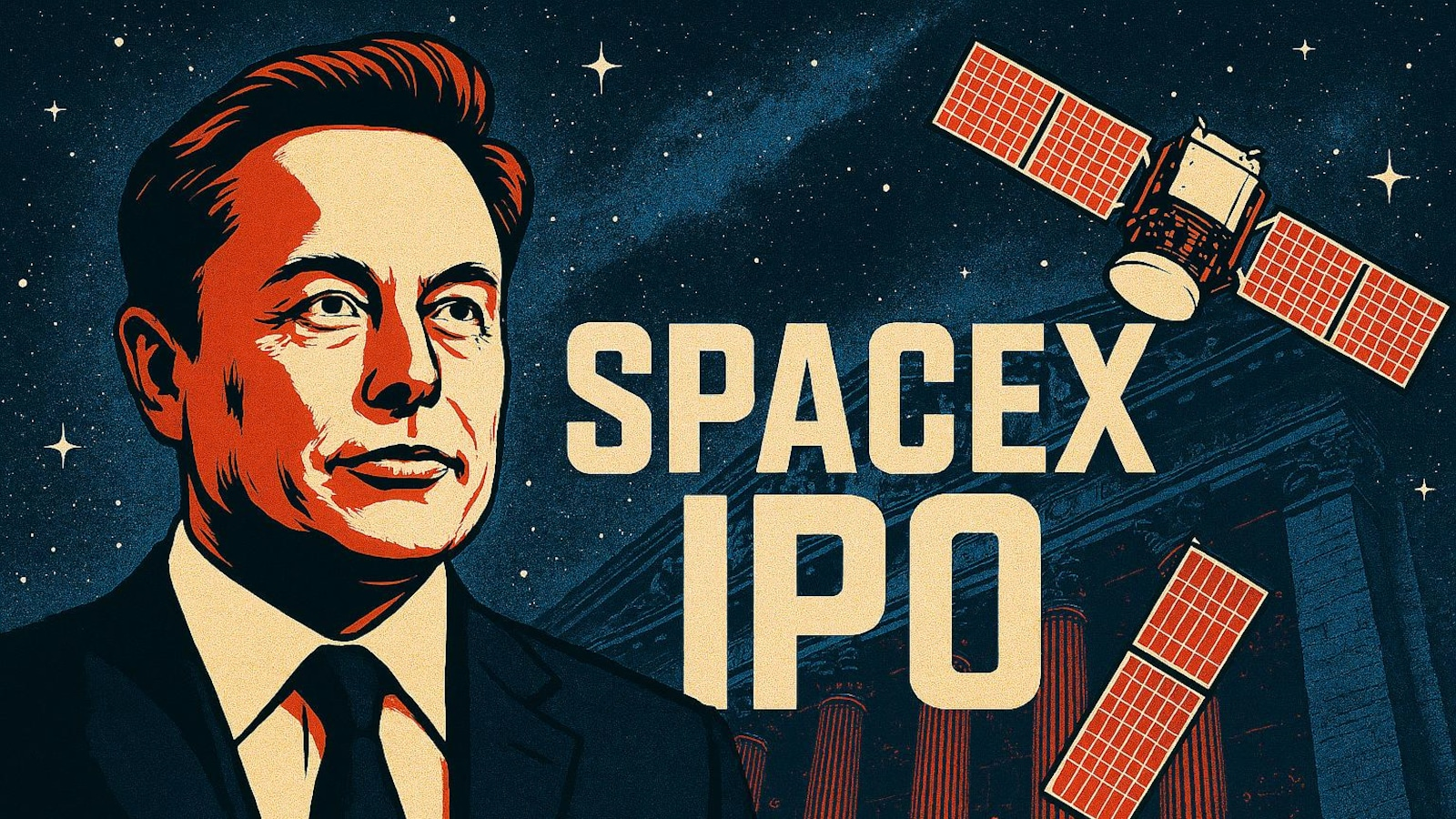
Bypassing standard price-discovery roadshows, the aerospace behemoth hits a fixed $135 share price, valuing the unified rocket, Starlink, and AI enterprise at a staggering $1.77 trillion.
Add businessleague.in as a Preferred Source


The physical boundaries of global capital markets have been completely redefined by the commercial space race. In a monumental financial milestone executed at the opening bell on Friday, June 12, 2026, Space Exploration Technologies Corp. officially went public on the Nasdaq exchange. The record-shattering SpaceX IPO pricing Elon Musk net worth matrix shows an unprecedented leap, pushing the billionaire’s personal fortune to nearly $970 billion and positioning him on the verge of becoming the world’s first validated trillionaire.
Upending decades of Wall Street convention, the company bypassed traditional price-discovery roadshows to lock in a firm, non-negotiable offering price of $135 per share. The blockbuster transaction successfully floating 555.56 million shares raised a massive $75 billion in fresh capital—cementing its status as the largest Initial Public Offering in global history by eclipsing Saudi Aramco’s $29.4 billion record.
Trading under the ticker symbol “SPCX,” the debut establishes an initial market capitalization of $1.77 trillion, placing the venture straight into the top tier of mega-cap global equities.
Also Read | Viral Trump Lookalike Buffalo Rescue: Saved From Eid Sacrifice
Deciphering the Trillion-Dollar Equity Ledger
The dramatic increase in Musk’s net worth is a direct consequence of his extensive equity concentrations within the aerospace firm. Following a strategic 5-for-1 stock split implemented on May 4, 2026, to attract greater retail investor participation, the founder’s paper wealth experienced a historic recalculation.
According to official Securities and Exchange Commission (SEC) regulatory filings, Musk holds a combined position of approximately 6.42 billion split-adjusted shares, consisting of 849.49 million Class A public shares and 5.57 billion Class B insider units.
At the finalized $135 listing price, this single asset pool is worth an astonishing $688 billion. This capital influx single-handedly added roughly $275 billion to his master balance sheet, pulling him miles ahead of any luxury retail or e-commerce contemporaries on the global wealth indexes.
The Governance Engine: Retaining absolute voting control
While institutional asset managers flooding the Nasdaq order books expressed concerns over the high revenue multiples, Musk structured the public debut to ensure his operational vision faces zero corporate interference.
| Share Class Designation | Total Outstanding Volume | Assigned Votes Per Unit | Target Distribution Channel | Corporate Governance Function |
| Class A Common | 555.56 Million (Public Float) | 1 Vote Per Share | 70% Institutional; 30% Earmarked Retail. | Delivers general public liquidity while expanding retail access. |
| Class B Insider | 5.57 Billion Units | 10 Votes Per Share | Locked exclusively to founders and early backers. | Secures 85% absolute voting power directly for Elon Musk. |
This dual-class governance framework ensures that public shareholders hold minimal leverage over long-term strategic decisions.
Musk retains absolute authority to direct capital toward high-risk, multi-decade milestones—including his stated goal of funding a self-sustaining colony on Mars—without facing short-term pressure from quarterly activist hedge funds.
Also Read | Viral Trump Lookalike Buffalo Rescue: Saved From Eid Sacrifice
The Business Pillars Driving the $1.77 Trillion Valuation
Wall Street analysts emphasize that the massive valuation multiple is driven by the vertical integration of three separate, high-growth industries housed within a single corporate hull.
The financial engine driving the company’s daily operations remains its satellite broadband division, Starlink, which generated $11.3 billion in revenue during 2025, accounting for roughly 61% of total company sales.
This steady cash flow is now being paired with the company’s newest division, SpaceXAI (formed via the all-stock absorption of xAI). While the unit’s computing demands contributed to a net loss of $4.94 billion last year, its massive 300MW Colossus 1 data center recently secured a landmark infrastructure lease with Anthropic worth $1.25 billion per month.
By placing high-density artificial intelligence grids directly alongside a launch network that can position next-generation satellite nodes at a fraction of standard commercial costs, the company has built a powerful technological fortress.
The successful listing marks a defining moment for public markets, showing that when standard investment templates are applied to visionary infrastructure, the financial rewards can expand past terrestrial bounds, resetting the limits of modern industrial wealth.
FAQ Section
How did the SpaceX IPO pricing affect Elon Musk’s net worth today?
The blockbuster public debut at a fixed price of $135 per share valued the aerospace company at $1.77 trillion. Because Elon Musk holds a combined position of 6.42 billion split-adjusted shares, the listing valued his personal stake at roughly $688 billion, driving his total net worth to a world-record $970 billion.
Why did SpaceX choose an unconventional fixed-pricing model for its IPO?
Elon Musk upended standard Wall Street procedures by publishing a fixed $135 share price a week before the listing, bypassing the traditional price-discovery roadshows managed by investment banks. This choice highlights the massive institutional demand for the company’s shares and reflects Musk’s unique leverage over capital markets.
What portion of the historic public offering was allocated to retail investors?
In a major effort to give everyday investors a larger stake, SpaceX reserved an unusually high 30% of its public float for retail buyers. Individual investors were able to request share allocations through partner brokerages, including Charles Schwab, E*Trade, Fidelity, and Robinhood.
Also Read | Viral Trump Lookalike Buffalo Rescue: Saved From Eid Sacrifice
End..
Add businessleague.in as a Preferred Source
🙏 Support Independent Journalism
We keep news free for you.
Most readers support with ₹500 ❤️
or scan QR below

Voluntary contribution. No tax benefits.
DISCLAIMER
We have taken all measures to ensure that the information provided in this article and on our social media platform is credible, verified and sourced from other Big media Houses. For any feedback or complaint, reach out to us at businessleaguein@gmail.com