


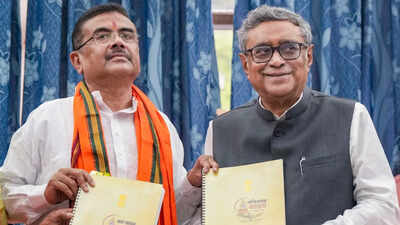
Finance Minister Swapan Dasgupta presents the newly formed BJP government’s first roadmap, headlining the ₹36,000 Crore “Annapurna Yojana” for women and an immediate job drive for one lakh vacancies.
Add businessleague.in as a Preferred Source


The structural financial guidelines and public welfare frameworks governing eastern India’s primary economic engine have undergone a total political shift. Presenting the state’s first full-term budget in the Legislative Assembly on Monday afternoon, June 22, 2026, state Finance Minister Swapan Dasgupta unveiled a net budgetary allocation of ₹4,38,775.29 Crore for the financial year 2026-27. The extensive document introduces a sweeping series of West Bengal Budget 2026 welfare schemes, signaling a new direction for the state administration led by Chief Minister Suvendu Adhikari.
The landmark budget arrived with heavy cultural symbols and clear political goals.
Before heading to the assembly, CM Suvendu Adhikari and FM Dasgupta performed a traditional puja, with the minister carrying the final budget files inside a customized briefcase woven from native Bengali mats and local jute.
Addressing the house, Dasgupta acknowledged that while the state is currently carrying a massive inherited public debt of ₹8.55 Lakh Crore, the new government is committed to honoring all active social projects while launching aggressive new safety nets.
Also Read | Viral Trump Lookalike Buffalo Rescue: Saved From Eid Sacrifice
The Welfare Architecture: Direct Cash Transfers and Job Creation
The legislative plan uses targeted direct benefit transfers (DBT) to provide immediate financial help to rural households and families across the state.
The absolute centerpiece of the budget is the newly launched Annapurna Yojana, which secures an immense ₹36,000 Crore allocation.
This foundational program will deliver direct cash support of ₹3,000 per month to all eligible women across the state.
This major policy shift directly reshapes the state’s welfare landscape, stepping up support beyond the previous administration’s localized cash-transfer frameworks.
Slicing Through the Top Three Departmental Funding Allocations
To manage these massive public programs smoothly, the treasury department has reorganized state funding blocks, directing resources straight to rural development, education, and family care:
| Rank | Targeted Public Department Sector | Secured FY2026-27 Outlay | Primary Focus Areas & Deliverables |
| 1 | Women, Child Development & Welfare | ₹52,308.50 Crore Base | Funds the Annapurna Yojana and the new all-women free bus network. |
| 2 | Panchayats and Rural Development | ₹51,836.55 Crore Base | Expands local housing via 25 lakh new PM Awas units and extends rural jobs. |
| 3 | School and Higher Education Desk | ₹44,948.21 Crore Base | Manages scholarships and maps out fresh regional state universities. |
Also Read | Viral Trump Lookalike Buffalo Rescue: Saved From Eid Sacrifice
Expanding Employment: 100,000 Vacancies and a 20% DA Increase
The budget moves fast to address long-standing wage disputes for public sector workers.
The finance minister announced an immediate 20 per cent hike in Dearness Allowance (DA) for state government employees and pensioners, lifting the state’s total DA payout to 38%.
The underlying text of the legislative session highlights an aggressive effort to fill public vacancies.
The state will launch a massive drive to fill 1,00,000 vacant government jobs, with 33% of these roles permanently reserved for women candidates.
To help youth who lost employment opportunities during previous economic slowdowns, the state is introducing the “Bhorsha Kormosuchi” program. This initiative will provide a monthly allowance of ₹3,000 to unemployed graduates aged 21 to 45, alongside a blanket two-year relaxation on upper-age limits for all state employment exams.
Five Sequence Steps Executed by the Treasury to Process Local Payouts
To ensure the new welfare transfers reach beneficiaries securely without getting bogged down by administrative delays, the state IT cell is deploying this five-step automated sequence:
The state budget complements its heavy focus on welfare with a bold long-term infrastructure roadmap.
The government has allocated funds to build a massive second greenfield airport near Kalyani to ease passenger traffic at Kolkata’s congested airport, while establishing an integrated deep-sea port at Dadanpatrabarh in Purba Medinipur.
Furthermore, to spur industrial growth, the Chief Minister announced that the state will re-examine the historical 1976 Urban Land Ceiling Act, setting aside a dedicated ₹5,000 Crore incentive fund to draw private manufacturing firms back to the state.
Ultimately, navigating the sweeping policy adjustments detailed in the West Bengal Budget 2026 welfare schemes brief requires looking at the big picture: balancing immediate relief for families with long-term economic building blocks. While environmental agencies monitor current regional phenomena like the sluggish southwest monsoon stall across central India, Bengal’s planners are focused on creating permanent economic safety nets.
By launching extensive employment programs, securing steady support for women, and setting up major trade infrastructure, the state is building a resilient foundation.
Tracking these policy rollouts early ensures communities can access these benefits smoothly, positioning local businesses and households to thrive under the state’s new economic framework.
FAQ Section
What are the main highlights of the West Bengal Budget 2026 welfare schemes announcement?
The budget introduces several major welfare programs, led by the ₹36,000 Crore Annapurna Yojana, which provides a direct cash allowance of ₹3,000 per month to eligible women. Additionally, the state has allocated ₹550 Crore to launch a free bus transit network for women, alongside an extensive ₹50,000 higher education scholarship for unmarried female students.
How does the budget address public sector wages and unemployment across the state?
The state government has announced an immediate 20 per cent increase in Dearness Allowance (DA) for all public employees and pensioners, raising the total DA ceiling to 38% effective October 1. The administration is also launching a drive to fill 1,00,000 vacant government jobs, while introducing a monthly allowance of up to ₹3,000 for unemployed graduates under the Bhorsha Kormosuchi program.
What major infrastructure projects were introduced during this legislative session?
To boost economic growth and improve connectivity, Finance Minister Swapan Dasgupta announced the construction of a new greenfield airport near Kalyani to relieve pressure on Kolkata’s main airport. The budget also outlines plans to build an integrated deep-sea port at Dadanpatrabarh in Purba Medinipur, and kickstart feasibility studies for new metro transit lines in Durgapur, Asansol, and Siliguri.
Also Read | Viral Trump Lookalike Buffalo Rescue: Saved From Eid Sacrifice
End….
Add businessleague.in as a Preferred Source

