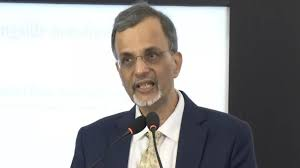
V. Anantha Nageswaran highlights expanding foreign exchange buffers and a structural revival in private capital expenditure, while former NITI Aayog CEO Amitabh Kant calls for massive investments in AI public infrastructure.
Add businessleague.in as a Preferred Source


The structural framework guiding the subcontinental financial landscape has reached a point of high stability against external volatility. Addressing business leaders and global policy analysts at the high-profile NDTV Ignite Summit, Chief Economic Advisor (CEA) V. Anantha Nageswaran officially detailed the current india macroeconomic growth outlook CEA blueprint. The economic chief confirmed that a combination of careful monetary tracking and timely domestic policy steps has successfully insulated the local market from global supply chain shocks.
The central takeaway from the economic assessment highlights a significant reduction in near-term vulnerabilities. Despite enduring intense turbulence across international energy markets over the past quarter, the advisor stated that the country’s macroeconomic fundamentals are now positioned cleanly to absorb international shifts without requiring the central bank to aggressively draw down its foreign exchange reserves to protect the Rupee.
Also Read | Viral Trump Lookalike Buffalo Rescue: Saved From Eid Sacrifice
The Capital Expenditure Path: Breaking the Private Capex Stagnation
A primary engine driving this updated economic forecast is a clear turnaround in private sector capital commitments. After spending multiple fiscal cycles relying primarily on government-funded infrastructure projects to boost growth, the corporate sector is stepping back into a high-investment phase.
Financial registries show that listed companies have significantly increased their machinery procurement, factory expansions, and long-term asset development programs over the last two quarters.
This corporate revival is supported by a strengthening rural economy.
With regional reservoir levels tracking well above historical averages, early sowing logs for the upcoming kharif agricultural season are bucking previous El Niño concerns, ensuring steady consumer demand across the hinterlands.
Slicing Through the Macro Targets and Global Risk Caps
The structural targets outlined by the economic chief divide near-term progress across clear baseline projections and external risk boundaries:
| Monitored Fiscal Vector | Target Baseline Forecast | Associated Risk Boundary Level | Direct Real-World Impact on Growth |
| FY27 GDP Expansion Rate | 6.6% Institutional Base | Drops to 6.0% under stress. | Matches RBI growth models; secures steady job creation. |
| Long-Term Growth Target | 8.0% Continuous Velocity | Required to meet developed goals. | The necessary speed to achieve the Viksit Bharat vision. |
| International Crude Caps | Safe between $80–$90 Range | Breaches over $100 Per Barrel | Sustained high crude prices threaten to squeeze corporate margins. |
| Foreign Exchange Buffers | Stable and self-sustaining. | Zero intervention drawdown. | Protects the Rupee from global multi-asset panics. |
Note: While the 6.6% baseline remains highly secure under current parameters, the CEA warned that prolonged geopolitical standoffs in West Asia that push oil prices past the triple-digit $100 boundary remain the primary headwind capable of slowing the country’s momentum.
The economic discussion at the summit focused heavily on the rapid integration of artificial intelligence across corporate environments.
Nageswaran emphasized that navigating the tech shift successfully requires workers to focus on developing hybrid skills that complement AI tools rather than trying to compete directly with automated lines.
Concurrently, former NITI Aayog CEO Amitabh Kant called on tech leaders to move quickly, warning that basic AI models will soon become commoditized. He stressed that the nation must leverage its massive digital public infrastructure (DPI) to build unique local data pools and progress its talent base.
Also Read | Viral Trump Lookalike Buffalo Rescue: Saved From Eid Sacrifice
Five Structural Pillars Defining the Modern Fiscal Roadmap
To lock in these macro gains and insulate corporate investments from international shocks, the advisory team highlighted five core areas of focus:
Ultimately, achieving long-term economic security requires balancing short-term challenges with ambitious future goals.
By utilizing corporate capital turnarounds to strengthen domestic supply chains and building a workforce that can thrive alongside automated tools, the country can insulate itself from global shocks.
Relying on clear, data-driven fiscal policies ensures that the india macroeconomic growth outlook CEA remains firmly on track, paving a steady path toward a prosperous, self-reliant future.
FAQ Section
What is the primary message regarding the latest India macroeconomic growth outlook CEA framework?
Chief Economic Advisor V. Anantha Nageswaran officially declared that the worst of the external pricing pressures are over for the domestic economy. Backed by steady corporate capex and robust foreign exchange reserves, the country’s fundamentals are structurally prepared to withstand global multi-asset shocks.
What GDP growth rates are projected for the current fiscal periods?
The CEA backed the Reserve Bank of India’s baseline GDP growth projection of 6.6% for the FY27 cycle. However, he noted that to fully achieve the long-term “Viksit Bharat” vision of transforming into a developed nation, the economy needs to maintain a continuous growth velocity of roughly 8.0% over the coming decade.
What international risk factors could potentially slow down this growth momentum?
The primary external risk factor is prolonged geopolitical friction in West Asia. If regional conflicts trigger extended supply chain disruptions that push international crude prices past the critical $100 per barrel mark, the country’s expansion rate could be compressed down to a more modest 6.0% baseline due to rising input inflation.
Also Read | Viral Trump Lookalike Buffalo Rescue: Saved From Eid Sacrifice
End…
Add businessleague.in as a Preferred Source
🙏 Support Independent Journalism
We keep news free for you.
Most readers support with ₹500 ❤️
or scan QR below

Voluntary contribution. No tax benefits.
DISCLAIMER
We have taken all measures to ensure that the information provided in this article and on our social media platform is credible, verified and sourced from other Big media Houses. For any feedback or complaint, reach out to us at businessleaguein@gmail.com