
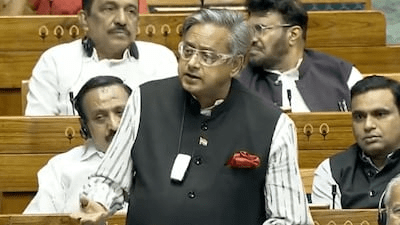
Now Shashi Tharoor delivered a stinging rebuke in the Lok Sabha Thursday. The Congress MP targeted the government’s new Delimitation Bill. Therefore, he compared the move to the controversial 2016 demonetisation exercise. Tharoor warned that redrawing constituencies in haste would damage India’s federal fabric. Specifically, he called the plan a “political demonetisation” that must be stopped.
Add businessleague.in as a Preferred Source


Meanwhile, the 131st Amendment Bill faced intense scrutiny during the session. Tharoor argued that the government is wrapping justice in “barbed wire.”
But his main plea was to decouple the women’s quota from delimitation.
Also Read |Tamil Nadu Voter List Purge: 97 Lakh Names Deleted in SIR Phase 1
Why Tharoor Calls it “Political Demonetisation”
Now Shashi Tharoor used a powerful metaphor to describe the bill. He referenced the 2016 note ban as a cautionary tale. Therefore, he suggested the government is repeating a massive policy mistake.
Haste and Damage
First, he noted the speed of the legislative exercise. He claimed the Centre is rushing delimitation just like demonetisation. Then, he reminded the House of the damage caused in 2016. Thus, he warned of a similar “political” shock to the system.
Next, he argued that redrawing maps is not a mere bureaucratic task. It is a profound shift in political power. Therefore, doing it without consensus is dangerous.
“Don’t do it,” Tharoor urged the Treasury benches repeatedly.
A Cautionary Message
So the comparison was intentional and sharp.
First, it highlighted the lack of consultation. Then, it pointed to the unpredictable consequences for the states. Therefore, the phrase “political demonetisation” started trending immediately.
The “Barbed Wire” Around Women’s Quota
Now the Tharoor delimitation speech addressed the “Nari Shakti” narrative. The Prime Minister calls the reservation a “gift of justice.” Therefore, Tharoor used a vivid image to counter this claim.
Justice Tethered
First, he said the gift is wrapped in “barbed wire.” This refers to the conditions attached to the bill. Then, he noted that implementation is tethered to the 850-seat expansion. Thus, women must wait years for their actual rights.
Next, he called this linkage a “legislative entanglement.” He argued that a moral imperative should not face such hurdles. Therefore, the aspirations of women are being held “hostage.”
“Why must we entangle a moral imperative?” he asked the Speaker.
Delimitation: A Demographic Minefield
Now Tharoor described the exercise as a “demographic minefield.” This refers to the population-based redrawing of constituencies. Therefore, states that controlled their population feel targeted.
Shifting Power Centers
First, delimitation favors states with higher population growth. This usually benefits the Hindi heartland. Then, it penalizes states in the South and East. Thus, the political balance of India would tilt dramatically.
Next, Tharoor argued this could tear the “fabric of federalism.” He claimed the exercise is fraught with complications. Therefore, it requires extensive national discussion first.
Administrative Complexity
Meanwhile, he called it one of the most “complex” exercises in history. Thus, he believes a 2026 deadline is unrealistic and risky.
Also Read |Tamil Nadu Voter List Purge: 97 Lakh Names Deleted in SIR Phase 1
Impact on Cooperative Federalism
Now the Congress MP raised deep concerns about “cooperative federalism.” This is the idea that the Centre and States work as partners. Therefore, a unilateral seat expansion threatens this bond.
The South’s Disadvantage
First, Kerala and Tamil Nadu followed national family planning goals. They successfully stabilized their populations. Then, a new delimitation would reduce their relative weight in Parliament. Thus, they are being “punished” for their success.
Next, Tharoor stressed that every major party wants the quota. But they do not want a federal crisis. Therefore, he urged the government to give the exercise a rethink.
“Consider the larger interest of the country,” he pleaded.
The Case for Immediate Implementation
Now Tharoor made a very practical suggestion. He argued that the women’s reservation is “ready for harvest.” Therefore, there is no need to wait for 2029 or delimitation.
Using Existing Strength
First, the quota can be implemented based on the current 543 seats. No expansion of Parliament is required for 33% reservation. Then, the Congress promised full support for an immediate rollout. Thus, the delay is purely political.
Next, he called the era of “tokenism” over. He demanded a collective partnership right now. Therefore, the government should pass the simple quota bill today.
“Pass it today, we will support it,” he stated clearly.
Why the 2011 Census is Contentious
Now the use of the 2011 Census is a major sticking point. The government wants to use 15-year-old data for the new map. Therefore, the Opposition is questioning the factual accuracy.
Outdated Data
First, India’s demographics have shifted significantly since 2011. Migration and urbanization have changed every district. Then, using old data ignores these new realities. Thus, the new constituencies would be inherently flawed.
Next, the 2026 Census exercise is already underway. Tharoor suggests waiting for these fresh numbers. Therefore, the redrawing would be based on actual current facts.
So why the hurry to use 2011 data?
Also Read |Tamil Nadu Voter List Purge: 97 Lakh Names Deleted in SIR Phase 1
The South’s Fear of Power Shifts
Now the Tharoor delimitation speech resonated deeply with Southern MPs. They see the 850-seat plan as a threat to their sovereignty. Therefore, the debate has become North vs. South.
The Seat Math
First, Uttar Pradesh might gain dozens of new seats. At the same time, Kerala might stay stagnant or lose influence. Then, the North would have a “super-majority” in the Lok Sabha. Thus, the South’s voice on national policy would vanish.
Next, Tharoor argued this is not just a “bureaucratic rearranging.” It is a move to consolidate power in specific regions. Therefore, it risks creating a permanent regional divide.
Tharoor’s Message to the Prime Minister
Now the MP addressed the Prime Minister’s “Nari Shakti” slogan directly. He urged the PM to show true “intent” rather than just “gifts.” Therefore, he asked for a moral harvest.
A Moral Imperative
First, he called for a Near Unanimous political consensus. Every party is ready for the women’s quota. Then, the PM should not “tether” this win to a controversial map. Thus, a clean bill would be a true victory for India.
Next, he urged the government to defer delimitation. He asked them to prioritize the “fabric of our nation.” Therefore, the debate should focus on the moral victory first.
Finally, he concluded by asking for a rethink of the entire strategy.
Common Questions Answered
What did Shashi Tharoor say about delimitation? Now he called it “political demonetisation.” He warned that redrawing constituencies in haste would damage India’s federal system.
Why is the 131st Amendment controversial? First, it links the women’s quota to a new delimitation exercise. Critics say this holds women’s aspirations “hostage” to political map-making.
What census data is being used for delimitation? Next, the government proposes using the 2011 Census data. Tharoor and others argue this is outdated and unfair.
Does Tharoor support the Women’s Reservation Bill? So yes, he said the Congress fully supports giving women their reservation. But he wants it implemented immediately without delimitation.
How will 850 seats affect the South? Finally, Southern states fear they will lose political power. Their lower population growth means fewer seats compared to the North.
Also Read |Tamil Nadu Voter List Purge: 97 Lakh Names Deleted in SIR Phase 1
End…
Add businessleague.in as a Preferred Source
🙏 Support Independent Journalism
We keep news free for you.
Most readers support with ₹500 ❤️
or scan QR below

Voluntary contribution. No tax benefits.
DISCLAIMER
We have taken all measures to ensure that the information provided in this article and on our social media platform is credible, verified and sourced from other Big media Houses. For any feedback or complaint, reach out to us at businessleaguein@gmail.com