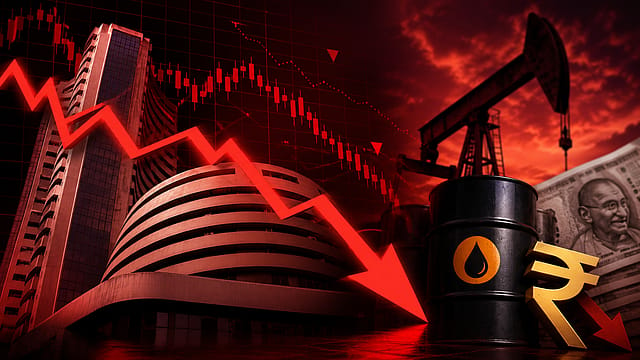
Now the domestic equity markets have succumbed to intensifying global macroeconomic headwinds. Indian benchmark indices witnessed a severe weekly correction, with both the Nifty 50 and BSE Sensex declining by over 2 per cent. Therefore, the flagship Nifty index shed 2.2 per cent to close at 23,643.5, while the Sensex dropped over 2,000 points to settle at 75,238. Meanwhile, investor sentiment remains highly cautious due to skyrocketing crude oil prices and escalating geopolitical tensions in West Asia. Following the disruption risks in the crucial Strait of Hormuz, Brent crude has remained elevated in the $105–$110 per barrel range. This commodity surge has acted as a mechanical necessity for capital reallocation, triggering notable foreign fund outflows from emerging markets.
Add businessleague.in as a Preferred Source


Also Read |Tamil Nadu Voter List Purge: 97 Lakh Names Deleted in SIR Phase 1
At a Glance: Weekly Market Performance Indicators
| MARKET METRIC | CLOSING LEVEL | WEEKLY CHANGE (%) | POINTS LOST |
| BSE Sensex | 75,238.0 | -2.7% | -2,000+ Points |
| Nifty 50 | 23,643.5 | -2.2% | -532 Points |
| BSE Realty Index | Sector Tracker | -8.0% | Sharpest Decline |
| BSE IT Index | Sector Tracker | -5.7% | Tech Outflow |
| April SIP Inflow | ₹31,115 Crore | + Record High | Retail Support |
The Weekly Crash: Sensex and Nifty Breach Key Support Levels
Now the optimistic sentiment that characterized early trading periods has completely reversed. Domestic equity benchmarks faced a relentless wave of selling across five consecutive sessions. Therefore, the Nifty 50 finished the week 532 points lower against its previous Friday closing base.
First, institutional desks noted that the technical support structures at 24,000 were broken with significant volume. Next, the BSE Sensex mirrored this weakness, losing 2.7 per cent of its total valuation in a rapid liquidation cycle. Thus, the indices have entered a formal correction phase as global conditions deteriorate.
So the pace of the drop has caught short-term leverage traders completely off guard. Meanwhile, small-cap and mid-cap indices faced even harsher treatment, with small-caps shedding nearly 4 per cent. Therefore, the overall erosion of investor wealth has re-established a defensive posture across local brokerages.
The Crude Oil Catalyst: Strait of Hormuz Standoff and $110 Brent
Now the primary driver behind this wave of domestic liquidations originates far beyond India’s borders. The unresolved conflict in West Asia has created systemic fears of prolonged energy supply disruptions. Therefore, Brent crude prices have remained locked in a highly inflationary band between $105 and $110 per barrel.
First, the primary maritime chokepoint, the Strait of Hormuz, faces persistent security bottlenecks and shipping seizures. Next, as an economy that imports over 80 percent of its oil requirements, India faces an immediate expansion of its trade deficit. Thus, elevated energy costs act as a mechanical necessity for downward revisions in corporate profit margins.
So the threat of fuel price pass-throughs impacting the broader consumer index is very real. Meanwhile, the Indian Rupee has shown corresponding weakness against a basket of major global currencies. Therefore, the structural risk of imported inflation is dominating the valuation models of large institutional funds.
Also Read |Tamil Nadu Voter List Purge: 97 Lakh Names Deleted in SIR Phase 1
Sectoral Bloodbath: Realty and IT Indices Lead the Downward Spiral
Now analyzing the specific sectors reveals that interest-rate-sensitive and export-oriented pockets took the maximum damage. The BSE Realty index emerged as the worst performing pack, plunging almost 8 per cent over the week. Therefore, real estate developers are facing the dual brunt of high input costs and tightening credit.
First, technology counters experienced aggressive trimming, with the BSE IT index falling by 5.7 per cent. Next, major players in auto, capital goods, and consumer durables followed closely into negative territory. Thus, cyclical sectors are seeing immediate capital contraction as fund managers look for safer allocations.
So even the traditionally stable banking and public sector units did not escape the selling pressure. The BSE Bankex and BSE PSU indices both recorded flat 3 per cent declines by Friday’s close. Meanwhile, local construction project timelines are being closely reviewed for cost overruns. Therefore, the sectoral pain is highly synchronized across the entire corporate spectrum.
Stock-Specific Drags: Titan and Reliance Headline the Losers
Now looking at the individual components of the 30-scrip Sensex basket reveals where the heavy institutional offloading was centered. Consumer discretionary giant Titan Company emerged as the top underperformer, sliding 7.6 per cent. Therefore, concerns over high domestic gold duties and cooling consumer spending are impacting retail majors.
Top Dragging Stocks This Week:
-
Titan Company: Down 7.6% on volume expansion.
-
Reliance Industries: Heavy index weightage amplified the Nifty’s downward pull.
-
Tech Mahindra: Suffered from the broader technology de-rating trend.
-
Mahindra & Mahindra: Automotive supply chains faced cost pressures.
First, the weakness in Reliance Industries was particularly damaging due to its massive structural weight in the index. Next, export-reliant automotive conglomerates saw their margins squeezed by rising logistics fees over oceanic routes. Thus, the blue-chip leadership failed to provide any meaningful resistance to the market’s descent.
Macroeconomic Headwinds: Rising Bond Yields and a Strong Dollar
Now financial analysts are pointing out that equity markets are adjusting to a broader realignment of global asset values. Sustained strength in the US Dollar Index has caused capital to flee riskier emerging markets. Therefore, foreign institutional investors (FIIs) have maintained a steady cadence of net sales.
First, elevated domestic wholesale inflation data has caused local bond yields to climb significantly higher. Next, higher yields reduce the relative attractiveness of equity risk premiums for large treasury desks. Thus, the macroeconomic environment is facing pressure from both international fund flows and domestic price indexes.
So any expectations of immediate interest rate cuts by central authorities have been pushed back. Meanwhile, regional trade balances are being actively managed to protect national foreign exchange pools. Therefore, these macro factors are forming a dense layer of resistance against any quick market recovery.
Also Read |Tamil Nadu Voter List Purge: 97 Lakh Names Deleted in SIR Phase 1
The Retail Cushion: Record ₹31,115 Crore SIP Inflows Absorb FII Selling
Now despite the aggressive liquidations by foreign funds, the domestic financial ecosystem has displayed impressive structural strength. Domestic Institutional Investors (DIIs) have stepped in to buy every major dip. Therefore, the market correction has been partially checked by a continuous wall of domestic liquidity.
First, systematic investment plan (SIP) inflows for April hit an unprecedented record of ₹31,115 crore. Next, this steady retail participation ensures that fund managers have ample cash reserves to absorb foreign selling. Thus, the mechanical necessity of a structural domestic savings pool is effectively insulating the market from a total route.
So the democratization of equity investments across tier-2 and tier-3 cities is paying major dividends. Meanwhile, mutual fund houses are strategically deploying these inflows into high-quality defensive businesses. Therefore, the retail investor has become the ultimate stabilizing force in the 2026 financial architecture.
Defensive Outperformance: Metal and Healthcare Gain Ground
Now it is important to note that a few specialized sectors managed to swim against the negative tide. As capital sought refuge from interest-rate risks, commodity and healthcare spaces saw positive accumulation. Therefore, these defensive outposts provided necessary green patches on the terminal screens.
First, the BSE Metal index managed to lock in a 1.5 per cent gain by the end of the week. Next, pharmaceutical and healthcare stocks rose 1.4 per cent, driven by stable domestic demand and traditional insulation from cyclical shocks. Thus, rotation into low-beta assets has become the preferred near-term tactic for portfolio managers.
So while the aggregate indices look heavily damaged, alpha generation is still possible within narrow boundaries. Meanwhile, resource firms are benefiting from firm global asset pricing caused by the broader geopolitical logjam. Therefore, tactical allocations are shifting rapidly toward these resilient commodity plays.
FAQ: Understanding the May 2026 Stock Market Correction
1. Why did the Sensex and Nifty crash over 2% this week? Now, the primary triggers include rising Brent crude prices ($105-$110/bbl), ongoing West Asia tensions, rising global bond yields, and sustained FII selling.
2. Where did the Nifty and Sensex close at the end of the week? First, the Nifty 50 closed down 532 points at 23,643.5, while the BSE Sensex ended over 2,000 points lower at 75,238.
3. Which sectors were the worst performers in this correction? So, the BSE Realty index led the losses with an 8% drop, followed closely by the BSE IT index, which fell 5.7%.
4. What is the impact of the Strait of Hormuz on Indian stocks? Next, threats of transit blockades in the Strait keep oil prices high. This expands India’s import bill, increases inflation fears, and pressures corporate margins.
5. How are domestic investors countering the foreign fund outflows? Now, domestic mutual funds are absorbing the pressure via record retail participation, with April SIP inflows touching an all-time high of ₹31,115 crore.
6. Did any sectors gain during this market drop? Finally, yes. Defensive sectors outperformed the broader trend, with the BSE Metal index gaining 1.5% and healthcare stocks rising 1.4%.
Also Read |Tamil Nadu Voter List Purge: 97 Lakh Names Deleted in SIR Phase 1
End…
Add businessleague.in as a Preferred Source
🙏 Support Independent Journalism
We keep news free for you.
Most readers support with ₹500 ❤️
or scan QR below

Voluntary contribution. No tax benefits.
DISCLAIMER
We have taken all measures to ensure that the information provided in this article and on our social media platform is credible, verified and sourced from other Big media Houses. For any feedback or complaint, reach out to us at businessleaguein@gmail.com