
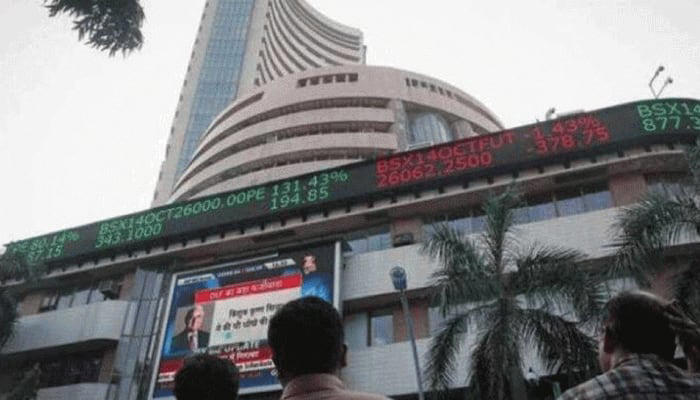
Now the domestic equity ecosystem is facing an aggressive wave of systemic risk adjustment during early trading sessions. Indian benchmark stock indices registered sharp, vertical losses during the opening bell on Monday, May 18, 2026, driven by collapsing global cues and surging commodity inputs. Therefore, the BSE Sensex plummeted by 890.31 points or 1.18 per cent to sit at 74,347.68, while the NSE Nifty 50 slid 229.30 points to languish at 23,414.20. Meanwhile, a powerful combination of international political friction and local currency weakness has severely rattled the confidence of institutional desks. Following a breach where the Indian Rupee slipped past the historic 96 mark against the US Dollar, managing input costs has evolved into an absolute necessity for domestic boardrooms.
Add businessleague.in as a Preferred Source


Also Read |Tamil Nadu Voter List Purge: 97 Lakh Names Deleted in SIR Phase 1
The Opening Bell Rout: Sensex and Nifty Face Intense Capital Exits
Now the structural support levels that preserved market values last week have completely dissolved under heavy volumes. Domestic trading terminals encountered a coordinated wave of liquidations the moment electronic matching engines went live on Monday morning. Therefore, long positions faced rapid liquidations as margin adjustments trickled through the retail brokerage architecture.
First, institutional desks noted that the macro-level selling pressure was highly synchronized across large-cap holdings. Next, the NSE Nifty 50 instantly breached its opening target zones, recording a near 1 per cent loss within the initial minutes of commercial activity. Thus, the quick drop highlights a total absence of aggressive institutional buyers at current valuation bands.
So retail traders are watching their derivative accounts face volatile swing conditions as index premiums collapse. This sudden evaporation of positive momentum matches the broad global de-risking phase running through western assets. Meanwhile, local mutual fund desks are prioritizing cash conservation over immediate dip-buying programs. Therefore, the opening bell sequence has established an incredibly defensive tone for the tracking period.
Sectoral Breakdown: PSU Banks and Real Estate Lead the Decline
Now analyzing the specific internal components of the market exposes a highly synchronized downward trend active across all primary sectors. Banking counters and rate-sensitive enterprises took the sharpest hits during the opening transaction loop. Therefore, fund managers are systematically rotating capital out of high-beta positions to preserve their baseline portfolios.
-
Nifty PSU Bank Index: Plummeted by 1.75 per cent to drop down to a base of 7,886.45 points.
-
Nifty Realty Index: Replicated the exact 1.75 per cent decline to touch 743.05 points.
-
Nifty Consumer Durables: Retreated by 1.64 per cent to rest at 34,973.90 points under weak volume signals.
-
Nifty Financial Services: Lost 1.37 per cent of its aggregate value to land at 27,304.65 points.
First, intermediate sectors including Nifty Metal and Nifty Auto recorded corrections exceeding a flat 1 per cent margin. Next, the commodity complex showed localized adjustments, with Nifty Oil & Gas sliding 0.79 per cent to settle at 11,162. Thus, defensive allocations in Nifty Healthcare and Pharma recorded minimal decreases of 0.45 per cent and 0.21 per cent.
The Trump-Iran Overhang: Analyzing the Ticking Clock Warning
Now macro-level investment officers are placing the blame for this sudden structural exit directly on collapsing geopolitical frameworks. Commenting on the early environment, Ponmudi R, the CEO of Enrich Money, clarified that international rhetoric continues to weigh heavily on global risk tolerance. Therefore, international fund pools are choosing to enter stable dollar environments rather than emerging coordinates.
First, U.S. President Donald Trump issued an explicit, high-visibility warning stating that the “clock is ticking for Iran.” Next, this aggressive tone indicates growing American impatience regarding the pace of diplomatic negotiations around maritime shipping rights. Thus, the mechanical necessity of pricing in potential naval disruptions across the Strait of Hormuz has become paramount for global trading algorithms.
So the ongoing threat of a wider confrontation continues to remain a key overhang for international financial markets. This political friction introduces severe supply-side anxieties that block long-term corporate budgeting plans. Meanwhile, automated trading desks are scaling down their leverage exposures across all Asian trading hubs. Therefore, the words spoken in Washington are transforming directly into localized capital flight across Mumbai.
Also Read |Tamil Nadu Voter List Purge: 97 Lakh Names Deleted in SIR Phase 1
Currency Devaluation: Why the Rupee Slipped Past the 96 Mark
Now another deep fundamental pain point accelerating the equity rout is a historic collapse across foreign exchange markets. The Indian Rupee breached the crucial 96 mark against the US Dollar early Monday morning, hitting historic lifetime lows. Therefore, foreign institutional investors (FIIs) are facing immediate, unhedged translation losses on their domestic asset pools.
Foreign Exchange Stress Parameters:
-
Primary Trigger: Unprecedented dollar demand from commercial oil importing desks.
-
Secondary Catalyst: Continued macro-level fund outflows by international treasury managers.
-
Current Metric: Trading comfortably past the 96.00 boundaries under high structural momentum.
-
Corporate Impact: Immediate expansion of landing costs for imported raw industrial materials.
First, this intense depreciation reduces the absolute value of Indian equities when measured in global base currencies. Next, it forces the central banking authority to consider tightening liquidity loops to defend the national accounting balance. Thus, the currency drop acts as a secondary weight pulling down the valuations of local banking blocks.
Commodity Pressures: High Oil and the Global Asset Layout
Now the financial inter-linkages between global energy assets and domestic equity markets are operating with high precision. Providing context on the Asian layout, Rajesh Palviya, Head of Research at Axis Direct, highlighted that international resources are displaying high volatility. Therefore, import-dependent economies across Asia are facing synchronized inflationary pressures this morning.
First, global crude oil prices scaled up to a punishing $110.7 per barrel, tracking the collapsing peace parameters in West Asia. Next, adjacent precious metals showed defensive pricing, with gold sitting near $1,450 and silver hovering below $17.70. Thus, the high energy cost acts as a direct drag that compresses the operating profit margins of local manufacturing corporations.
So the GIFT Nifty index predicted this morning gap-down by trading near 23,555.5 before the local bell. Palviya explicitly emphasized that with oil prices remaining high, a failure to hold current support regions is incredibly dangerous. Meanwhile, corporate treasury departments are rushing to execute forward hedges on fuel inputs to shield their balance sheets. Therefore, the commodity spike remains a primary catalyst driving the morning liquidation.
Moving Average Violations: Inside Kotak’s Technical Diagnostics
Now tracing the underlying structural chart layers reveals that the headline index has violated critical historical baselines. Shrikant Chouhan, Head of Equity Research at Kotak Securities, noted that the technical layout has turned heavily bearish. Therefore, trend-following quantitative models are issuing automated sell mandates across institutional desks.
First, during recent sessions, the Nifty slipped decisively below its highly critical 50-day Simple Moving Average (SMA) located near 24,000. Next, post-breakdown, the lack of immediate physical buying support allowed localized selling pressure to intensify exponentially. Thus, the formation of a prominent bearish candle on the weekly tracking charts signals deep medium-term structural weakness.
So the index is now trading comfortably below all valid short-term moving average caps. Chouhan stated that while the short-term market outlook remains weak, a minor technical pullback can only materialize if the index manages to trade back above 23,600. Therefore, the technical diagnostics indicate that the path of least resistance points downward until foundational accumulation re-emerges.
Also Read |Tamil Nadu Voter List Purge: 97 Lakh Names Deleted in SIR Phase 1
Alternative Risk Triggers: Projecting the 23,350 Support Target
Now as the afternoon session approaches, strategy desks are mapping out alternative downside targets to manage risk parameters. Technical analysts are warning that the current stabilization attempt at 23,414 remains highly fragile and dependent on global indicators. Therefore, establishing fresh long exposures requires a highly cautious, data-backed posture from retail participants.
First, if the index fails to defend the immediate opening zone, a fresh sell-off will likely break out. Next, Chouhan mentioned that dropping cleanly below the current floor could quickly bring the 23,400 to 23,350 territory into active play. Thus, the mechanical necessity of keeping strict stop-loss orders on all active trades is being highlighted across local brokerages.
So a structural retest of the 74,500 level on the Sensex remains a distinct probability if international tensions escalate further. Meanwhile, institutional liquidity metrics are being preserved to cushion any potential settlement volatility later in the week. Therefore, the alternative risk models suggest that the market will remain locked within a high-volatility discovery phase through the closing bell.
FAQ: Navigating the May 2026 Stock Market Liquidation Phase
1. Why did the Sensex and Nifty crash during the opening hours today? Now, the crash was driven by collapsing global cues, escalating US-Iran geopolitical rhetoric, crude oil prices climbing to $110.7, and a weak rupee.
2. What were the exact opening loss metrics recorded by the main indices? First, the BSE Sensex plummeted by 890.31 points (1.18%) to sit at 74,347.68, while the NSE Nifty 50 shed 229.30 points (0.97%) to land at 23,414.20.
3. Which industrial sectors led the losses during the market drop? So, Nifty PSU Bank and Nifty Realty led the sectoral liquidations, with both indices recording sharp drops of 1.75 per cent.
4. What historic milestone did the Indian Rupee reach against the US Dollar? Next, driven by heavy oil import demands and capital flight, the Indian Rupee weakened dramatically to breach the historic 96 mark against the US Dollar.
5. What technical indicators are signaling a weak market outlook? Now, the Nifty 50 has slipped comfortably below its crucial 50-day Simple Moving Average (SMA) of 24,000, forming a prominent weekly bearish candle.
6. What are the key downside support levels to track if the sell-off continues? Finally, market experts warn that a failure to hold current zones could quickly force the index to retest the 23,400 to 23,350 territory on the Nifty.
Also Read |Tamil Nadu Voter List Purge: 97 Lakh Names Deleted in SIR Phase 1
End…
Add businessleague.in as a Preferred Source
🙏 Support Independent Journalism
We keep news free for you.
Most readers support with ₹500 ❤️
or scan QR below

Voluntary contribution. No tax benefits.
DISCLAIMER
We have taken all measures to ensure that the information provided in this article and on our social media platform is credible, verified and sourced from other Big media Houses. For any feedback or complaint, reach out to us at businessleaguein@gmail.com