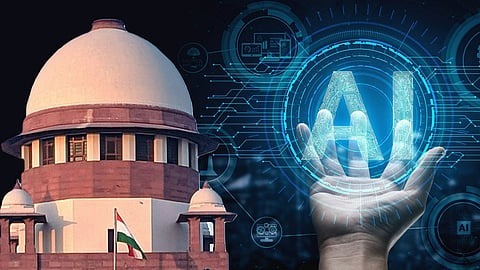
The hallowed halls of the Supreme Court witnessed a mix of amusement and frustration on Tuesday, March 10, 2026. What began as a Public Interest Litigation (PIL) challenging the constitutional status of the PM CARES Fund ended with a sharp rebuke for its author—a Ludhiana-based hosiery trader with a Class 12 education.
Add businessleague.in as a Preferred Source


Chief Justice of India (CJI) Surya Kant, along with Justices R Mahadevan and Joymalya Bagchi, quickly grew suspicious of the high-level constitutional terminology used in the petition, leading to a direct confrontation over the document’s true origin.
Also Read |Tamil Nadu Voter List Purge: 97 Lakh Names Deleted in SIR Phase 1
The “English Exam” in Court: CJI’s Suspicions
The bench was immediately struck by the mismatch between the petitioner’s background and the sophisticated legal prose in the filing.
-
The Background: Rajnish Sidhu disclosed he had studied only up to 10+2 at a school in Ludhiana and pays approximately ₹5.25 lakh in income tax.
-
The “Exam”: Skeptical that Sidhu wrote the plea, the CJI joked, “I will ask you to take an exam in English here. If you manage even 30%… I will believe you.”
-
The Bravery: “Bada bahaduri ka kaam kiya, seedha Ludhiana se chalke aa gaye!” (Very brave of you to come straight from Ludhiana), the CJI remarked, noting that Sidhu had skipped the High Court and approached the apex court directly for his first-ever litigation.
AI Tools and Jacket Payments: The Unravelling
Under the threat of a Punjab Vigilance Bureau probe and heavy financial costs, Sidhu eventually conceded.
-
Artificial Authorship: He admitted to using three to four AI tools to generate the complex legal arguments because he lacked the funds to hire a lawyer.
-
The Typist’s Fee: Sidhu explained that he had a typist on the court premises type the document. Since he couldn’t afford the ₹1,000 hourly rate, he gifted the typist four jackets from his stock instead.
Also Read |Tamil Nadu Voter List Purge: 97 Lakh Names Deleted in SIR Phase 1
Defining the Terms: The “Fiduciary Risk” Failure
The “moment of truth” came when the bench asked Sidhu to explain a specific phrase from his own petition.
-
The Term: “Fiduciary risk of corporate donors.”
-
The Result: Sidhu was unable to explain the concept, confirming the court’s suspicion that he was merely “reading from a script” prepared by technology or a hidden proxy.
The Global Context: AI Hallucinations in the Judiciary
This incident follows a series of warnings from the Indian judiciary regarding generative AI
-
Fake Precedents: Earlier in February 2026, the SC flagged an “alarming” trend of AI-drafted petitions citing non-existent cases like ‘Mercy vs Mankind’.
-
Judicial Burden: Justices have noted that verifying “hallucinated” quotes and fake citations adds an unnecessary layer of labor to an already overburdened system.
Reality Check
Sidhu’s intent might have been to seek transparency, but his method backfired. Still, the court’s decision not to order a “roving inquiry” was a mercy to the trader. Therefore, while the plea was dismissed, the court’s primary goal was to deter “proxy litigation”—where hidden interests use small-time individuals as “shoulders” to fire judicial shots. In fact, the CJI’s advice to “sell more sweaters” was a blunt reminder that PILs are an extraordinary jurisdiction, not a hobby for amateurs armed with a chatbot.
The Loopholes
Sidhu claimed he used AI because he couldn’t afford a lawyer. In fact, this is a “Legal Aid Loophole”—the Supreme Court has a robust Legal Services Committee that provides free lawyers to those who qualify based on income. Therefore, the “poverty” excuse for using AI tools is often a cover for avoiding the scrutiny of a real advocate. Still, the “Self-Representation Loophole” remains; while any citizen can argue their own case, they are held to the same standard of “responsibility” for the allegations they sign, regardless of whether a machine wrote them.
Also Read |Tamil Nadu Voter List Purge: 97 Lakh Names Deleted in SIR Phase 1
What This Means for You
If you are considering filing a PIL, don’t let a chatbot be your lead counsel. First, realize that AI often “hallucinates” legal principles that do not exist in Indian law; you could face heavy fines for wasting the court’s time. Then, if you cannot afford a lawyer, understand that you should approach the Supreme Court Legal Services Committee (SCLSC) instead of a typist with a penchant for jackets.
Finally, understand that the judiciary is now “AI-literate.” Judges are specifically looking for linguistic patterns and non-existent citations common to Large Language Models. Before you hit “print” on an AI draft, check every single term; if you can’t explain it in plain Hindi or English, the judge will know you didn’t write it.
What’s Next
The Supreme Court may soon issue formal guidelines for “Petitioner-in-Person” filings to prevent AI-generated frivolousness. Then, look for the Bar Council of India to release an advisory on “Ethical AI Use” for advocates. Finally, expect Rajnish Sidhu to return to Ludhiana, as the CJI’s parting words were a clear “stay in your lane” warning to the hosiery trade.
Also Read |Tamil Nadu Voter List Purge: 97 Lakh Names Deleted in SIR Phase 1
End….
Add businessleague.in as a Preferred Source
🙏 Support Independent Journalism
We keep news free for you.
Most readers support with ₹500 ❤️
or scan QR below

Voluntary contribution. No tax benefits.
DISCLAIMER
We have taken all measures to ensure that the information provided in this article and on our social media platform is credible, verified and sourced from other Big media Houses. For any feedback or complaint, reach out to us at businessleaguein@gmail.com