
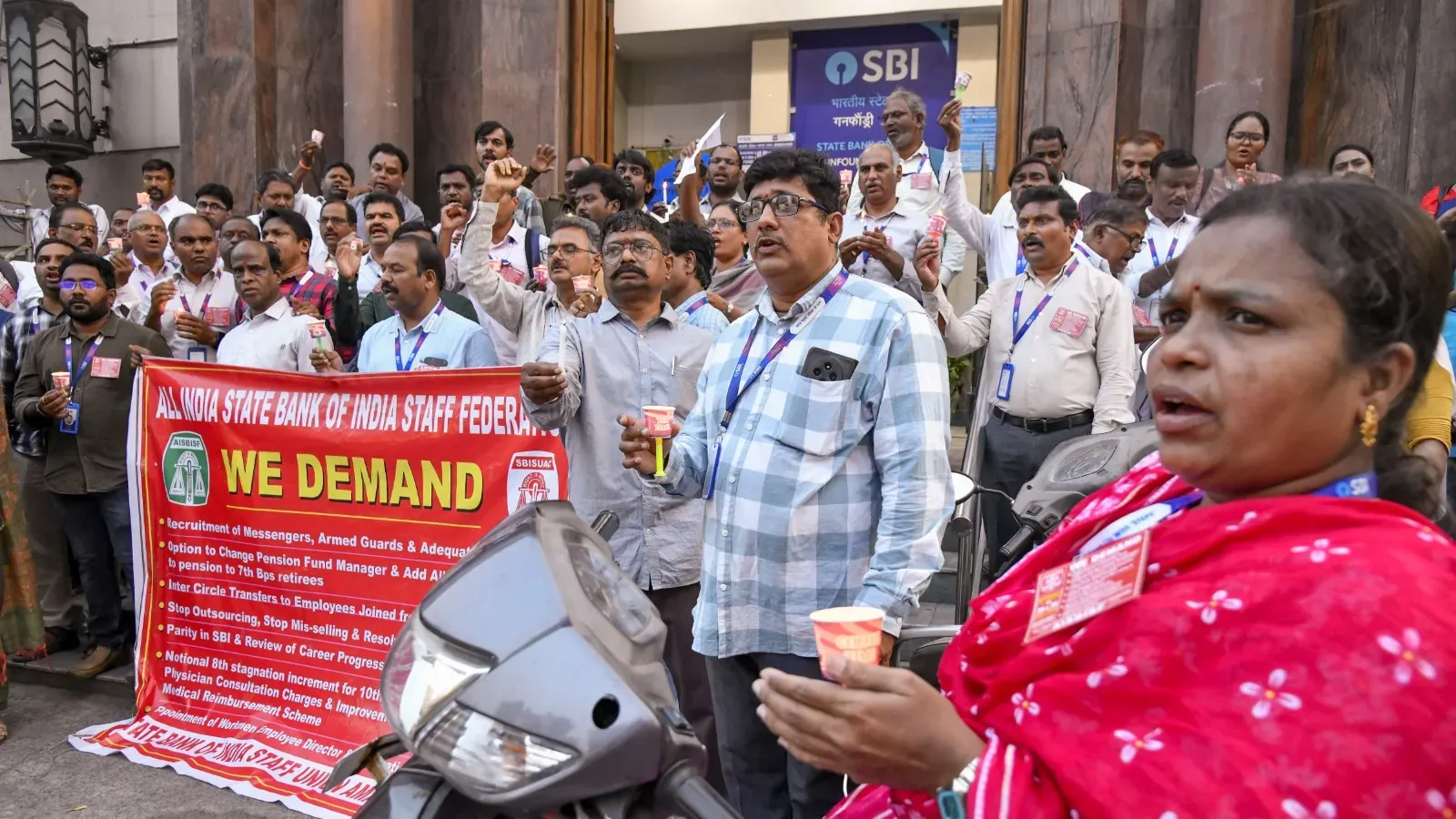
Now the official SBI branch strike status for May 25 and 26 brings massive relief to millions of retail consumers. The All India State Bank of India Staff Federation originally proposed a massive two-day nationwide shutdown. Specifically, employee representatives planned to close counters across every single state. Meanwhile, sudden emergency discussions between union leaders and corporate management completely averted the crisis. Therefore, the country’s largest public sector bank will maintain entirely normal operations today.
Add businessleague.in as a Preferred Source


Today, all financial transaction channels remain fully open. The corporate headquarters issued an urgent customer advisory to clarify the situation early Monday morning. According to the notice, every brick-and-mortar outlet will provide regular banking services without interruption.
Panic over locked bank vaults is officially over.
Also Read |Tamil Nadu Voter List Purge: 97 Lakh Names Deleted in SIR Phase 1
The Management Advisory: Keeping Counters Open
Now the official communication channels went active late Sunday evening to share the positive update. Executive directors wanted to secure market stability before financial trading floors opened Monday. Therefore, the shifting SBI branch strike status became top priority for corporate public relations teams.
Officials say the corporate machinery worked tirelessly to reach an interim settlement. Before the weekend talks, retail consumers feared a total freeze on physical check clearances. Now, the administrative offices can guarantee smooth operations. Thus, daily commerce proceeds without any sudden obstacles.
“We want to reassure our esteemed clients immediately,” an official bank statement noted. Still, the sudden change leaves some local union organizers feeling restricted.
The Official Mandate
First, consider the exact phrasing of the new bank notice. “This is to advise our esteemed customers that the proposed strike has been deferred,” SBI corporate media managers announced. Next, look at the operational guarantees. “All our branches will function normally and provide all regular banking services,” the text confirmed.
So the message removes all ambiguity.
Notably, an extended banking freeze would paralyze small business supply chains across the country. In this instance, the management acted fast to block the threat. As a result, cash deposition machines and clearing houses are running at full speed.
The Regulatory View
大量 of traders checked their banking portals early today to verify local facility availability. Because of the high stakes, any small delay would trigger massive financial penalties for corporate accounts.
Otherwise, the central office maintained its standard rigid focus on daily performance targets. Executives refused to let union agitation disrupt the clearing windows. Thus, the retail network escapes the strike safely.
Inside the 16-Point Charter of Union Demands
Now the federation did not call the strike over minor administrative issues. Instead, staff representatives built a comprehensive 16-point charter of demands over several months. Therefore, understanding these core grievances helps explain the deep friction.
The Core Arguments
First, the union targets the outsourcing of permanent job roles. They claim the bank is weakening essential worker protections by hiring temporary contractors. Next, they point to severe wage disparities between different employee ranks.
So the federation built a strong legal case against current corporate hiring strategies.
Demanding Career Growth
Meanwhile, the workforce wants a full review of the existing career progression framework. Clerical staff claim that advancement tracks have slowed down significantly under new rules.
“We need a fair career path for every junior worker,” a union circular noted.
Consequently, the current SBI branch strike status hinges on these deep structural debates. The temporary deferral does not mean these issues are permanently solved. It simply means both sides have agreed to negotiate without locking the doors.
The Staff Shortage and Security Guard Crisis
Now the daily environment inside local bank offices has grown increasingly difficult. The staff federation highlights a massive decline in general workforce strength over the past three years. Therefore, daily workloads have expanded exponentially for remaining personnel.
The Safety Threat
First, the union identifies an immediate crisis regarding branch security logistics. Many rural and suburban outlets are operating without designated armed guards. Next, the lack of messengers delays the movement of physical documents between regional hubs.
So the workforce faces both physical safety risks and administrative stress.
The Demand for Hiring
Subsequently, the 16-point charter demands the immediate recruitment of dedicated safety personnel. Workers want fixed numbers of armed guards inside every single urban branch. Then, they want specialized messengers added to the permanent payroll.
Because of these safety vulnerabilities, staff morale had reached an all-time low. The union used the strike threat as maximum leverage to force a formal safety review.
Also Read |Tamil Nadu Voter List Purge: 97 Lakh Names Deleted in SIR Phase 1
Pension Flexibility and the NPS Conflict
Now retirement benefits represent another major battlefield between staff and leadership. Employees are demanding significant structural updates to their retirement portfolios. Therefore, this financial topic dominated the weekend reconciliation sessions.
The NPS Demands
First, the federation wants greater flexibility under the modern National Pension System. Workers claim the current framework locks their hard-earned money too rigidly. Next, they want higher employer contribution matching to match other public sector entities.
So retirement safety remains a non-negotiable point for the aging workforce.
| Employee Rank | Pension Concern | Union Objective |
| Workmen & Clerks | Rigid lock-in periods under NPS | Introduce greater fund withdrawal flexibility |
| Junior Officers | Stagnant employer matching rates | Increase monthly corporate contributions |
| New Recruits | Zero historical pension access | Create unique safety nets within the system |
Gone are the days of simple, quiet retirement transitions.
The Post-2019 Inter-Circle Transfer Dilemma
Now geographical dislocation is causing severe distress among younger bank employees. New hiring rules implemented after 2019 locked workers into specific regional zones indefinitely. Therefore, the union is fighting to restore basic migration rights.
The Mobility Wall
First, thousands of young workers find themselves stuck thousands of miles away from their home states. Current policy blocks them from applying for standard inter-circle transfers. Next, this regional freeze separates families and destroys workplace harmony.
Thus, employee retention rates have started dipping in critical metropolitan circles.
The Policy Push
“Our younger colleagues deserve basic human consideration,” a federation representative stated during an afternoon briefing. This specific issue shows how modern corporate policies can alienate a new generation of workers.
Think again if you think bank strikes only focus on direct cash payouts. In reality, lifestyle design and regional mobility matter just as much to the modern workforce. Therefore, the management agreed to review the 2019 transfer block immediately.
How a Nationwide Protest Plan Dissolved
Now the federation originally built a very aggressive escalation map before the current deferral. They wanted to grab the attention of top federal policymakers in the national capital. Therefore, their mobilization plan was truly massive.
The Strategy Map
First, the union organized local demonstrations outside regional head offices last week. Next, they launched coordinated sit-ins across major industrial zones. Then, they deployed massive social media campaigns to educate the public on their grievances.
So the momentum was growing fast.
The High-Level Appeal
Meanwhile, union directors sent formal representations directly to Finance Minister Nirmala Sitharaman. They also delivered copies of their charter to Prime Minister Narendra Modi.
Currently, the threat of political intervention has forced the bank management to sit down and negotiate seriously. Thus, the massive protest plan dissolved into active boardroom mediation instead.
What the Deferral Means for Daily Customers
Now the ultimate outcome of this boardroom compromise favors the ordinary citizen. The stable SBI branch strike status means you can approach your local teller counter with complete confidence today.
The Immediate Future
First, check clearing services will follow standard operating timelines today. Next, cash dispensing machinery across the country will receive regular refills. Then, loan processing departments will continue reviewing pending consumer applications.
Simple as that.
Finally, public anxiety has completely disappeared following the official management statement. The threat of a national banking crisis has passed for the month of May. Thus, the financial system maintains its essential balance while negotiators work out a permanent labor contract.
Meanwhile, millions of customers go about their day in peace.
Also Read |Tamil Nadu Voter List Purge: 97 Lakh Names Deleted in SIR Phase 1
End…
Add businessleague.in as a Preferred Source
🙏 Support Independent Journalism
We keep news free for you.
Most readers support with ₹500 ❤️
or scan QR below

Voluntary contribution. No tax benefits.
DISCLAIMER
We have taken all measures to ensure that the information provided in this article and on our social media platform is credible, verified and sourced from other Big media Houses. For any feedback or complaint, reach out to us at businessleaguein@gmail.com