
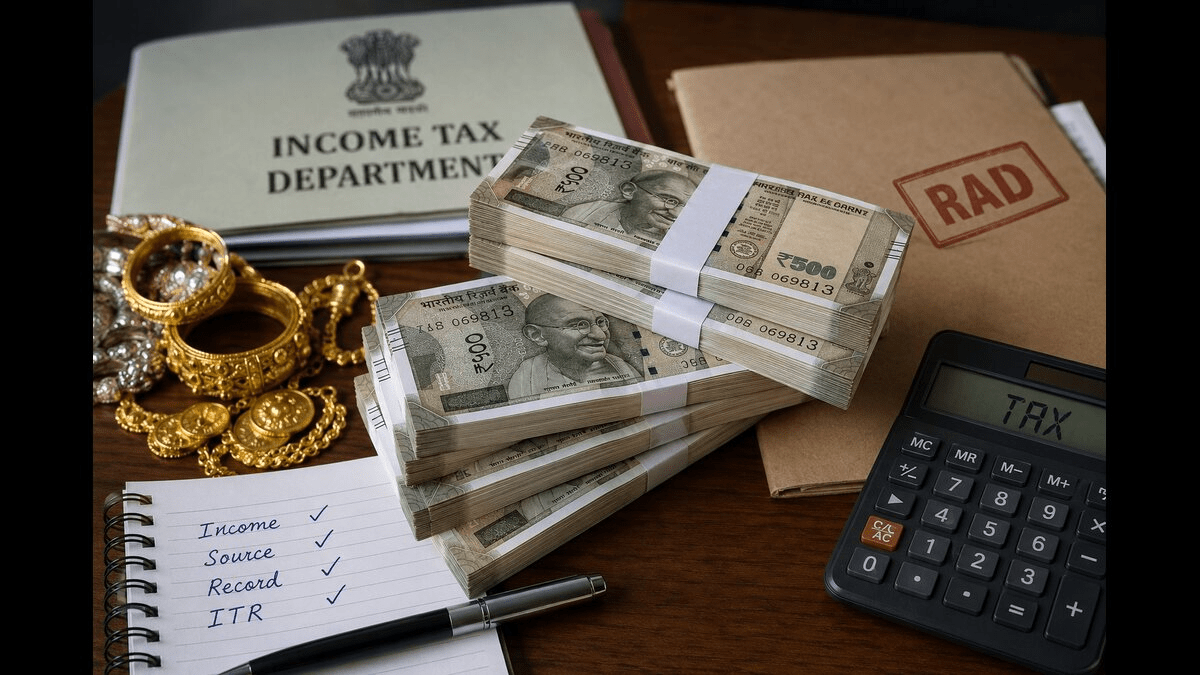
Now a viral social media thread has brought one of India’s most common financial curiosities back into the limelight. In the aftermath of massive income tax raids uncovering staggering amounts of currency, many citizens are asking: What is the legal limit for holding cash at home? Therefore, the short answer is that there is no absolute numeric limit. However, the catch lies in your ability to justify the “source” of every single rupee. Meanwhile, the TaxBuddy platform has detailed the severe penalties—reaching an effective tax rate of 84%—for those caught with unexplained income. Following the latest guidelines for Assessment Year (AY) 2026-27, staying compliant is the only way to ensure your savings remain yours.
Add businessleague.in as a Preferred Source


Also Read |Tamil Nadu Voter List Purge: 97 Lakh Names Deleted in SIR Phase 1
The Gold Rule: Declared Money is Legal Money
Now it is essential to understand that the Indian government does not restrict the physical volume of cash you keep in your residence. Whether it is ₹1 lakh or ₹100 crore, the possession itself is not a crime. Therefore, the legality of the cash is tied entirely to its reporting in your Income Tax Returns (ITR).
First, if the money is recorded in your books and you have proof of its source, it is considered “declared money.” Next, this rule extends beyond just currency to include gold, silver, and jewelry. Thus, any amount of wealth is legal as long as it has been taxed or originates from an exempt source that can be verified.
So the “viral curiosity” surrounding this topic often stems from a misunderstanding of tax raids. Meanwhile, TaxBuddy emphasizes that raids are not about the quantity of cash but about the transparency of its origin. Therefore, as long as you file honestly, you have nothing to fear from the authorities.
Section 115BBE: Why Unexplained Cash Could Cost You 84 Percent
Now if you are found with cash that is not reported in your ITR or has no proof of source, it becomes “unexplained income.” Under Section 115BBE of the Income Tax Act, the penalties are designed to be devastating. Therefore, the mechanical necessity of reporting your income becomes clear when you look at the effective tax rates.
The Math of Unexplained Cash:
-
Flat Tax: 60% (No deductions or exemptions allowed).
-
Surcharge: 25% on the tax amount.
-
Penalty: 10% on the tax (if not declared in ITR).
-
Cess: 4% Health & Education cess.
First, if you find ₹1 crore and declare it yourself, the effective rate is 78%, leaving you with ₹22 lakh. Next, if the IT Department catches the undeclared ₹1 crore, the effective rate jumps to 84%, leaving you with only ₹16 lakh. Thus, the cost of non-compliance is almost the entire value of the asset.
Banking and PAN: Limits for Deposits and Withdrawals
Now the interaction between your home cash and the banking system is strictly monitored by the Central Board of Direct Taxes (CBDT). Therefore, moving large sums of money in and out of your accounts requires specific documentation to prevent money laundering.
First, providing a PAN number is mandatory for any deposit or withdrawal exceeding ₹50,000 at a single time. Next, banks are required to report high-value cash transactions to the tax authorities. Thus, trying to “break up” large sums into smaller deposits can still trigger automated red flags in the 2026 digital banking ecosystem.
So the integration of Aadhaar and PAN allows the government to track the flow of cash with high precision. Meanwhile, consistent high-value transactions without a matching income profile in your ITR will almost certainly prompt an investigation. Therefore, the banking window is the primary point where “home cash” meets official scrutiny.
Also Read |Tamil Nadu Voter List Purge: 97 Lakh Names Deleted in SIR Phase 1
Property and Real Estate: The ₹2 Lakh Cash Ceiling
Now the real estate sector has historically been a major sink for cash transactions. To counter this, Section 269ST imposes a strict cap on the purchase and sale of property using physical currency. Therefore, the cash limit for property transactions is currently capped at ₹2 lakh.
First, any transaction beyond this limit must be conducted through digital means, cheques, or demand drafts. Next, violating this rule can lead to a penalty of up to 100% of the cash amount involved. Thus, a ₹10 lakh cash payment for a plot of land could result in a ₹10 lakh fine, effectively doubling the cost of the property.
So the government uses these limits to ensure that high-value assets are tied to a clear paper trail. Meanwhile, the registrar’s office is required to report transactions that seem suspicious or exceed these thresholds. Therefore, “investing” unexplained cash in property is one of the riskiest financial moves you can make.
Family and Personal Loans: Understanding the ₹20,000 Barrier
Now even personal relationships are subject to the strict rules of the Income Tax Department. Many people assume that taking a loan from a friend or relative in cash is a private matter. However, the law strictly prohibits accepting ₹20,000 or more in cash for loans or deposits.
First, if you need a loan of ₹50,000 from a colleague, it must be done via a bank transfer or a cheque. Next, receiving more than ₹2 lakh in cash from a relative in a single day—even as a gift—is also prohibited and can trigger penalties. Thus, the “₹20,000 rule” is a critical boundary to remember for daily financial life.
So these rules are in place to prevent people from “masking” unexplained income as personal loans. Meanwhile, the penalties for violating these limits are equal to the amount of the loan or deposit taken. Therefore, the mechanical necessity of using formal banking channels applies even to your closest social circles.
Raids and Investigations: How the IT Department Defines ‘Unexplained’
Now when a raid occurs, the primary goal of the officers is to match the physical assets found with the records in the owner’s books. If there is a discrepancy that cannot be explained with documented evidence, the asset is labeled “unexplained.” Therefore, documentation is your only defense during a search.
First, the department looks for “recorded” money—funds that have been mentioned in your balance sheets or tax filings. Next, they look for “proof of source,” such as withdrawal slips from a bank or inheritance documents. Thus, having a large sum of money from a decade-old sale that was never recorded will still be treated as unexplained income.
So the viral TaxBuddy thread serves as a timely reminder that “raids are not about how much you have, but where it came from.” Meanwhile, the digital footprint of your spending is often used to cross-reference the cash you hold. Therefore, the IT department’s definition of “unexplained” is broad and heavily favors the state.
Also Read |Tamil Nadu Voter List Purge: 97 Lakh Names Deleted in SIR Phase 1
Filing Honestly: The Path to ‘Sleeping Peacefully’
Now the ultimate advice for any citizen in 2026 is simple: “File honestly and sleep peacefully.” With the effective tax rate on caught unexplained income reaching 84%, the “savings” from evading tax are statistically negligible compared to the risk. Therefore, compliance is the most profitable long-term strategy.
First, ensure that every high-value asset, whether cash or gold, is accounted for in your annual filings. Next, maintain a file of bank statements and sale deeds to justify any large spikes in your cash holdings. Thus, you transform your home into a secure vault of “declared wealth” that no authority can legally seize.
So the “staggering recoveries” seen in recent raids serve as a warning of what happens when these rules are ignored. Meanwhile, the government continues to tighten the digital net around cash transactions. Therefore, the most important rule to remember is that there is no limit to your wealth, as long as the taxman knows it exists.
FAQ: Frequently Asked Questions on Holding Cash in India
1. Is there a legal limit to keeping cash at home? Now, no. You can keep any amount of cash at home legally in India, provided you can prove its source and it is declared in your tax filings.
2. What happens if I can’t explain the source of my cash? First, it is treated as unexplained income. Under Section 115BBE, it can be taxed at an effective rate of up to 84% if caught by the IT department.
3. What is the limit for cash transactions in property? So the limit is ₹2 lakh. Any transaction above this amount must be done through non-cash methods to avoid 100% penalties.
4. Do I need a PAN card for large cash deposits? Next, yes. A PAN card is mandatory for any cash deposit or withdrawal exceeding ₹50,000 at a time.
5. Can I take a cash loan from a friend? Now, you cannot legally accept ₹20,000 or more in cash as a loan or deposit. It must be done through banking channels.
6. Is gold and jewelry also subject to these rules? Finally, yes. Just like cash, you must be able to prove the legal source or inheritance of any gold or jewelry kept at home during an investigation.
Also Read |Tamil Nadu Voter List Purge: 97 Lakh Names Deleted in SIR Phase 1
End…
Add businessleague.in as a Preferred Source
🙏 Support Independent Journalism
We keep news free for you.
Most readers support with ₹500 ❤️
or scan QR below

Voluntary contribution. No tax benefits.
DISCLAIMER
We have taken all measures to ensure that the information provided in this article and on our social media platform is credible, verified and sourced from other Big media Houses. For any feedback or complaint, reach out to us at businessleaguein@gmail.com