


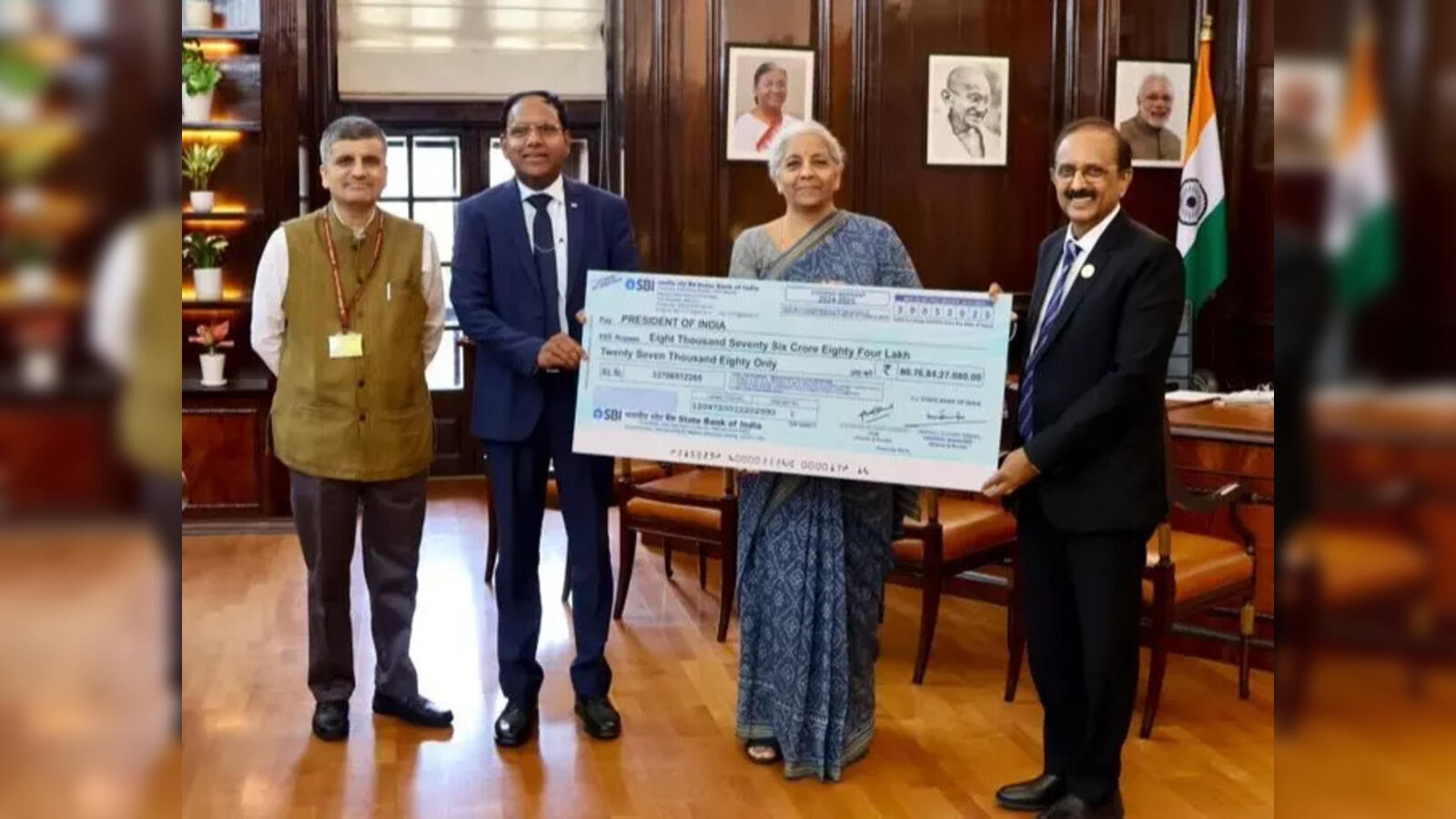
SBI Chairman C.S. Setty delivers the multi-crore payout to Finance Minister Nirmala Sitharaman following a 12.8% surge in annual net profits and historic asset quality milestones.
Add businessleague.in as a Preferred Source


The fiscal balance sheet of the Government of India has received a massive non-tax revenue injection. On Monday afternoon, State Bank of India (SBI), the country’s largest public sector lender, formally presented a record-breaking ₹8,813 crore dividend cheque to the Central government for the financial year ending March 31, 2026.
The high-value financial instrument was delivered in person to Union Finance Minister Nirmala Sitharaman at the Ministry of Finance headquarters in New Delhi by the newly positioned SBI Chairman, C.S. Setty. The multi-crore payout highlights the bank’s exceptional financial position and will assist the central treasury in managing its current fiscal deficit targets.
Also Read | Viral Trump Lookalike Buffalo Rescue: Saved From Eid Sacrifice
Inside the Balance Sheet: Driving the Multi-Crore Payout
The massive scale of the SBI dividend cheque 2026 is the direct result of strong structural growth across all primary banking vectors. According to the bank’s audited financial statements, SBI closed the fiscal cycle by hitting a record consolidated annual net profit of ₹80,032 crore, representing an impressive 12.88% year-on-year expansion compared to the previous financial year.
The state’s massive payout is tied securely to its dominant ownership structure. Because the Government of India holds an approximate 55.52% controlling stake in the equity shares of the public sector giant, it remains the primary beneficiary of corporate profit distributions. For the concluded financial cycle, SBI’s Central Board approved a standalone dividend of ₹17.35 per equity share, which was distributed to all registered retail and institutional investors.
Exceptional Asset Quality Gains
A major reason behind the bank’s ability to free up such extensive capital for dividend distribution is a sharp reduction in non-performing assets (NPAs). The bank’s risk-mitigation desks successfully isolated and removed bad loan variables, leading to historic asset quality milestones.
| Core Financial Metric Layer | Performance Log (FY 2024-25) | Performance Log (FY 2025-26) | Real-World Operational Shift |
| Gross Non‑Performing Assets | 1.82% Baseline | 1.49% Consolidated | Dropped by 33 basis points, indicating strong corporate repayment pipelines. |
| Net Non‑Performing Assets | 0.47% Baseline | 0.39% Consolidated | Reduced to near-zero levels, limiting the need for bad-debt provisioning. |
| Total Annual Operating Profit | ₹1,10,578 Crore | ₹1,23,015 Crore | Expanded by 11.25%, demonstrating strong core operational efficiency. |
| Domestic Net Interest Margin | 3.01% Flat Baseline | 3.03% Hardened Margin | Maintained comfortably above the bank’s strict 3.0% threshold. |
The systemic improvement in asset quality allowed the bank’s return on equity (ROE) to finish at a healthy 18.57%, while its overall return on assets (ROA) stabilized at a solid 1.12%.
Also Read | Viral Trump Lookalike Buffalo Rescue: Saved From Eid Sacrifice
Interest Rate Trajectory: Supporting a Policy Pause
Beyond managing internal operations, Chairman C.S. Setty addressed broader macroeconomic strategies during a recent elite banking forum in Mumbai. Commenting on the upcoming schedule for the Reserve Bank of India’s Monetary Policy Committee (MPC), Setty noted that market indicators point toward a continued pause in the benchmark repo rate.
Setty clarified that while local food inflation dynamics require continuous monitoring by central planners, maintaining the current interest rate status quo is the most effective path to support corporate investments and ensure a stable borrowing market.
The Long-Term Structural View: The public sector banking head strongly urged domestic and international investors to stop judging India’s financial health solely by short-term swings in the BSE Sensex. “Do not look only at the Sensex… look at India as a long-term story,” Setty emphasized.
He pointed out that the true strength of the domestic market relies on deep, structural transformations—including digital public infrastructure deployment, expanded rural credit programs, and extensive government capital investments. With its multi-crore cash contribution now securely positioned inside the government’s non-tax revenue ledger, the banking giant enters the new fiscal quarter with clean books and deep capital reserves.
FAQ Section
How much did the government receive from the SBI dividend cheque 2026?
The Government of India received a dividend cheque worth exactly ₹8,813 crore from the State Bank of India. The funds were formally presented to Union Finance Minister Nirmala Sitharaman on Monday, June 8, 2026.
What was the final dividend per share announced by SBI?
Following a record-breaking financial year, SBI’s Central Board officially declared a final dividend of ₹17.35 per equity share. The government received the largest chunk of this distribution due to its 55.52% majority stake in the bank.
What were SBI’s net profit and bad loan figures for the financial year?
SBI reported an all-time high annual net profit of ₹80,032 crore, marking a 12.88% year-on-year increase. Concurrently, its gross non-performing asset (NPA) ratio improved significantly, dropping to 1.49%, while its net NPA ratio fell to a historic low of 0.39%.
Also Read | Viral Trump Lookalike Buffalo Rescue: Saved From Eid Sacrifice
End…
Add businessleague.in as a Preferred Source

