
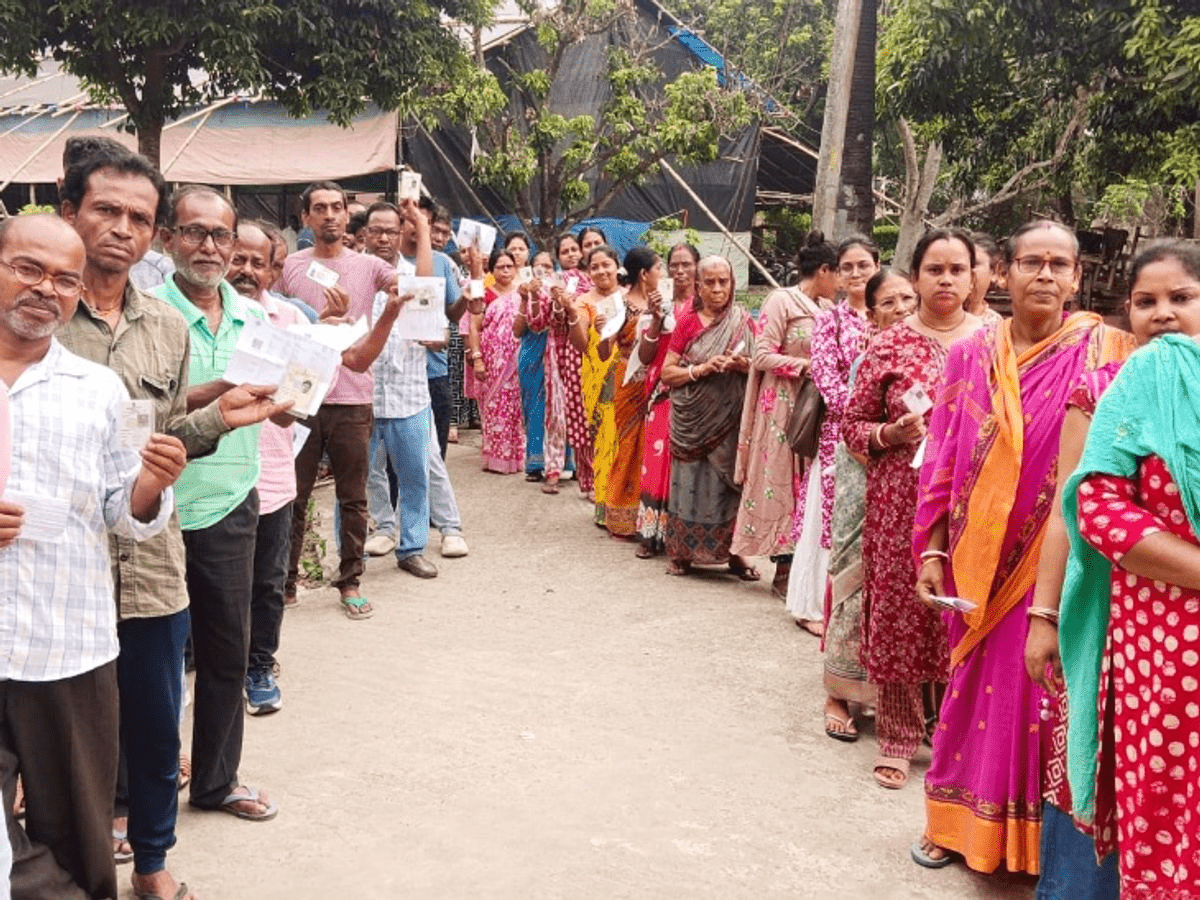
Now the democratic fabric of Tamil Nadu has been fundamentally rewoven. On Saturday, April 25, 2026, official figures confirmed an unprecedented Tamil Nadu voter turnout 2026 record of 85.15%. This represents a staggering 11.4% jump from the 2021 Assembly polls, throwing up striking regional contrasts that have left political analysts and parties in a state of high-alert anticipation. Therefore, the state is witnessing a historic level of engagement that could signal either a massive mandate for continuity or an explosive demand for change.
Add businessleague.in as a Preferred Source


Meanwhile, the capital city of Chennai has delivered a “remarkable surge,” signaling that urban mobilization is no longer a secondary factor in Dravidian politics.
But for the traditional powerhouses, the most concerning data comes from the South, which has lagged behind the soaring participation rates seen in the Western belt.
Also Read |Tamil Nadu Voter List Purge: 97 Lakh Names Deleted in SIR Phase 1
Western Tamil Nadu: The Standout Performer of 2026
Now we must look at the “engine room” of this electoral surge. Western Tamil Nadu has emerged as the most active region in the state, with participation figures that defy conventional averages. Therefore, the Tamil Nadu voter turnout 2026 record was largely powered by the agrarian and industrial heartlands of the West.
Leading District Figures:
First, Karur led the charts with a massive 92.63% turnout. Then, Salem (90.76%) and Namakkal (90.21%) followed closely, creating a contiguous belt of high-intensity voting. Thus, the region showed a unified front in exercising its franchise. Next, at the specific constituency level, both Karur and Veerapandi topped the scales with 93.4% turnout each. Therefore, the Western belt has effectively become the primary decider of the 2026 mandate, forcing every party to re-evaluate their performance in these districts.
Chennai’s Urban Revolution: A 23.9% Participation Jump
Now, perhaps the most shocking data point of the election is the urban mobilization in the capital. Chennai, often criticized for “voter apathy,” has rewritten its own narrative by clocking a turnout of 83.74%.
Breaking the Apathy
First, this represents a sharp 23.9% increase from the 59.7% recorded in 2021. Then, this surge suggests that urban issues—or perhaps a new urban-centric political force—have finally resonated with the metropolitan electorate. Thus, the “Chennai block” now carries as much weight as rural districts. Next, analysts believe this jump is a combination of better voter awareness and a polarized political atmosphere. Therefore, the capital’s surge is the “X-factor” that could either protect the incumbent or propel a newcomer to power.
The Southern Contrast: Why Palayamkottai and Kanniyakumari Lagged
Now, in a stark contrast to the West and North, the Southern districts recorded comparatively subdued participation. Despite intense campaigning by all major players, the South did not mirror the statewide surge.
Subdued Participation
First, Palayamkottai recorded the state’s lowest turnout at 68.97%, which is nearly 7% lower than its previous performance. Then, other Southern districts like Kanniyakumari (75.61%), Sivaganga (76.66%), and Ramanathapuram (77%) also trailed the state average. Thus, a regional disconnect appears to have formed, where the high-voltage campaign failed to translate into a mass turnout in these belts. Next, this “lag” in the South could impact parties that traditionally rely on these regions for their core support. Therefore, the regional disparity is a central theme in the Tamil Nadu voter turnout 2026 record story.
Also Read |Tamil Nadu Voter List Purge: 97 Lakh Names Deleted in SIR Phase 1
Special Intensive Revision (SIR): Reshaping the Voter Base
Now we must address the “mathematical catalyst” behind these high percentages. Many analysts attribute the spike to the Special Intensive Revision (SIR) of electoral rolls conducted by the Election Commission.
The Baseline Shift
First, the SIR exercise removed nearly 70 lakh deceased, duplicate, and “illegal” names from the rolls. Then, around 30 lakh new voters—mostly young and first-time participants—were added. Thus, the total voter base was “scrubbed” to be more accurate, which naturally increases the percentage turnout if the same number of people vote. Next, the removal of “ghost voters” means that the 85.15% figure is likely a more honest reflection of active participation than previous records. Therefore, the SIR has not only cleaned the list but has fundamentally reshaped the “voter denominator” for the 2026 election.
DMK’s Interpretation: Governance and Welfare Endorsement
Now the ruling DMK has been quick to claim the turnout as a positive sign. The party views the high participation as a “vote of confidence” in its governance over the last five years.
Welfare Consolidation
First, DMK spokesperson Dr. Syed Hafeezullah stated that the massive turnout reflects overwhelming support from women and youth. Then, he credited flagship schemes like the monthly assistance for women and free bus travel for this consolidation. Thus, the party believes that those who “benefited from the kitchen-table economy” showed up in droves to protect the government. Next, DMK sources claim strong performance across the Delta and Western regions as well. Therefore, the incumbent party is reading the Tamil Nadu voter turnout 2026 record as an endorsement of the “Dravidian Model” of welfare.
Actor Vijay’s TVK: A New Political Force in Chennai?
Now a significant “new political force” is being blamed—or credited—for the urban surge. Actor Vijay’s TVK has claimed that the historic turnout is a clear vote for change and for their leader.
The Urban Rally
First, TVK spokesperson Felix Gerald highlighted the Chennai surge as proof that people are rallying behind Vijay. Then, the party believes that the “silent majority” in urban centers has finally found an alternative to the traditional DMK-AIADMK binary. Thus, the TVK is predicting that Vijay will become the Chief Minister based on these participation spikes. Next, the party’s focus on “youth mobilization” seems to correlate with the 30 lakh new voters added during the SIR. Therefore, the TVK factor is the most discussed “threat” to the established political order in this election.
Also Read |Tamil Nadu Voter List Purge: 97 Lakh Names Deleted in SIR Phase 1
AIADMK’s Confidence: Reading the Anti-Incumbency Wave
Now the AIADMK has a completely different interpretation of the 85.15% figure. Historically, a massive jump in turnout often signals a desire to remove an incumbent government.
The Wave of Change
First, the AIADMK asserts that it has made significant gains in the South, North, and parts of the West. Then, the party interprets the high turnout as a sign of deep-seated anti-incumbency triggered by rising costs and administrative issues. Thus, they are confident in a major political comeback on May 4. Next, the party believes that the consolidate “opposition vote” has finally found its way to the booths. Therefore, the AIADMK is banking on the traditional “high turnout = change” formula to return to power in Fort St. George.
Demographic Shifts: The Role of Women and Youth Voters
Now the demographic makeup of those who stood in line is the final piece of the puzzle. Reports suggest that women and youth voters were present in “record numbers” across the 234 constituencies.
The Silent Deciders
First, the 30 lakh first-time voters added during the SIR are seen as the primary drivers of the Chennai and Western surges. Then, the specific welfare schemes targeted at women have ensured that female participation remained high even in the lagging Southern districts. Thus, these two groups have become the “silent deciders” of the 2026 mandate. Next, political parties have spent the last month specifically wooing these demographics with digital campaigns and grassroots outreach. Therefore, the Tamil Nadu voter turnout 2026 record is not just a number; it is a demographic statement.
Common Questions Answered
What was the final voter turnout for Tamil Nadu 2026? Now the official final turnout is 85.15%, which is an 11.4% increase from the 2021 Assembly elections.
Which district had the highest turnout in TN? First, Karur led the state with a record 92.63% turnout. Thus, the Western region remains the most politically active.
Why did Chennai’s voter turnout surge so much? Next, Chennai saw an 83.74% turnout (up from 59.7%). Therefore, analysts attribute this to urban mobilization, the “Vijay factor,” and the removal of defunct names via SIR.
What is the SIR of electoral rolls? So it stands for Special Intensive Revision. Thus, the Election Commission removed 70 lakh old names and added 30 lakh new ones to clean the voter list.
When will the Tamil Nadu election results be declared? Finally, the counting of votes is scheduled for May 4, 2026. Therefore, the wait for the final verdict is nearly over.
Also Read |Tamil Nadu Voter List Purge: 97 Lakh Names Deleted in SIR Phase 1
End…
Add businessleague.in as a Preferred Source
🙏 Support Independent Journalism
We keep news free for you.
Most readers support with ₹500 ❤️
or scan QR below

Voluntary contribution. No tax benefits.
DISCLAIMER
We have taken all measures to ensure that the information provided in this article and on our social media platform is credible, verified and sourced from other Big media Houses. For any feedback or complaint, reach out to us at businessleaguein@gmail.com