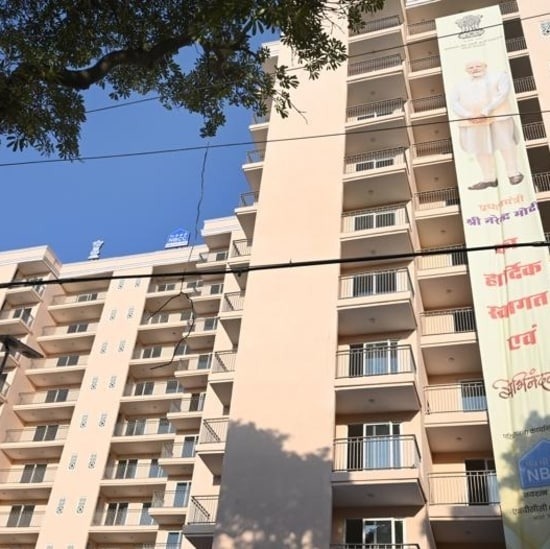
The architectural landscape of Central Delhi is undergoing its most significant transformation in decades. On Sunday, March 8, 2026, Prime Minister Narendra Modi marked International Women’s Day by handing over the keys to state-of-the-art residential units to women government employees. The inauguration of 2,722 General Pool Residential Accommodation (GPRA) flats is part of a massive “Self-Funding” redevelopment project aimed at replacing aging, low-density housing with modern, high-rise sustainability.
Add businessleague.in as a Preferred Source


Joined by Delhi Chief Minister Rekha Gupta and Union Minister Manohar Lal Khattar, the PM signaled that the era of crumbling “Type-II” and “Type-III” quarters is being replaced by a vertical, energy-efficient vision of urban living.
Also Read |Tamil Nadu Voter List Purge: 97 Lakh Names Deleted in SIR Phase 1
The GPRA Overhaul: From 12,000 to 24,000 Units
The project isn’t just a renovation; it’s a total reimagining of how government staff lives in the capital.
-
Consolidation: The plan eventually aims to replace 12,970 old dwelling units with a total of 24,917 modern homes.
-
Key Locations: The first phase covers Kasturba Nagar and Sarojini Nagar, with the next phase expanding to Netaji Nagar and Sriniwaspuri.
Bharat Business Park: Delhi’s New Commercial Landmark
Parallel to the housing, the government is building a massive commercial engine.
-
The Scale: A built-up area of 217,000 square metres of premium office space.
-
Sustainable Design: The towers are designed with “world-class” sustainable and energy-efficient features.
-
Valuation: The project has an estimated commercial value of ₹2,270 crore.
Also Read |Tamil Nadu Voter List Purge: 97 Lakh Names Deleted in SIR Phase 1
International Women’s Day: A Focus on Beneficiaries
The PM utilized the platform to emphasize women-led development (Nari Shakti).
-
Direct Interaction: The PM held discussions with women construction workers and engineers from the NBCC who executed the project.
-
Broader Support: Later in the day at Burari, he distributed PM-Ayushman Bharat cards and PM Svanidhi credit cards specifically to women beneficiaries, highlighting the “double-engine” government’s reach.
The Economic Model: Self-Funding Redevelopment
Unlike traditional government projects that rely solely on taxpayer funds, this redevelopment follows a commercial-offset model.
-
Monetization: The NBCC earns revenue for the government by selling commercial hubs like the World Trade Centre in Nauroji Nagar and Downtown in Sarojini Nagar.
-
Continuity: This model builds upon the “East Kidwai Nagar” template established previously to ensure projects are financially self-sustaining.
Reality Check
The redevelopment of central colonies is a massive win for government employees who have lived in dilapidated housing for years. Still, the environmental cost of such a large-scale overhaul—specifically the felling of old-growth trees in these green belts—remains a point of contention for local activists. Therefore, while the “sustainable” features of the new buildings are highlighted, the transition to high-rise density will permanently change the “bungalow-city” character of Central Delhi.
The Loopholes
The project is “self-funding.” In fact, this is a “Commercialization Loophole”—by building massive office towers like the Bharat Business Park in residential zones, the government is significantly increasing traffic and utility pressure on the surrounding neighborhoods. Therefore, while the buildings are paid for, the infrastructure (roads, water, sewage) will likely require massive state funding later. Still, the “Allottee Loophole” remains; as 24,000 units replace 12,000, the selection criteria for who gets these “new-age” flats will be a point of high internal competition within the civil services.
Also Read |Tamil Nadu Voter List Purge: 97 Lakh Names Deleted in SIR Phase 1
What This Means for You
If you are a central government employee, the quality of life in Delhi quarters is about to spike. First, realize that the new flats come with modern amenities that were previously unavailable in government housing. Then, if you are a resident of South or Central Delhi, understand that Sarojini Nagar and Kasturba Nagar will soon be massive construction zones with diverted traffic patterns.
Finally, understand that commercial real estate in Delhi is shifting. You should keep an eye on the Bharat Business Park if you are looking for premium office space, as it is set to become a major rival to private hubs like Aerocity. Before you apply for an allotment, check the updated GPRA guidelines for 2026 to see if “women-head-of-household” priorities have been formally integrated into the software.
What’s Next
The allotment process for the first 2,700 flats will be completed by the end of March 2026. Then, look for the tendering process for the 6,632 new units to be finalized by the CPWD. Finally, expect the Bharat Business Park to open for commercial leasing by the fourth quarter of 2026, marking the completion of the Nauroji-Sarojini commercial corridor.
Also Read |Tamil Nadu Voter List Purge: 97 Lakh Names Deleted in SIR Phase 1
End…
Add businessleague.in as a Preferred Source
We have taken all measures to ensure that the information provided in this article and on our social media platform is credible, verified and sourced from other Big media Houses. For any feedback or complaint, reach out to us at businessleaguein@gmail.com