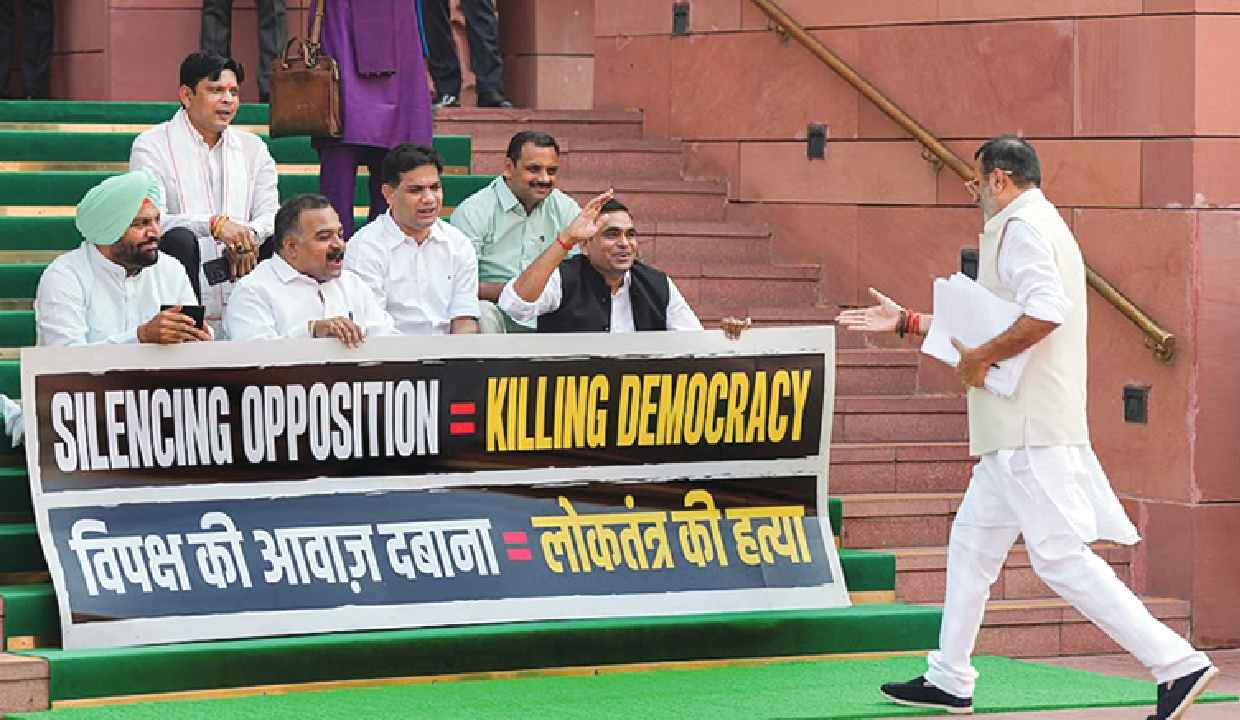
After weeks of legislative gridlock and a failed no-confidence motion against the Chair, the Lok Sabha witnessed a rare moment of reconciliation on Tuesday, March 17, 2026. The suspension of eight prominent Opposition members was revoked following a strategic “thaw” brokered in the Speaker’s chamber.
Add businessleague.in as a Preferred Source


Speaker Om Birla, who recently survived an Opposition-led no-confidence motion, has emerged with a noticeably firmer grip on House proceedings. While allowing the members back, he made it clear that the “New Age” of protests—involving AI-manipulated content and digital slogans—would be met with immediate and severe disciplinary action.
Also Read |Tamil Nadu Voter List Purge: 97 Lakh Names Deleted in SIR Phase 1
The Road to Reinstatement: Meetings in the Chamber
The breakthrough wasn’t spontaneous; it was the result of high-level negotiations held on Monday.
-
The Participants: Leaders from both the Treasury and Opposition benches met privately with the Speaker.
-
The Condition: The government insisted on an explicit apology or expression of regret on the floor of the House to maintain the “dignity of the Chair.”
-
The Statement: Congress Chief Whip K. Suresh rose during Zero Hour to state: “Whatever indiscretion may have inadvertently happened is deeply regretted.”
AI and Digital Integrity: The Speaker’s New Rule
A significant takeaway from Tuesday’s session was the Speaker’s specific targeting of Artificial Intelligence in political protests.
-
Digital Slogans: The Chair noted with concern the attempt to bring tablets or mobile devices displaying AI-generated images into the well of the House.
-
The Ban: Birla ruled that any member found using AI to create “derogatory or misleading” visuals of fellow members or parliamentary proceedings would face permanent expulsion from the session.
Defining the “Lakshman Rekha” for Both Sides
Parliamentary Affairs Minister Kiren Rijiju invoked the term “Lakshman Rekha” to describe the code of conduct required to prevent a total collapse of the 18th Lok Sabha.
-
Treasury Responsibility: Opposition leaders like Dharmendra Yadav (SP) argued that the ruling party must also stop making personal attacks, specifically naming BJP’s Nishikant Dubey.
-
Opposition Duty: The government maintained that the “Right to Dissent” does not include the right to physically block the Speaker’s view or tear up official documents.
Also Read |Tamil Nadu Voter List Purge: 97 Lakh Names Deleted in SIR Phase 1
The Naravane Book Controversy: A Quick Refresher
The original cause of the February 3 suspensions centered on a debate over a book by former Army Chief M.M. Naravane.
-
The Trigger: Leader of Opposition Rahul Gandhi attempted to quote from an unpublished manuscript of the General’s memoir.
-
The Ruling: The Chair disallowed the reference, citing rules against quoting unauthenticated or private documents, leading to the massive protest that saw the eight MPs removed.
Reality Check
The revocation of these suspensions is a tactical retreat for both sides. The government wants the Finance Bill passed without a walkout, and the Opposition wants its key voices back in the House for the upcoming debate on the 2026 National Security Policy. Therefore, while the “regret” was expressed, it remains a fragile peace. In fact, the Speaker’s focus on AI images suggests that the nature of political warfare in India is shifting from physical placards to deepfakes and digital optics.
The Loopholes
The Speaker has banned AI images. In fact, this is an “Enforcement Loophole”—in a crowded House, it is nearly impossible for the Chair to instantly verify if a displayed image is a “real” photo or an “AI-generated” one. Therefore, the rule may be used selectively against the most vocal dissenters. Still, the “Indiscretion Loophole” remains; by calling the conduct “inadvertent,” the Congress avoided a full-blown apology while still satisfying the technical requirement for reinstatement.
Also Read |Tamil Nadu Voter List Purge: 97 Lakh Names Deleted in SIR Phase 1
What This Means for You
If you follow parliamentary proceedings, expect a more orderly debate over the next few days. First, realize that both sides are exhausted by the recent no-confidence motion cycle. Then, if you are a constituent of the eight reinstated MPs, understand that your representative is back in the House to raise local issues during the crucial closing week of the session.
Finally, understand that AI is now a formal part of the Indian legislative rulebook. You should watch how “Digital Conduct” becomes a standard part of the ethics committee’s oversight throughout 2026. Before you believe every viral clip from Parliament, check for official Lok Sabha TV (LSTV) footage, as manipulated clips are precisely what the Speaker is trying to curb.
What’s Next
Expect the Finance Bill to be taken up for a full-day discussion on Wednesday. Then, look for the Ethics Committee to release a formal ‘Digital Conduct’ handbook for MPs. Finally, expect Rahul Gandhi to lead a major debate on the Naravane book controversy—this time with “authenticated” documents to bypass the Speaker’s earlier objection.
Also Read |Tamil Nadu Voter List Purge: 97 Lakh Names Deleted in SIR Phase 1
End….
Add businessleague.in as a Preferred Source
🙏 Support Independent Journalism
We keep news free for you.
Most readers support with ₹500 ❤️
or scan QR below

Voluntary contribution. No tax benefits.
DISCLAIMER
We have taken all measures to ensure that the information provided in this article and on our social media platform is credible, verified and sourced from other Big media Houses. For any feedback or complaint, reach out to us at businessleaguein@gmail.com