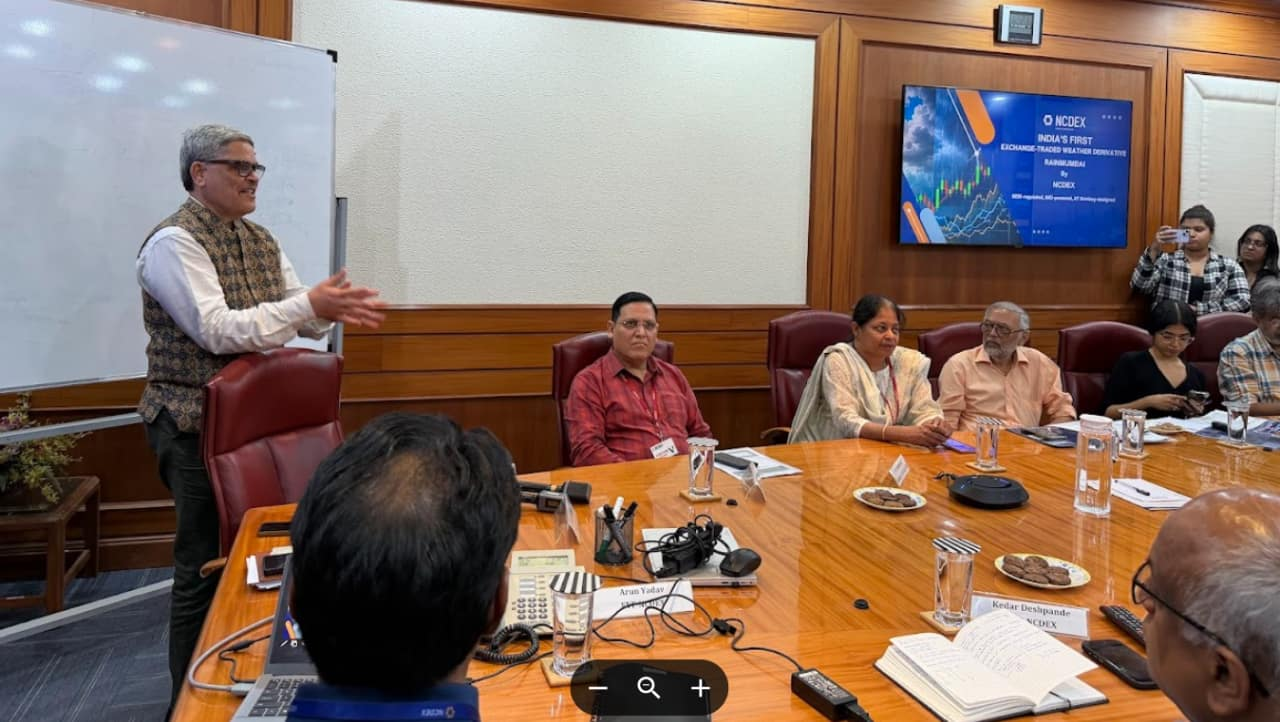
Now the internal risk architecture and commodity exchange parameters stabilizing India’s multi-billion dollar financial system are experiencing a historic, highly progressive evolution. The premier agricultural commodity derivative trading floor NCDEX has officially introduced “RAINMUMBAI,” launching the country’s first-ever SEBI-approved, exchange-traded weather derivatives framework. Structured to transform unpredictable seasonal precipitation volumes into highly scannable, tradeable capital assets, this revolutionary asset class initializes open trading desks on Thursday, May 29. Therefore, institutional portfolio allocators, infrastructure corporations, and commercial lending firms are adjusting their hedging playbooks on Thursday, May 21, 2026. Following extensive scientific validation loops performed alongside elite regional academic bodies, enforcing this transparent mathematical insulation layer stands as an absolute mechanical necessity to shield diverse corporate balance sheets from seasonal monsoon shocks.
Add businessleague.in as a Preferred Source


Also Read |Tamil Nadu Voter List Purge: 97 Lakh Names Deleted in SIR Phase 1
At a Glance: RAINMUMBAI Weather Derivative Contract Framework
| ASSET SPECIFICATION NODE | DESIGNED INDEX CONFIGURATION | DATA SOURCING BASE | CLINICAL MARGIN OBJECTIVE |
| Trading Identifier Name | RAINMUMBAI Derivative Block | Unified SEBI-regulated framework | Converting climate shifts into tradeable risk |
| Mathematical Base Core | Cumulative Deviation Rainfall (CDR) | IIT Bombay joint development | Measuring precipitation distance from averages |
| Physical Sensor Array | Automatic Weather Stations (AWS) | Santacruz and Colaba gauges | Tracking standard 24-hour cycles cleanly |
| Historical Baseline Scale | 30-Year Historical Data Matrix | Captured formal 1991–2020 records | Benchmarking true seasonal precipitation variations |
| Final Clearing Execution | Complete data-driven cash settlement | Direct electronic account drops | Bypassing sluggish manual loss checks |
The Weather Reset: Unpacking the Launch Strategy for the May 29 Open Contracts
Now the regulatory documentation cleared by the capital market monitors establishes an entirely fresh category of derivative trading instruments across the subcontinent. The expansion of unpredictable climate spikes across recent tracking years frequently complicated raw production margins for agricultural businesses and urban construction corporations alike. Therefore, central exchange directors finalized a highly structured, transparent index to convert atmospheric chaos into measurable financial coordinates cleanly.
First, look at the launch timeline: the specialized contract block begins active execution across official matching screens on May 29. Next, the primary design focuses heavily on helping corporate members transfer their atmospheric risk exposures without requiring physical property damage assessments. Thus, the mechanical necessity of building a regulated, transparent marketplace to trade seasonal variance factors is successfully satisfied.
So the forward strategy aims to move large-scale climate protection routines away from traditional, slow-moving insurance claims toward fast-moving digital trades. This smart update allows corporate treasury boards to hedge their seasonal cash flow variances with identical ease seen across standard gold or wheat options. Meanwhile, digital brokerage systems are configuring specialized mobile alerts to keep trading firms updated on localized volume movements through the pre-monsoon weeks. Therefore, the strategic launch parameters establish an exceptionally stable foundation to support the new asset class’s market entry.
The CDR Substrate: Inside IIT Bombay’s Cumulative Deviation Modeling
Nowhere does the execution of sound financial product design require higher mathematical precision than when engineering a benchmark index around natural seasonal rain layers. To translate erratic storm trends into balanced numeric units, the exchange collaborated deeply with data scientists at IIT Bombay. Therefore, quantitative analysis desks are utilizing this scientific modeling framework to execute balanced trading orders across the commercial index.
First, look at the underlying core layout: the RAINMUMBAI contract calculates trading values based on a sophisticated Cumulative Deviation Rainfall (CDR) algorithm. Next, this specific tracking engine measures how significantly actual seasonal rainfall blocks drift away from the established Long Period Average (LPA). Thus, the mechanical necessity of creating an un-biasable, purely data-driven risk measure is beautifully met by the university’s modeling choices.
[Atmospheric Storm Clouds Drop Rain Matrix] ──► Automated Gauges Measure Local Millimeter Accumulations
                                                       │
                                                       ▼ (The Cumulative Deviation Processing Phase)
[IIT Bombay Core CDR Algorithm Activates]   ──► Calculates Precise Variance Distance from Historical 30-Year LPA
                                                       │
                                                       ▼
[Cash-Settled Index Index Values Adjust]    ──► Delivers Immediate, Transparent Hedging Protection to Trading Accounts
So these advanced calculation models run calculations continuously across the active monsoon window, which spans systematically from June through September. The index evaluates performance parameters against an extensive historical reference grid tracing thirty consecutive years of local data from 1991 through 2020. This deep historical backdrop provides trading firms with an exceptional baseline to price their contract positions with high mathematical accuracy. Meanwhile, automated institutional algorithms are loading these historical data cards to execute rapid trend-following positions as soon as the opening bell rings. Therefore, the updated CDR substrate successfully insulates the trading floor from encountering arbitrary data errors during highly erratic weather cycles.
Also Read |Tamil Nadu Voter List Purge: 97 Lakh Names Deleted in SIR Phase 1
The Metrology Blueprint: Tracking 24-Hour Observation Windows via IMD Norms
Now separating standard market speculation from absolute scientific reality requires analyzing the highly rigid weather measuring networks running across the Mumbai district. The transaction settlement system skips arbitrary private estimates, relying exclusively on data delivered by the India Meteorological Department (IMD). Therefore, compliance officers ensure that incoming index values correspond perfectly with official government gauge instruments.
-
The Systemic Metrology Tracking Parameters:
-
Observatory Anchors: Drawing primary data inputs straight from historic surface tracking setups in Santacruz and Colaba.
-
Sensor Redundancy: Deploying high-speed Automatic Weather Stations (AWS) to verify precipitation records within milliseconds.
-
Strict Chronological Loops: Recording rainfall metrics on an unvarying 24-hour cycle running strictly from 8:30 AM to 8:30 AM.
-
Operational Verification: Following strict IMD standard administrative norms to guarantee total data transparency.
-
First, this fixed observation routine guarantees that everyday index movements stay completely free from human data manipulation or logging delays. Next, utilizing dual-station validation streams from both suburban and island-city collection buckets prevents localized urban anomalies from creating false market readings. Thus, the system effectively captures genuine regional weather trends, allowing trading participants to manage their financial exposures with complete technical confidence.
Stakeholder Diversification: Securing Builders, Power Grids, and Agri-Lenders
Now crossing away from measurement stations toward practical corporate market usage reveals an incredibly broad, multi-industry user base. Managing Director and CEO of NCDEX Arun Raste highlighted that the contract serves to protect an expansive network of corporate balance sheets. Therefore, enterprise finance committees are analyzing their seasonal cost summaries to determine how many index blocks to acquire to offset upcoming monsoon delays.
-
The Corporate Hedging Application Channels:
-
Infrastructure Consortia: Offsetting expensive labor and material delay costs when heavy downpours halt urban foundation pours.
-
Power Distribution Grids: Managing sudden revenue drops or severe equipment damage spikes driven by heavy summer storm events.
-
Commercial Banking Boards: Securing deep protection metrics around massive corporate agricultural loan portfolios against farming crop losses.
-
Logistics Transport Networks: Insulating delivery supply chains from facing long travel delays across flooded highway intersections.
-
First, this multi-sector entry ensures that the contract book functions as an essential financial cushion across the regional trade arena. Next, letting banks buy protection against rainfall shortfalls prevents seasonal farming crop losses from turning into systemic bank defaults down the road. Thus, the mechanical necessity of preserving corporate capital through intense climate cycles is flawlessly achieved across all targeted business groups.
[Heavy Monsoon Downpours Halt Construction Work]──► Spikes Weekly Material Maintenance and Idled Labor Costs
                                                             │
                                                             ▼ (The Index Protection Offset Phase)
[RAINMUMBAI Derivative Index Value Escalates]   ──► Triggers Automatic Cash Payouts to the Corporate Account
                                                             │
                                                             ▼
[Builder Offsets Losses to Keep Project Safe]    ──► Preserves Enterprise Capital Inflows Without Facing Project Stalls
So this flexible financial shield allows corporate treasurers to balance their annual performance sheets without relying on emergency corporate loans. Bikram Singh, Head of the Regional Meteorological Centre (RMC) in Mumbai, praised the instrument as an elite integration of science and finance. This structured tracking model helps corporate planners forecast their third-quarter operational margins with unprecedented clarity. Therefore, the stakeholder diversification parameters demonstrate how a single financial contract can deliver exceptional stability across entirely separate business sectors.
Liquidity Injection Mechanics: The Role of Designated Market Makers
Now expanding the tactical operational overview of the incoming trading framework exposes a well-planned market stabilization plan designed by exchange developers. To guarantee that early participants can enter and exit their trading positions without encountering extreme transaction delays, the platform implements strict liquidity rules. Therefore, exchange risk committees are appointing specialized financial participants to keep order matching books perfectly balanced around the clock.
-
The Liquidity Management Guidelines:
-
Designated Market Makers: Contracting elite corporate trading desks to maintain continuous two-way buy and sell quotes.
-
Slippage Minimization: Compressing the spread width between bids to let retail accounts clear orders with low cost.
-
Volume Buffering Trajectories: Providing consistent capital depth to absorb large institutional block adjustments smoothly.
-
Continuous Order Execution: Ensuring that options and futures transactions match within low millisecond latencies continuously.
-
First, this active market maker framework ensures that entering a high-volume hedge position does not trigger un-controlled, sudden price gaps across the exchange screens. Next, maintaining tight bid-ask spreads allows small commercial participants to test out the contract without spending massive chunks of their budget on trading fees. Thus, the systematic introduction of these market stabilizers successfully provides the contract with high trading resilience through all market hours.
Also Read |Tamil Nadu Voter List Purge: 97 Lakh Names Deleted in SIR Phase 1
Sovereign Climate Defenses: Moving Past Traditional Relieflines and Insurance Loops
Now the final definitive framework confirming the long-term utility of this exchange-traded instrument is visible across the country’s broader sovereign climate defense planning sheets. By moving away from slow, budget-draining state bailouts and traditional insurance claims, the nation builds a highly modern, market-driven financial safety web. Therefore, central finance ministries treat the rollout of these scientific weather indices as a primary task to protect national economic growth.
First, executing fast, electronic cash settlements removes the old administrative bottlenecks that routinely stall traditional crop and property insurance payouts for months. Next, keeping all tracking metrics grounded inside public, unvarying IMD radar and station logs completely prevents data manipulation disputes from slowing down account clearings. Thus, the mechanical necessity of constructing an un-challengeable climate risk management asset class is beautifully satisfied by the platform’s fresh market design.
So the unified approach chosen by NCDEX developers guarantees that upcoming monsoon seasons will proceed with maximum financial visibility and zero processing loopholes. This disciplined trading posture blocks volatile weather events from causing un-controlled balance sheet damage across vital domestic engineering projects. Meanwhile, national data networks are scaling up their cloud server capacities to ensure that real-time automatic weather station feeds stream straight into the trading engine without any operational bottlenecks. Therefore, the comprehensive structural updates confirm that India’s financial technology architecture remains perfectly locked into absolute readiness coordinates through the changing global landscape of the current year.
FAQ: Navigating the 2026 NCDEX RAINMUMBAI Trading Parameters
1. What is the core functionality of the newly launched RAINMUMBAI contract? Now, it is India’s first SEBI-approved, exchange-traded weather derivative contract engineered to hedge financial risks arising from monsoon rain fluctuations.
2. Which specific scientific model determines the contract’s settlement values? First, the index utilizes a scientifically structured Cumulative Deviation Rainfall (CDR) model developed in deep collaboration with IIT Bombay.
3. From which precise weather tracking stations does the index source its daily data? So, the contract relies exclusively on official IMD automated weather station observations situated in Santacruz and Colaba.
4. How does the contract settlement process work compared to traditional insurance? Next, the instrument is completely cash-settled based on rainfall metrics, bypassing slow physical loss checks to deliver rapid risk protection.
5. Which business groups can actively utilize this weather contract to hedge capital risks? Now, the tool is designed for an expansive range of stakeholders, including construction companies, agricultural lenders, banks, power utilities, and logistics firms.
6. When do active trading desks officially open for the RAINMUMBAI contract? Finally, official market matching screens open for live, regulated participant transactions on Friday, May 29, 2026.
Also Read |Tamil Nadu Voter List Purge: 97 Lakh Names Deleted in SIR Phase 1
End….
Add businessleague.in as a Preferred Source
🙏 Support Independent Journalism
We keep news free for you.
Most readers support with ₹500 ❤️
or scan QR below

Voluntary contribution. No tax benefits.
DISCLAIMER
We have taken all measures to ensure that the information provided in this article and on our social media platform is credible, verified and sourced from other Big media Houses. For any feedback or complaint, reach out to us at businessleaguein@gmail.com