


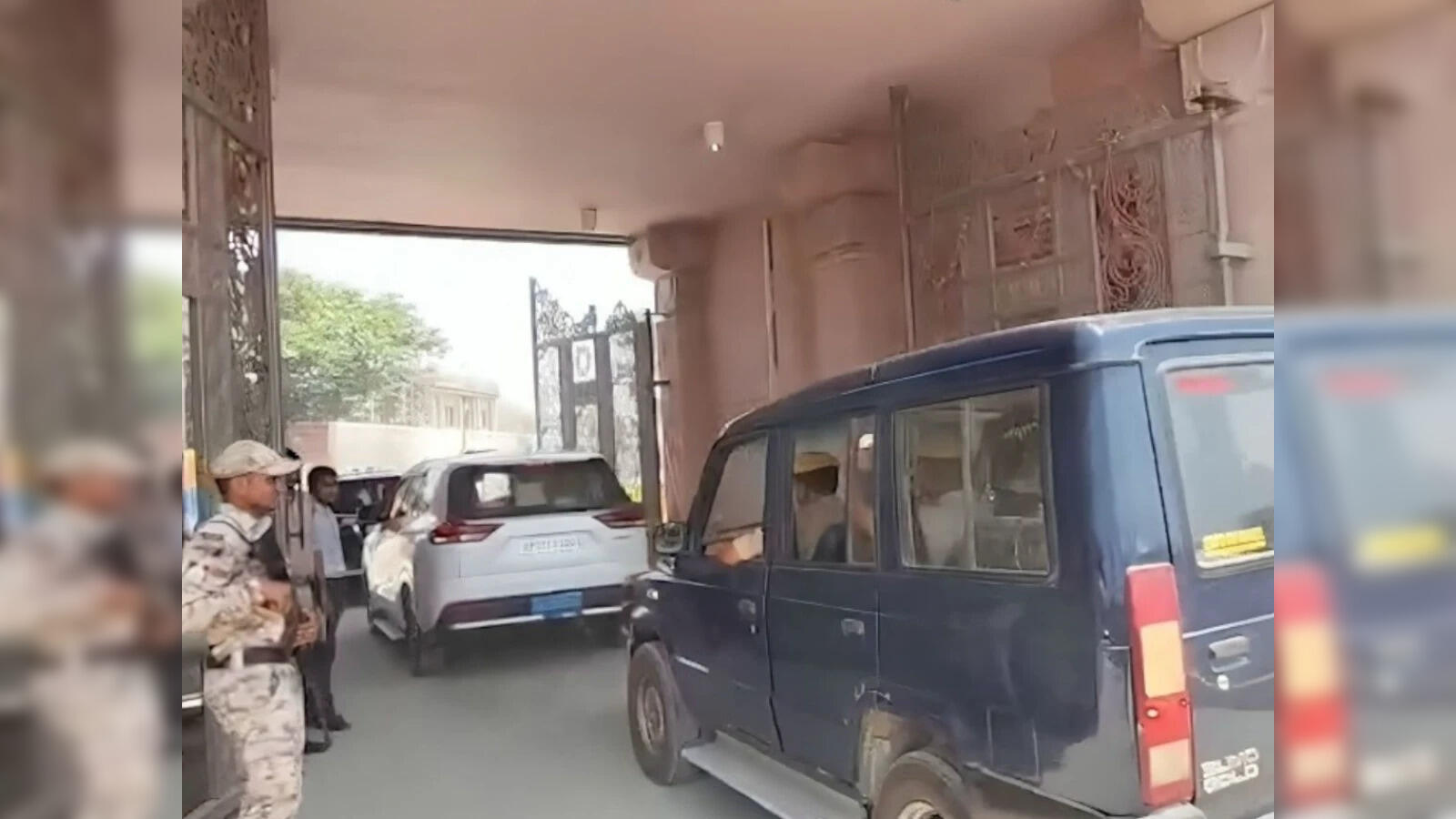
Investigative panels uncover systematic failure to enforce State Bank of India clothing guidelines during cash-counting hours, as an employee is caught with ₹12 lakh in a widening ₹7 crore pilferage audit.
Add businessleague.in as a Preferred Source


The institutional oversight networks, sovereign asset-tracking panels, and high-level judicial forums that govern India’s most prominent religious trusts have launched a sweeping anti-corruption crackdown. Acting on direct executive orders issued by Uttar Pradesh Chief Minister Yogi Adityanath, state law enforcement authorities officially registered a comprehensive First Information Report (FIR) on Thursday afternoon, June 25, 2026, anchoring the Ram Temple donation theft row SIT case files. The dramatic enforcement action directly follows the formal submission of a preliminary report by a three-member Special Investigation Team (SIT), which uncovered widespread irregularities, lack of administrative oversight, and direct cash theft inside the shrine’s collection networks.
The rapid escalation of the case has shaken the religious and political landscape.
The three-member SIT—comprising Lucknow Divisional Commissioner Vijay Vishwas Pant, Inspector General Kiran Singh, and Finance Department Special Secretary Neel Ratan—was initially set up on June 14, 2026, following an urgent request from the Shri Ram Janmabhoomi Teerth Kshetra Trust.
The trust sought an independent inquiry after local sadhus, donors, and political leaders raised intense alarms over missing offerings, unacknowledged gold valuables, and unaccounted currency reserves.
Also Read | Viral Trump Lookalike Buffalo Rescue: Saved From Eid Sacrifice
The Architecture of the Pilferage: The ₹12 Lakh Cash Seizure and SOP Violations
The underlying details of the investigation move past simple bookkeeping errors, exposing an organized operation run by rogue shrine employees.
The severity of the situation became clear on Monday when police executed a raid on the residence of a 27-year-old temple employee, Luvkush, recovering ₹12 lakh in unexplained currency notes.
Local intelligence files suggest the seized cash is part of a much larger, coordinated asset drain that could total at least ₹7 crore in stolen offerings.
In response, Construction Committee Chairman Nripendra Misra flagged major supervisory failures, revealing that a detailed Standard Operating Procedure (SOP) established between 2023 and 2025 was completely ignored by management.
The technical breakdown of the bypassed SOP shows a total breakdown of basic secure currency-handling rules:
-
The Protective Uniform Clause: The official protocol mandated that every staff member entering the donation-counting room must wear specialized, pocket-less clothing provided directly by the State Bank of India (SBI).
-
The Access Protocol Failure: Security teams completely skipped the mandatory strip-and-search routines required upon entering or exiting the currency vaults.
-
The Informal Supervision Gap: Rather than enforcing strict, formal accounting double-checks, the joint oversight teams—comprising two bank representatives and two trust delegates—monitored the massive cash volumes through entirely casual, un-logged workflows.
Slicing Through the Evolving Ayodhya Legal and Enforcement Grid
The high-profile investigation spans both local administrative actions and top-tier legal petitions before the country’s highest court:
| Monitored Accountability Axis | Active Public Agency / Forum | Core Action or Directive Executed | Direct Consequence for Temple Administration |
| Sovereign Criminal Filing | Ayodhya Regional Police | Registered a formal FIR based on SIT findings. | Allows investigators to carry out targeted arrests and freeze bank accounts. |
| Administrative Control | Three-Member High-Level SIT | Ordered all trust office-bearers to stay inside the city. | Prevents management figures from delaying ongoing questioning sessions. |
| Prime Minister’s Review | Prime Minister’s Office (PMO) | Demanded a complete financial disclosure file. | Trust refused to furnish logs, citing the active state-led probe. |
| Apex Judicial Appeal | Supreme Court of India | Filed a petition seeking a CBI-led SIT inquiry. | Justice B.V. Nagarathna scheduled formal arguments for next Monday. |
| High Court Monitoring | Lucknow Bench of Allahabad HC | Filed a Public Interest Litigation (PIL) for a CAG audit. | Forces an independent examination of all historical land purchases. |
Also Read | Viral Trump Lookalike Buffalo Rescue: Saved From Eid Sacrifice
The Supreme Court Petition: Demanding an Independent CBI-Led Probe
As the state-appointed panel prepares to wrap up its final investigation within the next two weeks, the battleground has expanded straight to New Delhi.
Advocates Ajay Kumar Rai and D.H. Kumar Yadav moved a fresh petition before the Supreme Court of India, looking to strip local authorities of the case due to its immense public sensitivity.
The petition presented to an apex bench led by Justice B.V. Nagarathna explicitly demands the creation of an independent, time-bound Special Investigation Team under the Central Bureau of Investigation (CBI).
The legal challenge argues that because millions of ordinary citizens donated their savings to the shrine out of pure faith, the public has an absolute right to an un-compromised, federal accounting review.
Concurrently, Vishva Hindu Parishad (VHP) International President Alok Kumar has backed the push for immediate transparency, demanding that once the FIR process is complete, the trial must move to a fast-track court on a day-to-day basis to punish the guilty swiftly.
Five Sequence Steps Financial Teams Execute to Secure Large-Scale Public Trusts
To ensure high-volume institutional donations remain completely safe from insider theft, and to protect large-scale public funds from automated accounting errors, tracking teams use this multi-layered safety sequence:
Ultimately, navigating large-scale organizational governance requires balancing deep empathy for public trust against a strict commitment to regulatory standards. While consumer technology brands launch weather-hardened budget tools—such as the IP64-certified Lava Smart 4 Plus debut under the ₹10,000 baseline this week—institutional managers must focus on building un-breachable security systems.
By enforcing strict, pocket-less uniforms, utilizing multi-layered third-party audits systematically, and acting swiftly on high-level investigation findings, organizations can successfully protect public trust.
Tracking these high-profile legal updates early ensures your compliance knowledge stays perfectly accurate, keeping your understanding of institutional law completely aligned as national regulatory frameworks evolve.
FAQ Section
What is the core development in the Ram Temple donation theft row SIT case today?
Following the formal submission of a preliminary report by a three-member Special Investigation Team, an official First Information Report (FIR) has been registered in Ayodhya. The criminal complaint allows police to launch a targeted investigation into a suspected ₹7 crore cash and jewelry pilferage operation.
Why did Construction Committee Chairman Nripendra Misra criticize the shrine’s management?
Misra pointed out severe management lapses, revealing that a detailed Standard Operating Procedure (SOP) built between 2023 and 2025 was completely ignored. He highlighted that personnel failed to wear pocket-less uniforms provided by the bank, while supervisory oversight during the counting and transport of cash remained entirely informal.
How has the Supreme Court responded to the calls for a federal investigation?
A petition seeking a CBI-led investigation into the trust’s finances has officially reached the Supreme Court. While an apex bench led by Justice B.V. Nagarathna declined an immediate emergency hearing, the court has instructed advocates to present their arguments on Monday for formal evaluation.
Also Read | Viral Trump Lookalike Buffalo Rescue: Saved From Eid Sacrifice
End..
Add businessleague.in as a Preferred Source

