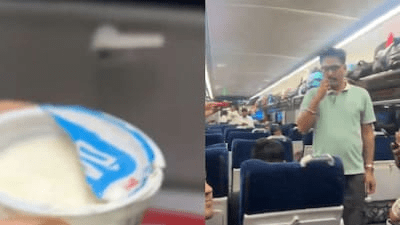
Now the Ministry of Railways is sending a stern message regarding passenger amenities. Following a serious quality complaint on the Patna-Tatanagar Vande Bharat Express (Train No. 21896), the Railways has imposed a ₹10 lakh fine on its own subsidiary, IRCTC. Therefore, this move highlights a zero-tolerance policy toward sub-standard catering services. Currently, the department is not stopping at fines; it has also cracked down on the private service provider involved. Thus, as Railway Minister Ashwini Vaishnaw rolls out the “Reform Express” initiative for 2026, the focus on accountability and passenger convenience has never been higher.
Add businessleague.in as a Preferred Source


Also Read |Tamil Nadu Voter List Purge: 97 Lakh Names Deleted in SIR Phase 1
At a Glance:
-
The Incident: Major food quality lapse reported on March 15 on the Patna-Tatanagar route.
-
The Fines: ₹10 lakh penalty on IRCTC; ₹50 lakh fine on the private service provider.
-
Contract Action: Termination of the concerned service provider’s contract has been ordered.
-
Reform Express: Five new reforms approved, bringing the total for 2026 to nine.
-
Safety Stats: 58 crore meals served annually with a 0.0008% complaint rate.
In This Article:
-
Accountability in Motion: Fines and Contract Terminations
-
The 0.0008% Reality: Indian Railways’ Catering Statistics
-
Reform Express 2026: Five New Pillars of Change
-
Salt Logistics: A New Frontier for Railway Revenue
-
Frequently Asked Questions (FAQs)
Also Read |Tamil Nadu Voter List Purge: 97 Lakh Names Deleted in SIR Phase 1
Accountability in Motion: Fines and Contract Terminations
Now the days of lenient warnings for catering lapses appear to be over. Because the Vande Bharat Express is a premium brand, any dip in service quality is treated as a major reputational risk. Therefore, the March 15 incident has resulted in unprecedented financial hits for the stakeholders involved.
First, IRCTC was slapped with a ₹10 lakh fine for oversight failure. Next, the actual service provider faced a massive ₹50 lakh penalty alongside the immediate termination of their contract. Thus, the Railways is demonstrating that “passenger safety and quality are top priorities.” Currently, legal action is also being pursued against pantry staff in separate cases involving passenger disputes to ensure a professional environment on board.
The 0.0008% Reality: Indian Railways’ Catering Statistics
Now, despite recent headlines, the Ministry of Railways maintains that these incidents are statistically rare. Because the network serves nearly 58 crore meals every year, maintaining 100% perfection across every tray is a logistical challenge.
First, officials pointed out that the complaint rate stands at a mere 0.0008%, which includes issues like overcharging. Next, over the last three years, the ministry has collected ₹2.6 crore in fines from various catering entities to enforce standards. Thus, while the volume of service is massive, the “Reform Express” aims to bring that tiny percentage of complaints down even further. So, the focus remains on systemic improvements rather than just reactive penalties.
Also Read |Tamil Nadu Voter List Purge: 97 Lakh Names Deleted in SIR Phase 1
Reform Express 2026: Five New Pillars of Change
Now Railway Minister Ashwini Vaishnaw has introduced a fresh set of structural changes. Under the “Reform Express” initiative, five new reforms have been approved, bringing the total for the year 2026 to nine. Therefore, the ministry is tackling everything from cargo logistics to passenger comfort.
First, two of the new reforms are dedicated to streamlining cargo movement to boost revenue. Next, one reform targets the construction sector to speed up track laying and station redevelopment. Finally, two reforms are specifically designed for passenger convenience, likely targeting digital booking and real-time grievance redressal. Thus, the goal is a comprehensive modernization of the world’s fourth-largest rail network.
Salt Logistics: A New Frontier for Railway Revenue
Now one of the most intriguing aspects of the 2026 reforms involves a staple mineral: salt. Because India is a global leader in salt production, the Railways sees a significant “untapped opportunity” in its transportation.
First, major producing states like Tamil Nadu, Gujarat, and Rajasthan produce about 35 million tonnes annually. Next, currently, only about 9.2 million tonnes are moved via rail. Thus, by optimizing salt logistics, the Railways aims to capture a larger share of this industrial cargo. This shift is expected to reduce road congestion and lower the carbon footprint of salt distribution across the country.
Frequently Asked Questions (FAQs)
Which Vande Bharat train was involved in the food complaint? The complaint was filed by a passenger on the Patna-Tatanagar Vande Bharat Express (Train No. 21896) on March 15.
How much was IRCTC fined for the food quality issue? IRCTC was fined ₹10 lakh, while the private service provider was fined ₹50 lakh and had their contract terminated.
What is the “Reform Express” initiative? It is a 2026 initiative led by Ashwini Vaishnaw to implement key structural reforms in cargo, construction, and passenger convenience.
How many meals does Indian Railways serve annually? Indian Railways serves approximately 58 crore meals per year with a very low complaint rate of 0.0008%.
Which states are the focus of the new salt transportation reform? The primary focus is on the major salt-producing states of Gujarat, Tamil Nadu, and Rajasthan.
Also Read |Tamil Nadu Voter List Purge: 97 Lakh Names Deleted in SIR Phase 1
End….
Add businessleague.in as a Preferred Source
🙏 Support Independent Journalism
We keep news free for you.
Most readers support with ₹500 ❤️
or scan QR below

Voluntary contribution. No tax benefits.
DISCLAIMER
We have taken all measures to ensure that the information provided in this article and on our social media platform is credible, verified and sourced from other Big media Houses. For any feedback or complaint, reach out to us at businessleaguein@gmail.com