
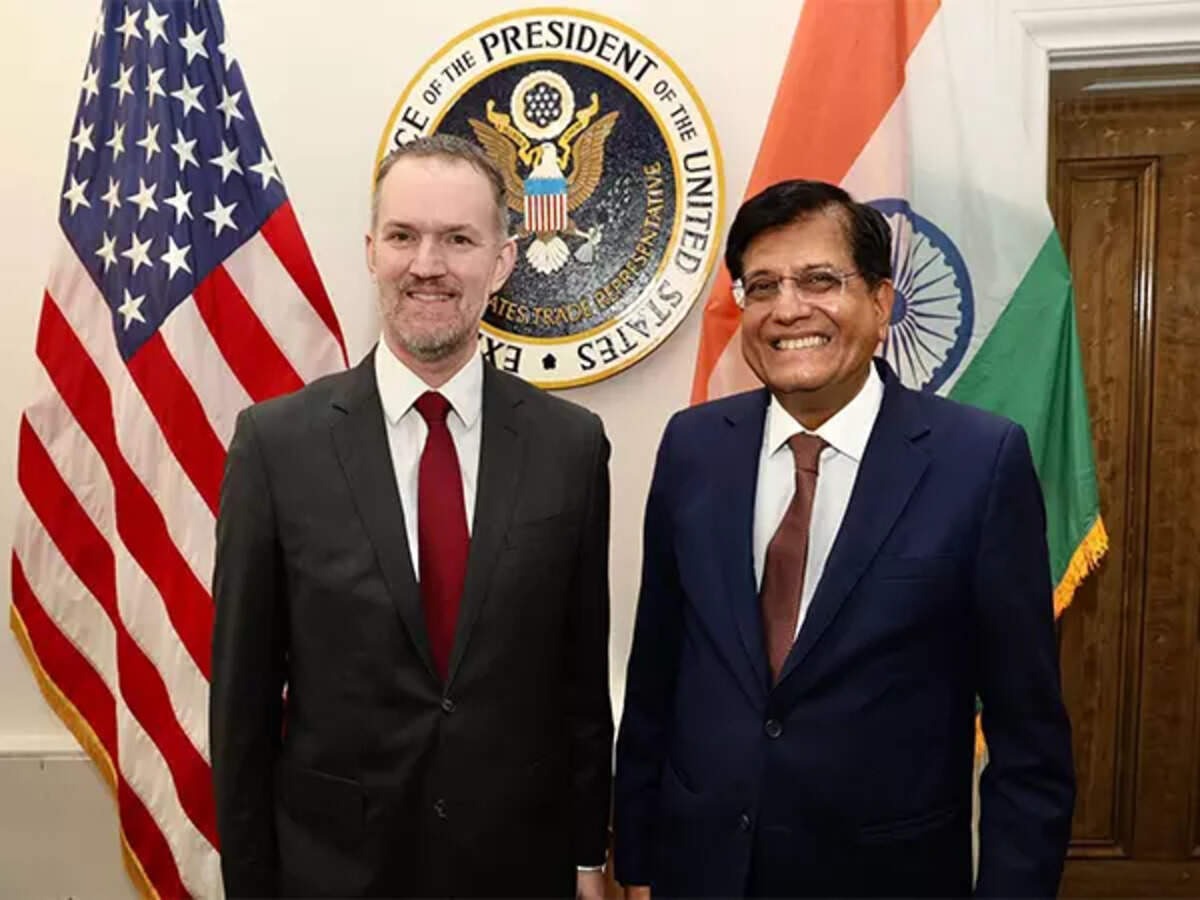
India is adopting a “wait and watch” approach to its largest trading partner as Washington navigates a complex legal battle over its tariff regime. Speaking in New Delhi, Minister Piyush Goyal clarified that while the ground beneath the India-US Interim Trade Agreement has shifted, the framework remains robust due to a pre-negotiated “rebalancing” clause.
Add businessleague.in as a Preferred Source


The meeting between Goyal and US Commerce Secretary Howard Lutnick on Thursday served as a crucial bridge during this period of American judicial uncertainty.
Also Read |Tamil Nadu Voter List Purge: 97 Lakh Names Deleted in SIR Phase 1
The SCOTUS Verdict: Striking Down IEEPA Tariffs
On February 20, 2026, the US Supreme Court delivered a 6-3 decision that invalidated the cornerstone of President Trump’s trade policy.
-
The Ruling: The Court held that the International Emergency Economic Powers Act (IEEPA) does not grant the President the authority to impose broad, revenue-raising tariffs—a power reserved for Congress.
-
The Impact on India: Before this ruling, Indian goods faced a massive 50% tariff (due to base rates plus punitive duties for Russian crude purchases). The interim deal aimed to slash this to 18%.
Rebalancing the Deal: The Joint Statement Safeguard
Minister Goyal pointed to a specific paragraph in the February 7 Joint Statement that acts as an insurance policy for New Delhi.
-
The Clause: “In the event of any changes to the agreed upon tariffs of either country, the United States and India agree that the other country may modify its commitments.”
-
Strategic Intent: This ensures that if the US cannot deliver the promised 18% rate due to court interference, India is not obligated to provide the agreed-upon $500 billion in purchases or market access until the “balance” is restored.
Also Read |Tamil Nadu Voter List Purge: 97 Lakh Names Deleted in SIR Phase 1
Alternative Tools: Section 122 and the 15% Surcharge
The Trump administration has not backed down, pivotally switching to Section 122 of the Trade Act of 1974.
-
Current Status: A 10% flat surcharge was implemented on February 24, 2024.
-
Future Signals: Goyal noted that the US may increase this to 15% for a 150-day period.
-
The Paradox: Ironically, a flat 15% Section 122 tariff is actually lower for India than the 50% or even the proposed 18% “special deal” rate, though it lacks the long-term stability of a formal treaty.
Comparative Advantage vs. Tariff Rates
Goyal emphasized that India’s primary goal is not just a “low rate,” but a comparative advantage over rivals like China and Vietnam.
-
Level Playing Field: If all nations pay 15%, India’s labor-intensive sectors (textiles, gems, and jewelry) can compete on quality and cost.
-
Sectoral Focus: With 40 million people in the textile sector, maintaining a competitive edge in the US market is a matter of national employment security.
Reality Check
Goyal’s confidence is backed by the fact that India is negotiating from a “position of strength.” Still, the US judicial system is notoriously unpredictable. Therefore, while Section 122 provides a temporary fix for the White House, it expires in 150 days. In fact, if Congress does not act to codify these tariffs, India-US trade could return to a chaotic state of “provisional” duties by July 2026.
The Loopholes
Goyal mentioned that the US has “many other tools.” In fact, this is a “Legislative Loophole”—while the President lost IEEPA powers, he can still request Congress to pass specific tariff laws. Therefore, the “evolving situation” Goyal speaks of is really a countdown to see if the Trump administration can strike a deal with the US House of Representatives. Still, the “Dairy Exclusion” remains a non-negotiable red line for India, ensuring that the most sensitive part of the rural economy stays shielded from American competition.
Also Read |Tamil Nadu Voter List Purge: 97 Lakh Names Deleted in SIR Phase 1
What This Means for You
If you are an exporter in the textile, pharmaceutical, or smartphone sectors, expect continued volatility in the short term. First, realize that the 10-15% Section 122 surcharge is currently your “floor.” Then, if you are a business owner, use this “wait and watch” period to diversify your supply chain, as the formal “inked” deal is likely pushed to mid-2026.
Finally, understand that Indian dairy and staples are safe. You should not expect any influx of US milk or grains due to this deal. Before you sign long-term US export contracts, ensure they have “tariff adjustment” clauses similar to the government’s own rebalancing language to protect yourself from sudden spikes in Washington.
What’s Next
Indian and US negotiators have postponed their Washington trip originally scheduled for this week. Then, look for a “re-scheduled” ministerial meeting once there is clarity on the 15% surcharge. Finally, expect the Bilateral Trade Agreement (BTA) negotiations to formally launch only after the “Phase 1” interim deal survives its current legal hurdles in the US.
Also Read |Tamil Nadu Voter List Purge: 97 Lakh Names Deleted in SIR Phase 1
Add businessleague.in as a Preferred Source
🙏 Support Independent Journalism
We keep news free for you.
Most readers support with ₹500 ❤️
or scan QR below

Voluntary contribution. No tax benefits.
DISCLAIMER
We have taken all measures to ensure that the information provided in this article and on our social media platform is credible, verified and sourced from other Big media Houses. For any feedback or complaint, reach out to us at businessleaguein@gmail.com