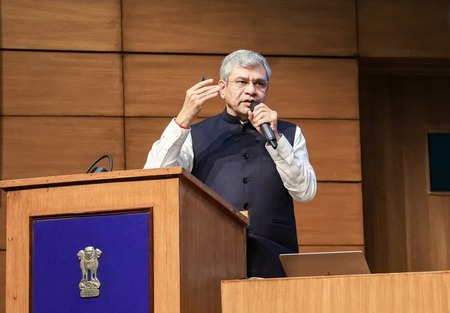
The era of the “free ride” for social media giants in India may be coming to an end. Speaking at the Digital News Publishers Association (DNPA) Conclave 2026, Union Minister Ashwini Vaishnaw issued a pointed warning to the trillion-dollar global tech industry: compensate Indian creators fairly, or the government will intervene.
Add businessleague.in as a Preferred Source


With over 900 million internet users, India is the world’s second-largest online market. Yet, while platforms harvest billions in advertising revenue, the millions of creators—from regional journalists to village-based educators—receive only a fraction of the wealth they generate.
Also Read |Tamil Nadu Voter List Purge: 97 Lakh Names Deleted in SIR Phase 1
The Ad Revenue Gap: Billion-Dollar Imbalance
The arithmetic of the digital age is stark. In FY2025, digital advertising in India overtook television for the first time, commanding 44% of all ad spend.
-
Projected Growth: The market is expected to reach $32.3 billion by 2030.
-
The Disconnect: While India’s creator economy is valued at up to $25 billion, a mere 8–10% of creators are able to make a sustainable living.
-
Platform Dominance: Ad revenue flows overwhelmingly upward to platform owners, despite the content being produced by independent influencers, researchers, and media houses at their own cost.
From Intermediary to Host: A Philosophical Shift
Minister Vaishnaw’s address signaled a fundamental change in how India views Big Tech.
-
Host vs. Intermediary: The government argues that platforms have evolved into “hosts to the world.” Consequently, they can no longer claim zero responsibility for the economic health of their “tenants.”
-
Expanding the Net: Unlike European or Australian laws that focus primarily on news publishers, Vaishnaw explicitly included influencers, professors, and regional researchers in the call for revenue sharing.
Also Read |Tamil Nadu Voter List Purge: 97 Lakh Names Deleted in SIR Phase 1
Lessons from Australia: The Fragility of Voluntary Deals
India is closely watching the “Australian Experiment.”
-
The Precedent: Australia’s 2021 Bargaining Code initially funneled AUD 250 million to news rooms.
-
The Failure: In 2024, Meta refused to renew deals, leading to a 2.25% levy on platform earnings to sustain the industry.
-
The Takeaway: India realizes that voluntary deals are fragile. To protect the “authentic pipeline” of Indian content, a more robust, statutory framework may be required.
Reality Check
The demand for “fair share” sounds noble. Still, forcing platforms to pay can backfire—as seen in Australia and Canada, where platforms simply blocked news links to avoid payment. Therefore, while India has massive leverage due to its user base, a “hard” legislative approach could lead to platforms limiting the reach of Indian creators to protect their margins. In fact, for a micro-influencer in a Tier-2 city, the “reach” provided by a platform is often more valuable than a small revenue-share check.
The Loopholes
The IT Rules of 2026 put “safe harbor” protections under scrutiny. In fact, this is a “Liability Loophole”—by threatening to remove the legal immunity platforms enjoy for user-posted content, the government is forcing them to the negotiating table for revenue sharing. Therefore, the “ask” for money is backed by the “threat” of legal liability. Still, the “Global Content Loophole” remains; platforms can argue that Indian users consume a vast amount of international content, making it difficult to calculate an “equitable” local share for regional professors or researchers.
Also Read |Tamil Nadu Voter List Purge: 97 Lakh Names Deleted in SIR Phase 1
What This Means for You
If you are an independent digital creator, start diversifying your revenue streams. First, realize that relying solely on platform-dictated ad-shares is risky, as rules can change unilaterally. Then, if you are a regional journalist or educator, look for the Indian Newspaper Society’s upcoming portal, which aims to formalize collective bargaining with Big Tech.
Finally, understand that transparency is coming. You should soon see more robust appeals mechanisms for demonetized content. Before you sign any exclusive “partner” deals, wait for the Ministry’s 2026 Digital Media Guidelines, which may mandate minimum payment thresholds for Indian creators.
What’s Next
The government is expected to host a roundtable with Meta, Google, and Apple by mid-2026. Then, look for a draft “Revenue Sharing Framework” to be included in the upcoming Digital India Bill. Finally, expect a surge in “Hyper-local” content platforms that may offer better terms to creators as they try to challenge the dominance of global giants.
Also Read |Tamil Nadu Voter List Purge: 97 Lakh Names Deleted in SIR Phase 1
End…
Add businessleague.in as a Preferred Source
🙏 Support Independent Journalism
We keep news free for you.
Most readers support with ₹500 ❤️
or scan QR below

Voluntary contribution. No tax benefits.
DISCLAIMER
We have taken all measures to ensure that the information provided in this article and on our social media platform is credible, verified and sourced from other Big media Houses. For any feedback or complaint, reach out to us at businessleaguein@gmail.com