
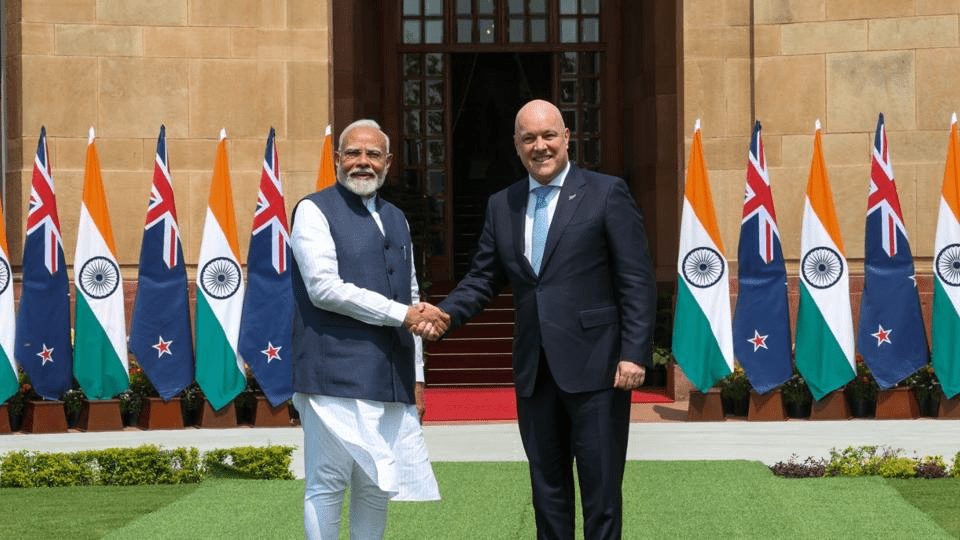
Now a new era of Indo-Pacific economic cooperation has officially dawned. On Monday, April 27, 2026, India and New Zealand are set to sign a historic Free Trade Agreement (FTA) that Prime Minister Christopher Luxon has dubbed a “once in a generation” deal. Therefore, the India New Zealand FTA signing 2026 marks the culmination of a rapid nine-month negotiation process that concluded late last year. Specifically, the pact includes a landmark $20 billion investment commitment from New Zealand into the Indian economy over the next 15 years, signaling a profound shift in bilateral trust and shared long-term vision.
Add businessleague.in as a Preferred Source


Meanwhile, the signing ceremony in Agra serves as a defining moment for Indian industries ranging from leather and footwear to pharmaceuticals and AYUSH.
But for Kiwi exporters, the primary benefit lies in “unprecedented access” to a market of 1.4 billion people as India rises to become the world’s third-largest economy.
Also Read |Tamil Nadu Voter List Purge: 97 Lakh Names Deleted in SIR Phase 1
The Agra Summit: Why Goyal and McClay Met at the Taj Mahal
Now we must analyze the symbolic significance of the venue. Union Commerce Minister Piyush Goyal hosted New Zealand’s Trade Minister Todd McClay in Agra, a city synonymous with India’s rich heritage and its booming leather industry. Therefore, the India New Zealand FTA signing 2026 is not just a high-level diplomatic event but a localized boost for regional economies.
Local Industry Impact
First, Goyal emphasized that Agra’s leather, handloom, and One District One Product (ODOP) items will find an immediate new market. Then, the ministers attended a Business Meet to engage directly with leaders from the footwear and medical device sectors. Thus, the choice of Agra underscores the “ground-level” benefits expected from the treaty. Next, McClay is leading a massive cross-party delegation, including over 30 business representatives. Therefore, the engagement in Agra serves as the formal starting block for a multi-sectoral trade surge.
$20 Billion Commitment: Decoding the 15-Year Investment Plan
Now the most striking feature of this agreement is the financial depth of the partnership. New Zealand has proposed a $20 billion investment commitment into India, to be deployed over a 15-year period.
Sustainable Economic Growth
First, this capital is expected to target India’s design, manufacturing, and raw material sectors. Then, the investment reflects New Zealand’s confidence in India’s trajectory as a global economic powerhouse. Thus, the FTA goes beyond simple “buying and selling” to create a deep-rooted investment corridor. Next, Piyush Goyal noted that this partnership is underpinned by “trust and shared values.” Therefore, the $20 billion pact ensures that the India New Zealand FTA signing 2026 provides a long-term cushion for sustainable economic growth in both nations.
Zero-Duty Access: How Indian Leather and Handicrafts Win
Now Indian exporters have every reason to celebrate. Under the new agreement, India has secured zero-duty access for all goods exported to New Zealand.
Removing the Barriers
First, Indian products will reach Kiwi markets without any tax or import duty. Then, sectors such as leather, handloom, and handicrafts—which are vital to northern Indian hubs—will see a sharp increase in competitiveness. Thus, Indian manufacturers can now outprice global competitors in the New Zealand market. Next, the agreement specifically targets the enhancement of small-scale industries and ODOP items. Therefore, the India New Zealand FTA signing 2026 acts as a powerful catalyst for the “Make in India” initiative on the global stage.
Also Read |Tamil Nadu Voter List Purge: 97 Lakh Names Deleted in SIR Phase 1
New Zealand’s Harvest: Access to 1.4 Billion Consumers
Now, for New Zealand, the agreement represents an essential diversify-or-perish strategy amid global unrest. Trade Minister Todd McClay highlighted that the deal has “never been more important” for his country’s prosperity.
The Market of the Future
First, New Zealand will receive immediate tariff elimination on 30% of its tariff lines. Then, this includes key exports like sheep meat, wool, wooden logs, and metal scraps. Thus, Kiwi farmers and wood producers will gain a significant edge in the Indian market. Next, India has allowed calibrated access across 70.03% of tariff lines, covering 95% of New Zealand’s total exports. Therefore, the deal provides a massive “win” for New Zealand’s primary industries while giving them a foothold in the world’s fastest-growing major economy.
The Ratification Process: When Will the FTA Actually Start?
Now, while the pact is signed today, it is not yet operational. New Zealand’s legal system requires a rigorous parliamentary examination before any international treaty can come into force.
The 6-Month Countdown
First, the signed FTA must be reviewed by New Zealand’s Foreign Affairs, Defence and Trade Committee (FADTC). Then, a “National Interest Analysis” will be conducted, which includes extensive public consultation. Thus, the public in New Zealand will have the opportunity to scrutinize the agreement in full. Next, the committee will submit its report for final parliamentary ratification, a process expected to take at least six months. Therefore, while the India New Zealand FTA signing 2026 happens today, the enforcement is realistically slated for the final quarter of the year.
Dairy and Professional Mobility: Balancing the Trade Scales
Now the negotiations were a masterclass in economic balancing. One of the most sensitive points for India was the protection of its massive domestic dairy industry, which is a livelihood for millions.
Protecting the “Red Lines”
First, India successfully protected its dairy sector from zero-duty Kiwi imports. Then, in exchange, India offered concessions on professional mobility, making it easier for Indian professionals to work and provide services in New Zealand. Thus, both nations have respected each other’s “red lines” while finding common ground for growth. Next, this balanced approach is what allowed the negotiations to conclude in a record nine months. Therefore, the India New Zealand FTA signing 2026 is being hailed as a mature agreement that prioritizes domestic stability alongside international trade.
Also Read |Tamil Nadu Voter List Purge: 97 Lakh Names Deleted in SIR Phase 1
Sustainability and Vision: The “Defining Moment” for Bilateral Ties
Now the rhetoric from both capitals suggests that this is more than just a commercial deal. PM Christopher Luxon and PM Narendra Modi have described the conclusion as a reflection of “shared ambition.”
Sustainability at the Core
First, Piyush Goyal noted that the partnership is focused on “sustainable economic growth.” Then, the cross-party nature of the New Zealand delegation suggests that the deal has broad political support back in Wellington. Thus, the agreement is shielded from future political shifts in either country. Next, the common vision for a stable Indo-Pacific region is a silent but powerful driver behind this economic alignment. Therefore, the FTA is a strategic pillar that strengthens the geopolitical bond between the two democracies.
Industry Impacts: From Pharma to Sports Goods
Now we can look at the specific sectors that will see an immediate change in their balance sheets. The Business Meet in Agra highlighted several “sunshine” sectors.
Winning Sectors:
-
Leather & Footwear: Zero-duty access to NZ will boost exports from Agra and Kanpur.
-
AYUSH & Pharma: Indian traditional medicine and medical devices get a new regulatory pathway.
-
Sports Goods: Jalandhar and Meerut-based manufacturers will find easier access to Kiwi athletes.
-
Light Engineering: Raw material trade between the two nations will lower manufacturing costs.
First, the deal facilitates the trade of raw materials, which Todd McClay said will boost the design sector. Then, the footwear industry is expected to see an immediate double-digit growth in orders. Thus, the India New Zealand FTA signing 2026 is a targeted intervention for several high-employment Indian industries. Next, the pharmaceutical sector will benefit from smoother trade norms, helping India expand its “Pharmacy of the World” status. Therefore, the economic ripples of this deal will be felt in manufacturing hubs across the subcontinent.
Common Questions Answered
When will the India-New Zealand FTA come into force? Now it is signed today, but it requires parliamentary ratification in New Zealand. Thus, it is expected to be operational by the end of 2026.
Is India’s dairy sector included in the FTA? First, no. India has protected its dairy sector from zero-duty imports to safeguard the livelihoods of local farmers.
What is the $20 billion investment about? Next, New Zealand has committed to investing $20 billion in India over the next 15 years, targeting infrastructure and manufacturing.
How does this deal benefit Indian professionals? So India secured concessions on professional mobility. Therefore, it will be easier for Indian service providers and professionals to access the New Zealand market.
What Indian goods get zero-duty access? Finally, all Indian goods exported to New Zealand will enjoy zero-duty access. Thus, leather, textiles, and handicrafts are set for a major boost.
Also Read |Tamil Nadu Voter List Purge: 97 Lakh Names Deleted in SIR Phase 1
End….
Add businessleague.in as a Preferred Source
🙏 Support Independent Journalism
We keep news free for you.
Most readers support with ₹500 ❤️
or scan QR below

Voluntary contribution. No tax benefits.
DISCLAIMER
We have taken all measures to ensure that the information provided in this article and on our social media platform is credible, verified and sourced from other Big media Houses. For any feedback or complaint, reach out to us at businessleaguein@gmail.com