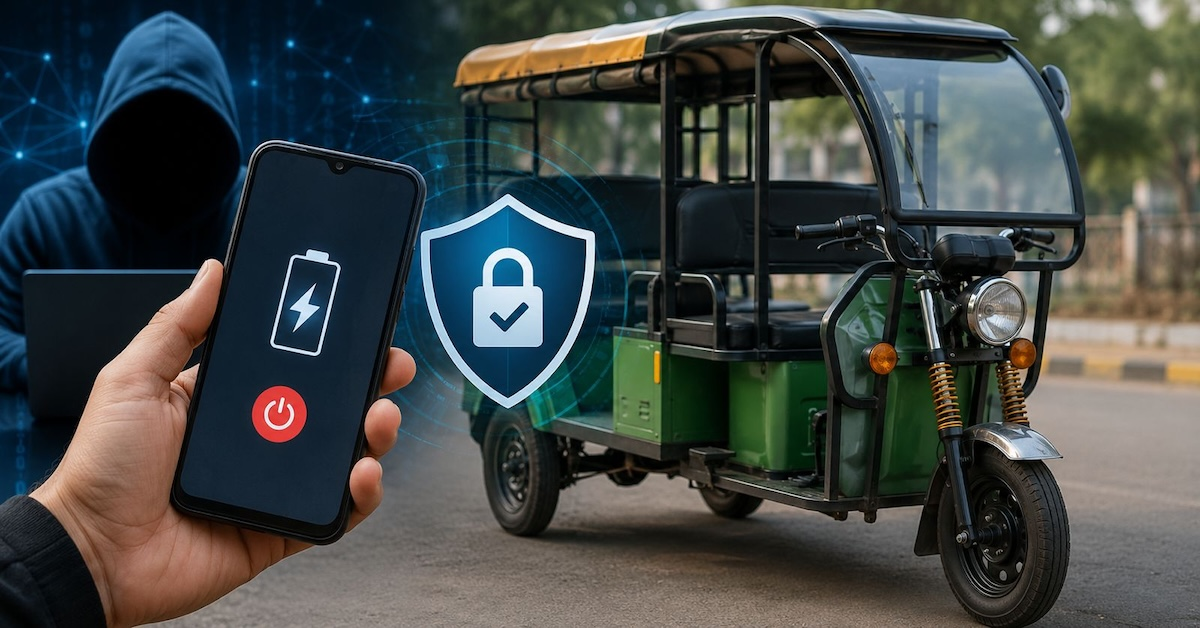
Exploiting unsecure Bluetooth connections on low-cost battery systems, the applications allowed strangers to kill vehicle power in transit.
NEW DELHI — The Government of India has issued an immediate order directing major smartphone application marketplaces to purge three specific software platforms—BAT-BMS, Lossigy, and Epoch-i-ion—following definitive proof of digital sabotage targeting battery-operated public transport vehicles.
Add businessleague.in as a Preferred Source


The emergency regulatory sweep was catalyzed by dozens of viral videos populating social media streams across the nation. The footage comprehensively demonstrated individuals utilizing these everyday applications to pair with and instantly deactivate local e-rickshaws by manipulating their unencrypted, Bluetooth-enabled Battery Management Systems (BMS).
Also Read | Bengaluru Daycare Horror: 5 Caregivers Booked After Appalling Child Abuse Surfaces
Technical Misuse Explodes Into Public Sabotage
Speaking on the sidelines of a Confederation of Indian Industry (CII) Cybersecurity Summit on Friday, Union IT Secretary S. Krishnan verified that the administrative framework executed swift enforcement procedures directly after the systemic loophole surfaced.
“That is right… there are a couple of apps, which came to our notice yesterday and both of them have been taken down from the app stores,” Krishnan stated to reporters.
Anatomy of the Vulnerability: How the Apps Operated
Initial technical reviews conducted by ministerial digital experts indicate that the mobile applications were originally designed for constructive diagnostic surveillance—allowing operators to monitor voltage gradients, core temperatures, and operational current metrics inside lithium-ion battery blocks.
Also Read | Bengaluru Daycare Horror: 5 Caregivers Booked After Appalling Child Abuse Surfaces
However, structural flaws inside the cheap consumer supply chain created a severe security hazard:
 Saboteur Smartphone (with BAT-BMS app)
       │
       ▼ (Sends Bluetooth signal within short range)
 Unsecured Chinese BMS (Lacks password protection)
       │
       ▼ (Discharges power completely)
 E-Rickshaw Stranded in Traffic
A significant portion of entry-level, budget e-rickshaws distributed within India integrate imported, Chinese-manufactured Battery Management Systems that natively possess zero password protection, multi-factor handshake protocols, or cryptographic authentication keys.
Consequently, anyone standing within local Bluetooth range could download an application like BAT-BMS—developed originally as a legitimate tool by Shenzhen Grenergy Technology in China—and force-switch off the battery’s core discharge toggle.
National Investigations and Financial Exploitation
The local fallout has caused immense financial distress to lower-income logistics workers. Several viral clips documented drivers stranded unexpectedly in the middle of active intersections, with operators reporting instances where unknown tech-savvy bystanders extorted financial fees to “re-authenticate” and turn the vehicle’s electrical supply back on.
In response, the regional Delhi administration has instructed its transport wing to comprehensively analyze the operational footprints of the BAT-BMS application. Transport Minister Pankaj Singh noted that while formal, written penal complaints had not yet flooded the registry, immediate departmental examination was non-negotiable given the clear physical danger of halting vehicles mid-transit.
The IT Ministry concluded its alert by advising storefront operators like Google and Apple to integrate strict structural due diligence pipelines, ensuring that diagnostic toolkits capable of overriding industrial machinery are barred from open distribution without authenticated verification.
Also Read | Bengaluru Daycare Horror: 5 Caregivers Booked After Appalling Child Abuse Surfaces
Frequently Asked Questions (FAQs)
Which specific apps did the Indian government ban?
The government ordered the immediate removal of three applications from mobile app stores: BAT-BMS, Lossigy, and Epoch-i-ion.
How were these apps shutting down e-rickshaws?
The applications connected wirelessly over standard Bluetooth to the lithium-ion batteries powering the e-rickshaws. Because many budget vehicles utilize imported battery management systems without password security or identity verification, the apps were manipulated to shut off the vehicle’s electrical discharge feature from a short distance.
What are authorities doing to prevent similar vulnerabilities?
Alongside enforcing the ban, IT Secretary S. Krishnan called for increased scrutiny from app store developers. Concurrently, regional authorities like the Delhi Transport Department have initiated internal investigations into vehicle component compliance to evaluate standard security protections.
Also Read | Bengaluru Daycare Horror: 5 Caregivers Booked After Appalling Child Abuse Surfaces
Add businessleague.in as a Preferred Source
🙏 Support Independent Journalism
We keep news free for you.
Most readers support with ₹500 ❤️
or scan QR below
Voluntary contribution. No tax benefits.
DISCLAIMER
We have taken all measures to ensure that the information provided in this article and on our social media platform is credible, verified and sourced from other Big media Houses. For any feedback or complaint, reach out to us at businessleaguein@gmail.com