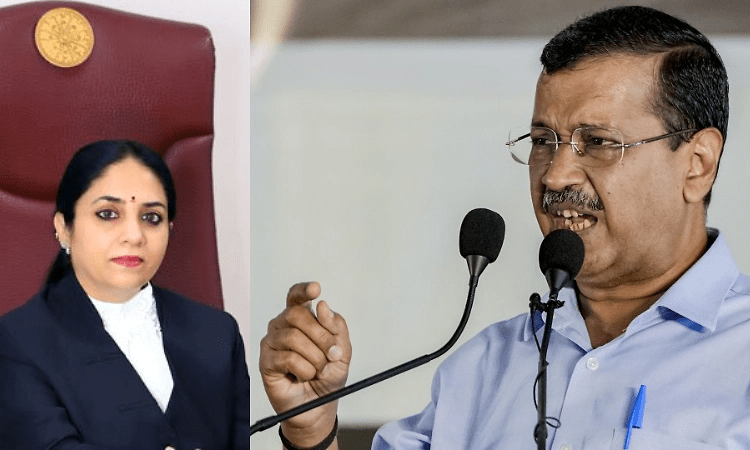
Now the legal battle surrounding the Delhi excise policy has escalated into a direct confrontation between the executive and the judiciary. In a move that has stunned the legal fraternity on Monday, April 27, 2026, former Delhi Chief Minister Arvind Kejriwal announced he would no longer appear before Justice Swarana Kanta Sharma. Therefore, the Arvind Kejriwal boycotts Justice Swarana Kanta Sharma decision marks a historic departure from conventional legal procedures. Specifically, the AAP national convenor stated in a letter that he has “lost faith” in the judge’s ability to remain impartial, choosing instead to follow a “Gandhian path of Satyagraha” by refusing to participate in the proceedings.
Add businessleague.in as a Preferred Source


Meanwhile, this drastic step comes after the judge dismissed Kejriwal’s plea for her recusal, where he alleged a conflict of interest involving her children’s professional links to the central government’s legal team.
But for the Delhi High Court, the refusal to appear could trigger a series of punitive legal measures, including the issuance of non-bailable warrants.
Also Read |Tamil Nadu Voter List Purge: 97 Lakh Names Deleted in SIR Phase 1
The Letter of Protest: Kejriwal’s Satyagraha in Court
Now we must examine the specific language used in this unprecedented act of judicial defiance. Kejriwal has framed his boycott not as an act of lawlessness, but as a moral protest. Therefore, the Arvind Kejriwal boycotts Justice Swarana Kanta Sharma move is being presented as a principled stand.
Heeding the Conscience
First, Kejriwal wrote that it is “not possible for me to pursue this case in her court, either in person or through counsel.” Then, he argued that the proceedings do not satisfy the fundamental principle that “justice must not only be done but must also be seen to be done.” Thus, he has chosen to withdraw from the High Court’s jurisdiction voluntarily. Next, the letter emphasizes that this was a “difficult decision” taken after coming to a clear conclusion about the lack of impartiality. Therefore, Kejriwal is effectively placing his moral standing above the immediate procedural requirements of the High Court.
Conflict of Interest: The Allegations Against Justice Sharma
Now the root of this conflict lies in specific allegations regarding the judge’s family and professional associations. Kejriwal’s team has raised several points that they claim create a “reasonable apprehension” of bias.
Professional Links and Ideology
First, Kejriwal alleged that the judge’s children are empanelled as lawyers for the central government and have worked with Solicitor General Tushar Mehta. Then, he pointed to her participation in events organized by the Akhil Bharatiya Adhivakta Parishad, an RSS-affiliated body. Thus, the AAP leader argues that these factors create a direct nexus between the judge and the interests of the party currently prosecuting him. Next, he claimed these links undermine the institutional credibility of the court in this high-profile political matter. Therefore, the boycott is a direct response to what Kejriwal views as an “untenable” judicial environment.
The Judge’s Refusal: Why Justice Sharma Won’t Step Aside
Now it is important to note that Justice Sharma has already addressed and rejected these claims in a strongly worded judicial order. She viewed the recusal plea as an attempt to “sow seeds of mistrust.”
Fearless Adjudication
First, the judge emphasized that her “oath is to the Constitution” and that justice does not “yield to any pressure.” Then, she dismissed the allegations of bias as lacking “concrete evidence,” noting that no direct link was established between her children’s work and the excise case. Thus, she described the recusal demand as an invitation to “abdication of duty.” Next, she warned that opening the floodgates to such claims would allow litigants to choose their benches through pressure tactics. Therefore, the judge remains firm that she will adjudicate the matter fearlessly, regardless of the boycott.
Also Read |Tamil Nadu Voter List Purge: 97 Lakh Names Deleted in SIR Phase 1
Legal Consequences: Warrants and the Risk of Contempt
Now legal experts are sounding the alarm regarding the potential fallout of Kejriwal’s non-appearance. While the boycott may be a powerful political statement, its legal repercussions could be severe.
The Warrant Ladder
First, Senior Advocate Satish Tamta noted that in cases of acquittal appeals, the accused is usually bound by a bond to appear. Then, if Kejriwal fails to show up in compliance with that bond, the court has the power to compel his presence. Thus, the court could first issue a bailable warrant, followed by a non-bailable warrant (NBW) if he continues to stay away. Next, this could lead to a fresh arrest or a “Complex legal and constitutional phase” involving contempt of court. Therefore, the Arvind Kejriwal boycotts Justice Swarana Kanta Sharma strategy carries a high risk of backfiring in the form of police action.
The Excise Case Context: Challenging the Acquittal
Now we must understand the specific legal matter at hand. The High Court is currently hearing a challenge by the CBI against a trial court’s decision to discharge Kejriwal in the excise policy case.
Erroneous Findings?
First, a lower court had earlier acquitted Kejriwal and others, citing a lack of evidence in the liquor policy matter. Then, the CBI appealed this to the High Court, which flagged certain findings of the trial court as “prima facie erroneous.” Thus, the current proceedings are intended to decide if the acquittal should be overturned. Next, Kejriwal has consistently maintained that the entire case is a “politically motivated” fabrication by the central government. Therefore, the stakes of this particular hearing are exceptionally high, as it could result in the revival of criminal charges against the AAP convenor.
Constitutional Implications: Justice Must Be Seen to Be Done
Now the standoff brings a classic constitutional maxim into sharp focus. The idea that justice must be “seen to be done” is a pillar of the Indian legal system.
Perception vs. Procedure
First, Kejriwal is using this maxim to justify his lack of confidence in the bench. Then, he argues that the appearance of a conflict is enough to disqualify a judge, regardless of actual bias. Thus, this creates a “Catch-22” situation for the judiciary, as Justice Sharma herself noted. Next, the court must balance the need for impartiality with the need to prevent “bench-hunting” by influential litigants. Therefore, the outcome of this standoff will set a major precedent for how recusal pleas are handled in politically sensitive cases.
Also Read |Tamil Nadu Voter List Purge: 97 Lakh Names Deleted in SIR Phase 1
The Supreme Court Route: Reserving the Right to Appeal
Now, despite the boycott of the High Court, Kejriwal is not abandoning the legal system entirely. He has explicitly reserved the right to move the highest court in the land.
Appealing the Verdict
First, the letter states his intention to approach the Supreme Court to appeal against any verdict delivered by Justice Sharma. Then, he may also seek a stay on the High Court proceedings from the apex court based on his recusal arguments. Thus, the “Satyagraha” is localized to the specific courtroom he finds biased. Next, the Supreme Court’s intervention will be the ultimate test of whether Kejriwal’s apprehensions are legally valid. Therefore, the Arvind Kejriwal boycotts Justice Swarana Kanta Sharma drama is likely to move to a much larger stage in the coming weeks.
Political Fallout: AAP’s Stand Against “Biased” Proceedings
Now the political optics of this move are clear. By choosing the “Gandhian path,” Kejriwal is positioning himself as a victim of a system that he claims is being manipulated by his political rivals.
Voice of Conscience
First, the AAP has backed its leader’s decision, emphasizing that the “voice of conscience” must prevail over flawed legal processes. Then, the party is using this incident to bolster its narrative of being “persecuted” by central agencies and the judiciary alike. Thus, the boycott is as much a campaign tool as it is a legal strategy. Next, it remains to be seen how the public—and the voters—will perceive this act of defiance against a constitutional court. Therefore, the move is a high-stakes gamble that could either spark a movement or result in a significant legal setback.
Common Questions Answered
Why is Arvind Kejriwal boycotting Justice Swarana Kanta Sharma? Now he alleges a conflict of interest because the judge’s children are panel lawyers for the Center and have professional links to the Solicitor General appearing against him.
What is the “Gandhian path” Kejriwal mentioned? First, he refers to Satyagraha (truth-force) and a non-violent protest by refusing to participate in what he deems an unfair judicial process.
Can the court issue a warrant against Kejriwal? Next, yes. Legal experts say that if he fails to appear in compliance with his bond, the court can issue bailable and then non-bailable warrants to compel his presence.
What is the excise case about? So it is an appeal by the CBI against a trial court order that had acquitted Kejriwal and others in the Delhi liquor policy case.
Is Kejriwal going to the Supreme Court? Finally, yes. In his letter, he asserted his right to approach the Supreme Court to appeal against the High Court’s proceedings or any future verdict.
Also Read |Tamil Nadu Voter List Purge: 97 Lakh Names Deleted in SIR Phase 1
End…
Add businessleague.in as a Preferred Source
🙏 Support Independent Journalism
We keep news free for you.
Most readers support with ₹500 ❤️
or scan QR below

Voluntary contribution. No tax benefits.
DISCLAIMER
We have taken all measures to ensure that the information provided in this article and on our social media platform is credible, verified and sourced from other Big media Houses. For any feedback or complaint, reach out to us at businessleaguein@gmail.com