
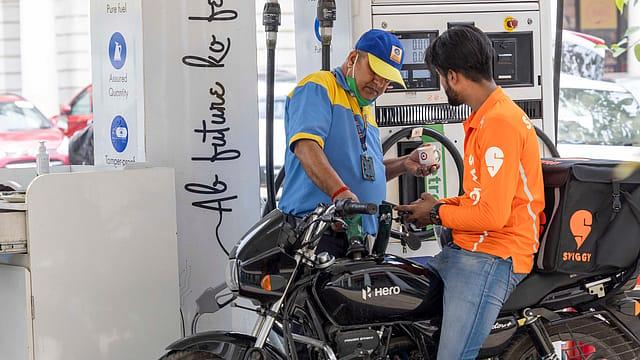
Now the internal financial defense architecture shielding India’s domestic retail market from international raw commodity shocks is demonstrating extreme fiscal resilience. The government has successfully restricted the unavoidable price hike in petrol and diesel to a low 4.4 per cent margin—the lowest registered across major global economies. Therefore, consumer logistics networks and agricultural transport divisions are navigating the volatile international energy landscape with absolute budgetary certainty on Wednesday, May 20, 2026. This protective cushioning was formally achieved by executing deep reductions in central excise duties parallel to ordering state-run oil companies to absorb heavy localized transaction losses. Following crude prices soaring well past the challenging $100 per barrel mark, deploying these active pricing caps stands as an absolute mechanical necessity to safeguard macroeconomic stability.
Add businessleague.in as a Preferred Source


Also Read |Tamil Nadu Voter List Purge: 97 Lakh Names Deleted in SIR Phase 1
At a Glance: Global Retail Fuel Price Shock Variance Matrix
| NATIONAL ECONOMY CORE | RETAIL PETROL INCREASE | RETAIL DIESEL ELEVATION | FISCAL STABILIZATION PROTOCOL |
| Republic of India | Minimal 4.4 Per Cent | Minimal 4.4 Per Cent | Massive Central Excise Cuts & Loss Absorption |
| United States | Close to 45.0 Per Cent | 48.0 Per Cent | Immediate Floating Pass-Through Models |
| United Kingdom | Around 19.0 Per Cent | 34.0 Per Cent | Heavy Fixed Duty Dampening Effects |
| Republic of Singapore | Below 20.0 Per Cent | Massive 65.0 Per Cent | Absolute Exposure to Freight and Trade Lines |
| Islamic Rep. of Pakistan | Surging 55.0 Per Cent | Sharp Vertical Surge | Total Structural Vulnerability to Energy Shocks |
The Sub-Trillion Fiscal Buffer: Unpacking the ₹30,000 Crore Revenue Sacrifice
Now the quantitative data metrics processed by the union treasury outline an incredibly aggressive revenue-sacrifice model built to defend the public. The central administration chose to take an immediate structural hit to its incoming tax receipts to offset soaring energy landing costs. Therefore, public sector budget planners are managing alternate domestic revenue files to offset this massive intentional deficit gap cleanly.
First, look at the absolute numbers: the central treasury absorbed a flat ₹30,000 crore drop in direct revenue collection. Next, this substantial capital sacrifice was driven entirely by executing a sharp reduction in the central excise duty component across all states. Thus, the mechanical necessity of lowering corporate production costs was prioritized directly over standard revenue collection goals.
So the uniform excise cut ensures that the tax base drop applies equally to all state distribution networks across the nation. This strategic intervention prevents retail price tracking indexes from entering an un-controllable inflationary cycle during the summer trading peak. Meanwhile, financial research units are updating their annual growth sheets to reflect how this tax drop protects broader consumer spending metrics. Therefore, the excise buffer provides a highly reliable foundation for long-term domestic economic security.
Downstream Loss Absorption: Parsing the OMCs’ Under-Recovery Logs
Now crossing over to the balance sheets of the country’s leading downstream fuel distributors reveals an identical, highly disciplined stabilization effort. Parallel to the tax cuts executed by the ministry, public sector oil marketing companies (OMCs) were ordered to handle heavy operational strains. Therefore, corporate finance directors are adjusting their near-term earnings targets to absorb massive under-recovery margins.
First, unclassified corporate logs show that state-run oil companies absorbed exactly ₹24,500 crore in under-recoveries on retail petrol and diesel. Next, these firms sacrificed an extra ₹40,000 crore to hold domestic liquefied petroleum gas (LPG) rates completely constant for household kitchens. Thus, the joint public sector enterprise network successfully acted as an immense national shock absorber against volatile global commodity swings.
[Global Imported Crude: Crosses $100/Barrel] ──► Threatens to Trigger Severe Domestic Inflation Spikes
                                                          │
                                                          ▼ (The Dual Stabilization Protocol)
[Union Government Revenue Sacrifice]           ───► Absorbs ₹30,000 Crore via Aggressive Excise Cuts
[Public Sector Oil Marketing Firms]            ───► Absorb ₹64,500 Crore across Petrol, Diesel & LPG
                                                          │
                                                          ▼
[Resulting Consumer Protection Matrix]         ───► Caps Domestic Fuel Price Hike to a Low 4.4% Margin
So these massive financial sacrifices effectively kept retail pump prices on complete hold for an extended seventy-six-day period of cost absorption. This operational breathing room gave local retail transport companies the time required to lock in their freight service contracts safely. Meanwhile, asset evaluation teams are configuring specialized credit buffers to protect the underlying credit ratings of the state oil companies. Therefore, the downstream loss absorption model demonstrates exceptional institutional capability in balancing corporate health with citizen welfare.
Also Read |Tamil Nadu Voter List Purge: 97 Lakh Names Deleted in SIR Phase 1
The Incremental Pass-Through: Dissecting the Two-Stage ₹3.91 Hike Mechanics
Now separating the massive state subsidy actions from actual field pricing changes reveals a highly controlled, gradual cost calibration strategy. After the long cost-absorption window closed, oil marketing managers executed a minor, partial calibration of retail rates. Therefore, pump price adjustments were rolled out via an incremental multi-stage structure to minimize sudden shocks to the consumer public.
-
The Two-Stage Cost Calibration Blueprint:
-
Total Price Adjustment: Capped firmly at an absolute rate of exactly ₹3.91 per liter for both fuel variants.
-
Initial Primary Installment: Commenced operations with a synchronized upward step of exactly ₹3.00 per liter.
-
Secondary Fractional Increment: Followed up smoothly with a minor upward movement of ninety-one paise per liter.
-
Cost Recovery Outcome: Restores only a small fraction of the true operational cost increases driven by global crude metrics.
-
First, this multi-tiered price adjustment methodology guarantees that consumer logistics platforms can recalculate their delivery models without facing panic. Next, the small ₹3.91 calibration was designed explicitly to cover baseline transport refining overheads without impacting everyday household travel bills. Thus, the system effectively spreads the global commodity weight across multiple months instead of triggering a sudden pricing shock.
The VAT Divergence: Mapping the Highest and Lowest Pump Price States
Now looking at the physical retail counters across separate states reveals a highly diverse layout in final consumer cash outputs. While the central excise component stays perfectly identical across every province of the Union, final consumer bills vary considerably based on local rules. Therefore, logistics planners must map out their cross-country refueling locations carefully to take advantage of shifting regional tax rates.
-
High-Tax Retail Quadrants (Highest Prices):
-
Telangana Circle: Leverages high localized ad-valorem percentages to fund regional development frameworks.
-
Kerala Territory: Imposes heavy regional transit duties that raise the baseline landing cost of refined fuels.
-
Karnataka/Tamil Nadu Belts: Maintain elevated value-added tax rates to balance their local public expenditure sheets.
-
-
Low-Tax Retail Quadrants (Lowest Prices):
-
Gujarat/Uttar Pradesh Hubs: Deploy aggressive local tax discounts to lower operational overheads for factories.
-
Delhi/Haryana Corridors: Keep municipal fuel levies low to capture high-volume transit refueling business.
-
Goa/Assam Sectors: Maintain low local retail pricing rules to support regional tourism and transport fleets.
-
First, this wide tax gap means that a truck driver traveling across state lines will encounter different pricing structures depending on the local VAT rules. Next, local cabinet desks are utilizing these low fuel rates to attract major manufacturing setups to build their next logistics yards inside low-tax states. Thus, the mechanical necessity of tracking localized tax variations serves as a core requirement for national transport operators.
The Global Contrast: Comparing Indian Resilience with Advanced Economy Spikes
Nowhere does the spectacular success of India’s energy isolation policy manifest more brilliantly than when contrasted with the severe inflation spikes hitting foreign nations. Across both developing and advanced Western economies, retail consumers are facing extreme pricing volatility due to the complete lack of central price-absorption models. Therefore, global trade centers are studying New Delhi’s proactive intervention framework as a premier lesson in national consumer protection.
[Global Retail Petrol Escalations] ──┬──► [Pakistan Consumer Markets] ──► Surging 55% Higher over 90 Days
                                      │
                                      ├──► [United States Pump Sites]  ──► Accelerating 45% due to Low Excise Caps
                                      │
                                      └──► [Republic of India Circle]  ──► Restricted to a Low 4.4% Price Hike
First, look at neighboring frontier zones: consumer networks inside Pakistan, Malaysia, and the UAE have seen petrol prices surge by over half their pre-war rates. Next, advanced economies are weathering substantial percentage hits, with American petrol prices exploding by 45 per cent due to thin federal tax cushion layers. Thus, while European nations deploy heavy duties to partially dampen market swings, the United Kingdom and France still logged heavy double-digit spikes.
Also Read |Tamil Nadu Voter List Purge: 97 Lakh Names Deleted in SIR Phase 1
Asymmetric Vulnerabilities: Why Freight-Linked Diesel Outpaced Petrol Abroad
Now performing a deep technical breakdown across international commodity markets exposes a dangerous divergence separating separate fuel types. Across almost all prominent international trading hubs, refined diesel prices scaled upward significantly faster than everyday consumer petrol grades. Therefore, international maritime transport fleets face extreme operational stress due to these asymmetrical fuel cost spikes.
-
International Diesel Acceleration Metrics:
-
Singapore Trading Terminal: Registered a massive, unprecedented 65 per cent vertical jump in spot diesel values.
-
American Logistics Network: Experienced a rapid 48 per cent cost spike across primary interstate truck stops.
-
European Transit Corridors: Germany and the United Kingdom recorded diesel escalations pacing 6 to 15% faster than petrol.
-
Global Supply Vector: The structural connection linking diesel straight to long-haul marine freight and industrial generators.
-
First, this global diesel squeeze stems directly from the fuel’s critical role in powering international cargo vessels and trans-continental rail engines. Next, as global conflict lines complicate maritime transit across key ocean straits, the demand for diesel to power longer shipping routes scales up instantly. Thus, by keeping domestic diesel increases tied tightly to the low 4.4% cap, India completely protected its internal manufacturing base from facing this global supply crisis.
Macroeconomic Insulation: Securing Sovereign Forex Reserves via Price Caps
Now the final definitive framework confirming the utility of the country’s joint tax and dividend insulation play is visible across central financial tracking rooms. By intentionally dampening the immediate retail pass-through of global crude spikes, the state prevents its internal trade metrics from entering a dangerous downward spiral. Therefore, the coordinated intervention actively protects the country’s broader sovereign credit ratings across prominent international validation registries.
First, capping fuel price adjustments prevents domestic transport firms from printing hyper-inflated logistics invoices that could stall consumer product shipments. Next, keeping everyday energy inputs stable stops corporate production costs from draining the central bank’s hard foreign exchange reserves. Thus, the mechanical necessity of maintaining a stable internal currency value is fully met, preventing the rupee from hitting unexpected depreciation drops.
So this unified stabilization posture guarantees that long-term domestic industrial expansion plans can proceed with zero operational disruptions. The close strategic cooperation maintained between the petroleum ministry, the central treasury, and state-run oil companies creates a powerful economic shield. Meanwhile, international investment teams are routing substantial funding blocks into local infrastructure, confident that the country can handle intense global energy crises smoothly. Therefore, the comprehensive structural updates confirm that India’s financial architecture remains tightly locked into absolute stability coordinates through the changing global landscape of 2026.
FAQ: Clarifying India’s 2026 Fuel Price Stabilization Framework
1. By what percentage was India’s domestic fuel price hike restricted according to official reports? Now, thanks to aggressive state interventions, the retail price hike for petrol and diesel was strictly restricted to just 4.4 per cent.
2. What total revenue volume did the central government absorb through the excise duty cut? First, the central treasury absorbed a substantial financial loss of ₹30,000 crore by reducing excise duties uniformly across all states.
3. How much financial loss did public sector oil marketing companies absorb to keep prices on hold? So, state-run oil firms absorbed ₹24,500 crore in under-recoveries on petrol and diesel, plus an extra ₹40,000 crore to freeze domestic LPG rates.
4. What was the exact scale of the two-stage retail fuel price adjustment implemented by OMCs? Next, pump prices were adjusted by a total of ₹3.91 per liter, rolled out via a primary hike of ₹3.00 followed by a minor 91 paise installment.
5. Which states register the highest and lowest retail pump prices due to local tax variations? Now, the highest consumer rates are logged across Telangana, Kerala, and Karnataka, while the lowest baseline prices are found in Gujarat, Uttar Pradesh, and Delhi.
6. How did global fuel price spikes compare with India’s capped 4.4% increment during the same period? Finally, while India capped its hike, the rest of the world faced extreme escalations, with petrol prices surging over 50 per cent across Pakistan and the UAE.
Also Read |Tamil Nadu Voter List Purge: 97 Lakh Names Deleted in SIR Phase 1
End…
Add businessleague.in as a Preferred Source
🙏 Support Independent Journalism
We keep news free for you.
Most readers support with ₹500 ❤️
or scan QR below

Voluntary contribution. No tax benefits.
DISCLAIMER
We have taken all measures to ensure that the information provided in this article and on our social media platform is credible, verified and sourced from other Big media Houses. For any feedback or complaint, reach out to us at businessleaguein@gmail.com